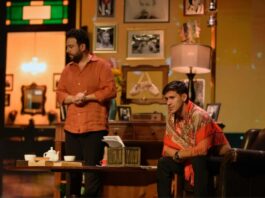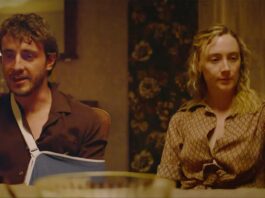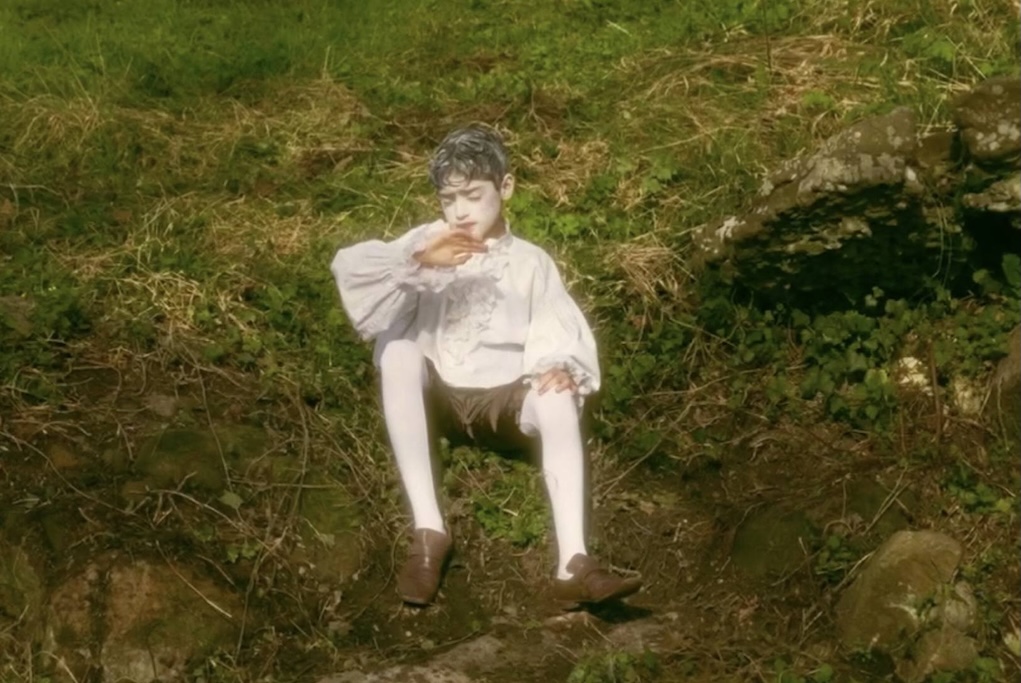
In his feature film WOLFGANG (2026), Iranian filmmaker Saleh Kashefi, also known as Filmsaaz, reinvents the young Mozart’s exile in Paris in his own image. Conceived as a kind of psychedelic anti-biopic, the film immerses us without compromise in the idiosyncratic cosmos of its eccentric, brilliant, and vulnerable character, while transcending generic, linguistic, sexual, and identity boundaries.
I met the director at Documenta in Kassel in 2022, and since then, our paths have kept crossing. During the 4th INSTAR Film Festival, I programmed his short film And How Miserable Is the Home of Evil (2023), a brilliant piece of political reappropriation and fabulation. Now, via WhatsApp, we discuss his unclassifiable “audiovisual opera,” recently premiered in the Bright Future section of the International Film Festival Rotterdam.
WOLFGANG recreates Mozart’s youth in Paris to reflect your experience as an Iranian filmmaker in exile. What inspired you to draw this parallel between figures and eras that are seemingly so different?
The development of this film and its story is curiously strange. The first time I decided to make a movie about Mozart was when I was around 16. My brother, who is a linguist and expert in German, played me a choral piece by Mozart. My first impression was: “yeah, sure, another classical Baroque song, who cares?” but when he revealed that the literal translation of what the choir was singing in German was “Lick my ass,” I was absolutely fascinated.
Suddenly, I saw Mozart not as a perfect, snobbish classical composer, but rather like the rockers and rappers I adored. I was moved by his silliness, rebelliousness, oddness, and longing for freedom. That’s how the dream of making a film about Mozart’s scatological music was born, in that very moment, although it’s quite incredible how much the project has changed over the years.
While the film was taking its time to be made, I went through many things in my own life, and, at the same time, I kept researching Mozart’s life. When I discovered that he had also gone into exile in Paris at the age of 22, I decided to see it as an opportunity to reflect on and express my own experience of exile and that of many others. In doing so, I tried to blur the differences between historical periods and focus on the similarities.
As individuals who experience life from a limited point of view, our key to empathy and compassion for others is pain, and the attempt to find that same pain in others. One of the main purposes of storytelling and cinema for me is to observe humanity, to be a tool for delving deep into human suffering, as a means to reach understanding and, ultimately, empathy, especially towards those for whom it’s a bit more difficult to feel compassion.
Through my research into Mozart’s life, I encountered an enormous amount of pain, a complex character who could be easily misunderstood. Because of all this, he ended up transforming into a mere symbol, a metaphor representing the pain of many sensitive and oppressed minds who are forced to leave their countries of origin for lacking the freedom they desperately long for.
Mozart’s sexuality has always been shrouded in speculation and ambiguity. What was your research process like, and what does “queering” his figure mean to you? I’m also interested in your relationship with previous portrayals of the character in film. I’m thinking, for example, of Miloš Forman’s Amadeus (1984).
The film unfolds in a universe that is fluid in terms of gender and language; it attempts to transcend all kinds of definitions about identity, particularly sexual identity, to the point of absurdity, all of which could be translated as being queer and not fitting in. WOLFGANG is a queer film, not only in its content, but also in its form and essence. Its existence is an imperfect experimentation, an effort to break free, to question all the concepts and ideas we commit ourselves to.
The first version of the film, written in 2021, was an incredibly realistic, almost documentary-like exploration of Mozart’s life in Vienna, but its main plot was still based on his scatological piece “Leck mich im Arsch” (“Lick my ass”), in which Mozart brutally mocks an old friend. From the beginning, the idea was to show his latent and repressed homoerotic desires through this piece, and to tell a kind of toxic male love story between him and his friend, with whom he was perhaps unconsciously in love.
Thus, the meaning of being an artist becomes synonymous with breaking free: someone who longs to be free in every sense. And how can one be free without shedding all the conceptual layers of identity that have been imposed on them, including gender and sexuality? Mozart again functions as a symbol of a hyperactive, deeply disturbed, and traumatized mind, which has no choice but to overcome all conditioning.
I love the portrayal of Mozart in Miloš Forman’s film; it’s certainly much more accurate than the one in my film. I tried to imagine the most hidden layers of his consciousness, to imagine how he perceived reality, which, at its core, is imagining the perception of all creative and sensitive minds. Instead of focusing so much on the plot and what happened to him on the surface, I tried to illustrate what was going on inside his mind.
The film is presented as an “audiovisual opera.” Can you delve into this concept? How did you approach the fusion of narrative cinema and operatic or musical structure?
What excites me in my practice is pushing the boundaries of the medium and exploring the still undiscovered potential of the audiovisual form and cinema. In the classical era of music, the creation of an operatic work—writing its story, composing it, directing it, and conceiving it within the theatrical form through the use of music, narrative and dialogue, staging, costume, sets, and all its other elements—could perhaps be considered the cinema of its time. A mixture of many different art forms, realized from the personal perspective of its author, told through music and theater. The art of opera reveals to me a huge, still unexplored potential for cinema.
That’s why I tried to approach the creation of WOLFGANG as an opera composer would, rather than as a filmmaker. I no longer write screenplays, except to try and obtain public funding (which, in fact, I’ve never managed to get). What I do is write a special document I call a “transcribed score,” similar to a musical composition, which already includes precise details and links to sound and music samples. Musical pieces and sound are an essential part of the narrative in my work, to the point where perhaps the work must be felt more than understood. I can imagine that if Mozart or other classical composers were alive today, they would make films, since the audiovisual form is perhaps the most powerful creative tool for expressing oneself and reflecting on existence.
The film, instead of relying on words and dialogue, uses cinematic elements, visual language, as well as music and sound, as narrative tools. The idea of calling WOLFGANG an “audiovisual opera” was, in a way, to let the viewer know that this is not a “film,” so they can let go of the usual unconscious expectations they have towards cinema and, instead, contemplate the work as if it were music. Like an opera that, instead of an acoustic orchestra and a theatrical stage, uses electronic sounds and the visual form.
The visuality of WOLFGANG is extremely distinctive—baroque, layered, and psychedelic—with heavy digital post-production that at times seems intentionally kitsch or lo-fi. How did you conceive the work’s aesthetic? Can you explain the balance between practical effects, camera work, and VFX?
The four years of formal research for WOLFGANG, which manifest in each of its cinematic elements—image, sound, performance, production design, makeup, lighting, costume, etc.—basically constitute the practice of my master’s thesis titled “Cinematic Presence” and my current doctoral thesis “Audiovisual Awakenings,” where I explore the different ways in which various states of perception can be illustrated through audiovisual language. I seek to discover new ways of representing the internal process of emancipation and awakening through image and sound, a theme that has obsessed me since the beginning of my practice. The challenge undertaken with the making of WOLFGANG and its prequel Overture was to traverse this entire diverse spectrum of cinematic aesthetics within a single film, to help demonstrate the radical shift in the main character’s perception.
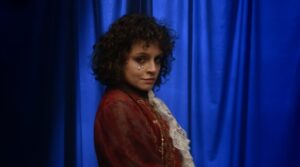
The inner journey of our hero Wolfgang, from the “fake” and unnatural world towards the “real” and natural world, is made visible through the evolutionary journey of the film’s cinematic aesthetic, which begins in the “very fake” theatrical world of childhood and ends in the “very real” documentary world of adulthood, to illustrate his radical inner transformation. This evolution is clearly expressed through the different types of cameras, their movements, production design, performance, colors, sound, and above all, editing.
At the beginning, the film is full of non-naturalistic lights, fake smoke, bubbles and wind, theatrical decorations, alongside an overdramatized and unrealistic performance, narrated through a strange, post-synchronized sound design. Gradually, scene by scene, all these elements are slowly stripped away, drawing closer to reality, until the final sequence in the forest, where everything feels more natural, to illustrate Wolfgang’s transformative journey.
The subversive nature of the film’s editing demanded that I spend almost two years experimenting with the footage to find the right direction. Although it was shot in just 7 days on a micro-budget of 20,000 euros, I had over a hundred hours of material, and there were countless creative possibilities that needed to be carefully investigated (the first rough cut was over four hours long).
For me, editing is without a doubt the most essential stage of cinema: it’s the moment to question, rethink, and deconstruct everything; it is, finally, the moment to build the screenplay. I believe that any flawed footage can be saved by good editing, to the point of believing that there is no such thing as a bad film, only bad editing. The image and sound composition of WOLFGANG was done by me, a task I’ve already carried out in all my previous works, with Overture being the best example, where sound is indisputably at the center, guiding all the other elements. So much so that I compose the sound and music for all the scenes before starting the image editing. In this way, the usual authority of the image is overthrown, and it has no choice but to follow the steps and rhythm of the sound.
The performances in the film are very physical and non-naturalistic, with a strong emphasis on body work, theatricality, and movement. How did you work with the actors to develop this performance style? What role did rehearsals, choreography, or improvisation play?
I myself have a theater background: I began as a child actor and participated in more than twenty plays in Iran from ages 8 to 16, when I decided to quit to focus on cinema. I deeply believe that acting is a sacred practice, a great tool for studying the human condition. That’s why I try to approach it as a very valuable time with the actors, in which we delve deeply into research to get to know the characters. For me, what matters is the actor’s dedication, seriousness, and passion, regardless of the character, age, gender, or ethnicity; if the actor is willing, we will manage to discover the character together. This approach automatically discards the usual realistic ways of thinking about casting and acting methods. Acting becomes a tool for understanding different characters, no matter how different they are from the actor’s personality. It transforms into a tool for empathy.
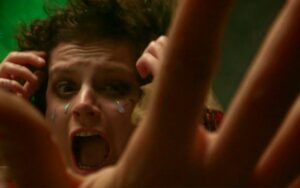
Kata plays five distinct characters throughout the film: Wolfgang’s Mother, Father, Bro, and Crush, in addition to the film’s initial narrator, to reinforce the dreamlike universe of the work, which takes place entirely within the main character’s mind. Ghazal Shojaei, who plays Wolfgang, is an Iranian actress who had been forced into exile in Paris due to political issues just two months before the shoot. Her stunning performance possesses a meta-subterranean layer, as she was going through exactly the same vital period. The film was also a study of different textures and tones of acting to show the main character’s inner evolutionary journey. The interpretative tone also undergoes a radical change: in the first act, it is extremely theatrical, and then, in the second act, it becomes more realist and documentary-like.
A still from the feature film ‘WOLFGANG’ (2026) by Iranian filmmaker Saleh Kashefi
Ghazal delivers an extremely powerful performance. How did you work with her in particular?
WOLFGANG was never meant to speak so directly about the experience of being an Iranian artist in exile. It reached that extreme point only after meeting Ghazal, two months before the shoot, the first night she arrived in Paris from Tehran to begin her exile. We had been following each other’s work from afar, but we never had the chance to meet. It was thanks to a mutual friend who recommended her. I had been auditioning dozens of Austrian, French, and German actors for the two main roles, and had even started rehearsing with some, but I still hadn’t found the right performer.
After meeting Ghazal, we talked about the project and shared the desire to collaborate, so I sent her the “transcribed score” without a clear purpose. The next day, she had already read it, and we met. I offered her the multiple role of five characters, but she told me she had to play Wolfgang, because she truly understood him. We tested some scenes, and I was immediately captivated and astonished, to the point of deciding to completely change the concept of the film to have her.
We met every day for the following two months at Kata’s house, which had become our production office, where we had team meetings and rehearsals. We held full-day workshops, delving into the scenes, building the characters, while I was writing the dialogues for each sequence the night before. It was thanks to the trust of both Ghazal and Kata, their dedication and radical approach, their willingness to go to the darkest places that most actors don’t allow themselves to reach, that we managed to achieve that result.
A specific sequence in the film addresses the tension between art and business. Considering that WOLFGANG was financed through an alternative model—support from festivals and crowdfunding—how did the production process influence the film’s themes, and how did you navigate the contradictions of creating such a free work in an environment ruled by the market?
The way this film came to exist is a disturbing and extremely rare story in today’s film industry. It’s not that we didn’t try to get money. We applied to all possible funding sources, but, unfortunately, this type of cinema seems to have no place in the industry nowadays.
Looking back, it seems absolutely crazy to me. I did a huge amount on my own; I went against all kinds of odds and obstacles. The whole world was giving me signals that making this film was impossible, but somehow I kept going no matter what. I couldn’t do it again, but at that moment I felt an incredible force within me. I felt it was urgent to create it, as if it were the only chance to scream my pain to the world. Now that it’s finished, I feel much calmer and, in a way, heard.
During its making, as in my entire life, I suffered a lot with money, not only to finance this project but also many others, and this struggle became visible and was expressed within the film. Moreover, since that was also Mozart’s main conflict, especially during his time in Paris, it felt natural to include it.
WOLFGANG was made in the gray areas of the industry, breaking many rules. The total budget is barely 26,000 euros, which is absolutely ridiculous for a feature film, and if I explained how that budget was obtained, it would only cause me more trouble. It was shot in just 7 days with a crew made up entirely of volunteers, something extremely rare in Europe, so I am deeply grateful to all the wonderful people who worked hard and extensively on the project, because they believed in it and felt its urgency.
The topic of funding and production of my work has been and will continue to be incredibly painful, but when you consciously decide to make such strange films for strange people, you also accept the enormous amount of suffering that comes with it. It’s not my choice to make films with no budget; it’s simply that I have no other choice. When there is an urgent need to create, nothing can stop you.
I am totally aware of the film’s countless flaws and imperfections. I am its biggest critic, but I am deeply happy that it exists. The whole meaning of this film is simply to exist. It’s a statement demonstrating that cinema can be like this.
Writers like Joseph Brodsky have argued that exile is a condition that shapes identity, memory, and creation, without necessarily reducing the artist to a role of mere victim or to the figure of the politically committed author. How did you navigate the tensions between guilt and pleasure, loss and reinvention?
Exile is a complex topic, so complex that I find it difficult to talk about with words: that’s why I suppose I made this film. The feeling most commonly associated with exile is perhaps alienation, but an even more frequent feeling I observe among exiled Iranians is guilt. Displacement pushes one to destroy any sense of identity; one constantly lives feeling out of place.
Thus, the great suffering and pain that exile can cause us would become factors for overcoming it and breaking free. At first, it might be through escaping reality, taking refuge in an illusory paradise where no trace of home appears, but then it becomes evident that there is no escape, because the scars of home will remain in the heart forever. I hope I’m not romanticizing it too much, but I like to question how one can be free when one identifies so deeply with a nation and a country.
Most exiled Iranians I know live with immense pain, perhaps as much as those still living in Iran, because they feel they don’t deserve to be happy. If our family and friends are suffering, we must suffer with them. We can’t make a positive contribution. We only end up causing more problems and conflicts for ourselves and others. It’s an incredibly strange feeling: before your eyes, things look like paradise, but you know that at this very moment, your home, your family, and your country are going through hell.
Iran has experienced intense socio-political upheaval in recent weeks, with widespread protests and brutal repression by the government. In this context, how do you see the role of Iranian filmmakers, both inside and outside the country? Not only in terms of creating international awareness of what is happening, but also in building a different society and future.
It’s a very difficult question. These days I wonder if making films matters at all, but I know I would never take up a weapon, so I try—and it seems I have no other choice—to approach cinema as if I were at war. With each film, I try to take on the responsibility of being Iranian, and the pain accumulated over so long always finds a way to express itself through my work.
I can’t tell others what they should do, but it saddens me to see Iranian filmmakers who still follow the rules of censorship, who are still afraid, hide, and have not joined the protests. After everything that has happened, after countless people brutally murdered, after our lives completely ruined and wasted by that terrorist mafia ruling the country, it’s sad to still see that the filmmaker is the most fearful of artists, when Iranian rappers, who have always been my greatest inspiration, are putting their lives directly at risk by being the voice of the revolution.
WOLFGANG begins with a quote from Mozart about overcoming sadness through “silliness.” In a culture that often equates maturity with seriousness, do you see the film as a defense of youth, innocence, and the right to be a little “silly”?
Totally. This film functions as a praise of freedom, silliness, and play, all of which I believe Mozart, especially in his scatological pieces, knew how to demonstrate perfectly. He, whose life and work are the best example of the artistic maturity of a supposedly immature person, a child trapped in an adult’s body, became an excuse to remind us that, in reality, none of us is an adult. We are all a bunch of children who have been forced to become extremely skilled and committed to wearing the mask of adulthood, hiding our emotions, our sadness, our fragility, our vulnerability… If music about licking other people’s asses offends you, I think perhaps there is a deep darkness in you that you are trying to avoid.