Critics have interpreted the work of Fernando García Correa (Mexico City, 1958) as part of the consolidation of a shift in perspective within Mexican abstract painting. Since the late nineties, García Correa has primarily worked on a type of painting close to post-minimalism, extremely obsessive in its variations, its mathematical thinking, its geometric patterns. However, anyone reviewing the body of work from those years—as showcased in Procurada corrupción, the exhibition dedicated to him by the Museum of Modern Art in Mexico City at the end of 2012—will find that García Correa’s work does not renounce the organic, the experience of the living, what the artist calls in this interview “sensations.”
Perhaps the secret to the magnetism produced by his paintings’ materiality lies in that specific interplay between method and what Fernando describes as “letting go,” between abstract logic and sensory reminiscence. Elephant skin, forest shadow, bark, enlarged surfaces, epidermis, succulents: García Correa’s work not only proposes a path for abstraction but also for landscape and the representation of nature in contemporary art. A path that, thanks to its obsessive, pointillist logic, conveys a particular form of melancholy, perhaps a trigger for impressions of past lives.
Precisely as if we were atoning for sins committed in a previous reincarnation, García Correa and I have inflicted upon ourselves life in a city where, in May, the heat index exceeds 50 degrees Celsius. Hence, our increasingly frequent meetings take place after the sun goes down, at bar tables as close as possible to the air conditioning, or half-submerged in his swimming pool. In this white city, crowded with gringos, colonial, hidden under layers of classism and gentrification, peninsular, near Mayan pyramids, and the site where the meteorite that wiped out the dinosaurs fell, and where we feel partly privileged and partly somewhat disoriented, Fernando decided to show the series of works prompted by his family trips to Japan. To me—who lately practices psychoanalysis in its dilettante variant—it seemed an oblique way of talking about his tropical destiny, his Yucatecan exile. Isla was the name of the exhibition that opened last May and was on view during the summer at the Salón Gallos in Mérida.
Isla is the result of a trip, a family trip to Japan, a place that has been a mystery and a seduction for Western artists for centuries. Was it your first trip? How much did it confirm, and how much did it distance you from your prefigured Japan? Would you like to share some impressions of that trip beyond what we can see in the exhibition?
It was our second trip. The first one was also a family trip five years earlier, and on that occasion, we only visited Tokyo and some nearby historical sites. From the first encounter, Japan was an extraordinary experience. My knowledge of Japanese culture was limited. My appreciation for Japanese culture naturally stems from my admiration for Ukiyo-e Japanese prints; nothing unusual for a visual artist.
In total, I have spent 39 days in Japan. It’s nothing. Furthermore, I’ve never been one to make pronouncements hastily. But I believe the most important thing, before and after these visits, has been the sensations.
Even before traveling, our curiosity was fueled by passionate conversations with colleagues and friends who had visited this country before, sharing enthusiastic descriptions and genuine respect and admiration for the culture, civics, cleanliness, and cuisine. Their words motivated and inspired us to make the trip. Remarkably, no matter how passionate they were, they couldn’t diminish our fascination. In Japan, everything is different: the air, the colors, and the way of moving through space. Visually, Japan is an overwhelming and beautiful lesson.
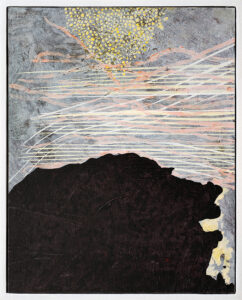
One could say this exhibition is the result of a trip, its product, in the manner of a diary, a log. But Isla could also be read in an interrogative tone: more as an investigation, a way of unraveling the meaning of that journey, than its document. How do you see it? Would this be, in a manner of speaking, your most private exhibition, the closest to a form of self-writing?
Regarding the log, I can confirm there is a material reality to it in the exhibition. Particularly in one of the four sets of works, the one titled in German das Zugflug (which means train-plane and is the name my daughter gave to the Shinkansen bullet trains on our first trip). In these works, at the center of the pieces, are pages from the travel sketchbook folder. A folder where I noted down all sorts of general information, either while preparing the itinerary or searching for information while there, which I later used to draw on at certain moments.
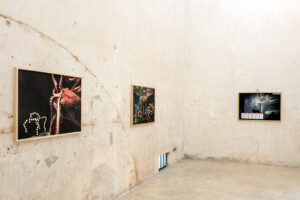
The other three bodies of work are very different. The five photographs are something new, as I had never worked with a support bearing a printed image before. On the other hand, there is the Isla series, a recycling of a series of small-format pieces loaded with material that I hadn’t finished, and in which I found a support for dealing with the theme of the remembered landscape from the trip. And—lastly—three pieces in wood, which I had started after our first visit to Japan and which had been abandoned in the studio for a long time, without finding a resolution.
The word investigation doesn’t seem entirely appropriate to me within the scope of these works, which seek more to describe sensations than to posit truths about Japanese culture. Unraveling an experience would be more accurate. The key lies in the desire to share a journey.
Finally, I don’t consider this work more private or personal than others, but if we approach it from that specific perspective, I would say no. I have a set of photographs of my body, all macro shots of the organ of my skin, which I took during the pandemic in a particular state of mind resulting from the confinement. That is the most personal and private thing I have done, and it remains in the form of a book that still lacks its text.
I know the trip was also an opportunity to show Japan to your young daughter, and it was surely also a chance to see Japan through the eyes of a child, with their innocence and strangeness devoid of cultural assumptions and data. How much of that unprejudiced gaze is in the exhibition? And how much, in that more playful handling of the material, is an attempt to present yourself as an artist in your daughter’s eyes, to win her approval?
During this second family visit, and due to our daughter’s age, we did many activities to meet her needs and particular curiosity. This took us to places we otherwise would not have visited, such as theme parks, leisure spots, natural parks, and children’s museums. But the differences these places have in Japan compared to what you find elsewhere turn everything into an adventure and a lesson.
The unprejudiced gaze you mention, which is reflected in the show, stems, on one hand, from a desire to move radically away from the theoretical academicism of contemporary art. Let’s say I wanted to abandon specialization to return to sensation. This is perhaps what makes you think of a more personal body of work.
The handling of the material is very important in my practice. The material in painting is emulsified with meaning. And you are right to observe that during the creation of these works, I playfully mixed materials.
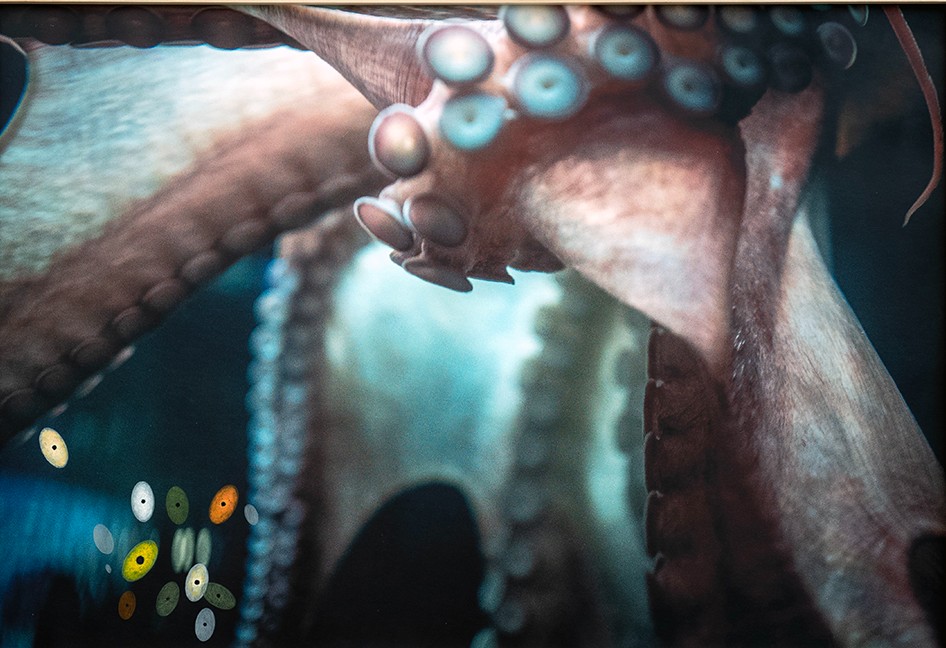
The most disruptive element in the exhibition is perhaps those photos of the octopus (and possibly also in relation to your previous work, although they could be linked to your obsession with organic surfaces, with enlarged microscopic forms). This is no longer the powerful, sexual octopus of the fisherman’s wife’s dream, but one confined behind the glass of an aquarium, an octopus as an attraction. Tell me its story. How does this octopus fit into this journey and the exhibition? These are also intervened images, which seem like collages. In what sense does this imply a link and a dislocation with your previous work?
That octopus! When I took those photographs, I wasn’t thinking about the historical weight of certain images like the ones you mention. That octopus probably has a name that, due to lack of time and brilliance, I never looked up.
Aquariums are important to me; I appreciate them greatly, and they are ideal spaces to share with family. There are many in Japan. They have a relaxing and calming atmosphere and don’t generate the sadness that zoos do for me, perhaps due to the difference, albeit superficial, between bars and glass as means of containment and enclosure. But, well, in this particular case, the octopus at the Kaiyukan aquarium in Osaka was contained in a relatively small, circular tank in the middle of a room. The optical distortion effects generated by the thick glass, together with the theatricality of the lighting and the movements of the animal, became, at times, an active experience of a post-cubist vision where perspective and the horizon remained in constant fluctuation. The difficulties in focusing and in achieving a clear view of the animal gave the visual experience a very particular, almost surreal sensation.
If the exhibition is about the trip to Japan, it is also the first one to take place in Mérida, the place where you have settled for a few years after moving from Mexico City. Isla represents, one could say not without irony, your debut in Yucatecan society, and in this sense, it bears witness to two journeys. How much of this tropical Fernando García Correa is new? Is Isla the product of new searches, of engaging with a more evidently lyrical imagery? Is it part of a natural transition from the objectivist corpus of your canonical work towards another place, perhaps not unrelated to expressionism, one that maybe peeked through in those cellular samples of Tokio Blues?
They are two very different things. Our move to Mérida happened in the summer of 2020, in the middle of the pandemic. The first six months we were indeed completely isolated, and integration into social life was very, very slow. Furthermore, here in tropicalia, things flow very differently, with the climate and geography being determining factors. The change in lifestyle generated something I can consider a rupture or a—not always pleasant—distancing.
The truth is, after 5 years, I don’t feel very tropical; who knows, maybe in a while I’ll seek out the mountains. But anyway, when José García proposed I do something at Salón Gallos, I found in the theme of Japan an anchor to develop several series of work in the same direction, which ended up being these four that form the exhibition. I simply didn’t feel like showing something I had already done, even if it’s unknown here, and regarding new works, I had many series started, but with very diverse objectives, nothing that worked as a cohesive whole for a small-scale exhibition.
In a great interview a few years ago with María Minera, you discussed the place of painting in contemporary art and how, for example, the success of painters like Gerhard Richter lay in the fact that the finish of his paintings seemed like “something more than just painting.” In Isla, across its three divisions, one can follow a conceptual thread. One can see traces of your previous work, but now as a personal mark, like a signature, intervening in photographs or writing. In what way can this exhibition be understood as “something more than just painting”?
Well, that’s a question with a very broad, complex theme. From a general point of view, I believe the institutions that “administer and direct” contemporary art have become increasingly academic, and not in a good sense, but at the same time, there is tremendous freedom, with an extremely rich diversity of products.
As an artist, I believe working with new materials and techniques is a reflection of my general curiosity about everything that is being made. And I am interested in all techniques, even if I don’t try to encompass everything.
On the other hand, I don’t think a brand image has any artistic value anymore beyond the commercial, the interests of the market. Parallel to this aspect, there are undoubtedly artists who maintain their line of work perfectly defined for varied reasons and some throughout their entire lives, but there are others—as Flavio Garciandía says—who, like me, don’t like to get bored. We must also consider that the world changes and those changes exert their influence. It’s not that we are forced to change, but the world moves.
In that same interview, you mention that for a time, you dedicated yourself to painting the line left in the sand by the sea water as it recedes, something so important to Japanese culture it has its own term: nagori; I’ve also seen the collection of Japanese art housed in the entrance of your home, or I’ve already mentioned the vague Japanese lyricism of the circular Tokio Blues. Aside from these details, what was the previous relationship of your work with Japanese art?
I believe there are aspects of Japanese culture that are reflected in my work less as an influence and more as a shared state of mind. The trace, the rhythm, and the temporality are part of an essence that I came upon through twisted, strange, and hazardous paths, easier to notice than to explain. Then, later, there are the Japanese prints I began acquiring in 2013, which I keep very present at all times. The enormous influence these have had on modern and contemporary art is obvious. Those magnificent and humble works from a disappeared industry are a compendium of lessons for the conceptualization of the image in the West. They have a formidable resistance to the passage of time. They are small and simply colossal.
The exhibition is framed in each of these three groups we have been mentioning by these intriguing wooden objects carved by you, which also give the whole a spatial attribute. What are they? What do they signify?
In this show, it is the first time I have used my objects or sculptures—whatever you want to call them—as divisional elements of the space, as a way of putting a kind of physical (more than visual) full stops or paragraph breaks between the two-dimensional pieces. They also work to define the exhibition space, taking away a bit of its cubic character, triangulating it.
My objects, stones, or pieces of wood, at least when I produce them, represent a more straightforward confrontation for me. There’s no need to struggle with the material for it to find its place, to have a presence, although I do have to try to make it meaningful. The object offers me the possibility to simplify. The forms tend to be simple and natural, with a relationship to the organic that seeks simplicity and that, at times, also speaks of functionality, of how the object functions in the space by representing. In the case of these three pieces on the same theme, some people see them as whales, others as fish; the form has references, and you cannot escape nature.
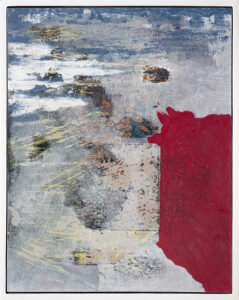
You mentioned to me that one of these divisions of Isla, the one formed by the series of small-format paintings, involves previous work taken up again after the trip in the Japanese manner. Can you explain to us, in concrete terms, what this continuation consists of?
Well, these are “old” supports, started in Mexico City and quite loaded with material, which I wanted to recycle. A small series that didn’t find a general resolution, and from which—from that time—only two pieces remained. In reality, there is no continuation; rather, the supports served me as a base due to their material quality to generate images that are in some way superimposed, as if also imposed, and based on sensations and memories of the views from the trip.
In the painting from Isla that perhaps fits least within the serialities of the exhibition, we observe, from a street perspective, one of those commercial galleries from another time, behind whose display windows, located on a second floor, striking neon lamps are exhibited. Peeling away the realistic illusion, giving it the consistency of a dream, the image is cut in half by the silhouette of a supersonic train. What I saw in that painting reminded me of the melancholic scenes in Tokyo in Chris Marker’s Sans soleil, where the crowd is shown walking through those shopping arcades as if in a dream.
Marker’s sender tells us that, from the transit of people from the galleries to the subway stations where they all lead, the city can be read like a musical score. He speaks of the collective dream of the city made of a multitude of individual dreams. Those Japanese galleries reminded you—as you told me—of a zone and a time in Mexico City that have now disappeared. Talk to me about the layers, the temporalities, the places that are conjugated and brought together in that painting, about the meanings condensed there.
The retouched photograph you are talking about certainly stands apart from the rest of the works. I believe that, being the last piece produced for the exhibition, it functions as a proposal for another possible series to develop, in which the main theme would be transit, displacement, the place of passage.
This is a theme that overlaps with rhythm and repetition, but more on a physical scale than a contemplative or musical one. It is a completely urban theme, and one that certainly, in my memory, presents certain parallels between large cities, like Tokyo and Mexico City.
The street in the photograph is a commercial avenue in Kyoto, very close to the recently built (1990-1997) central station, which is a small city in itself. This avenue turned out to be a transit route between the commercial and transport bustle—concentrated at the station—and the quiet life of a small city. At the same time, it reminded me of the busiest streets in the center of my city, which, in a way, also connect commercial areas with the more residential ones of Mexico City, and whose shop windows also display products of curious manufacture.