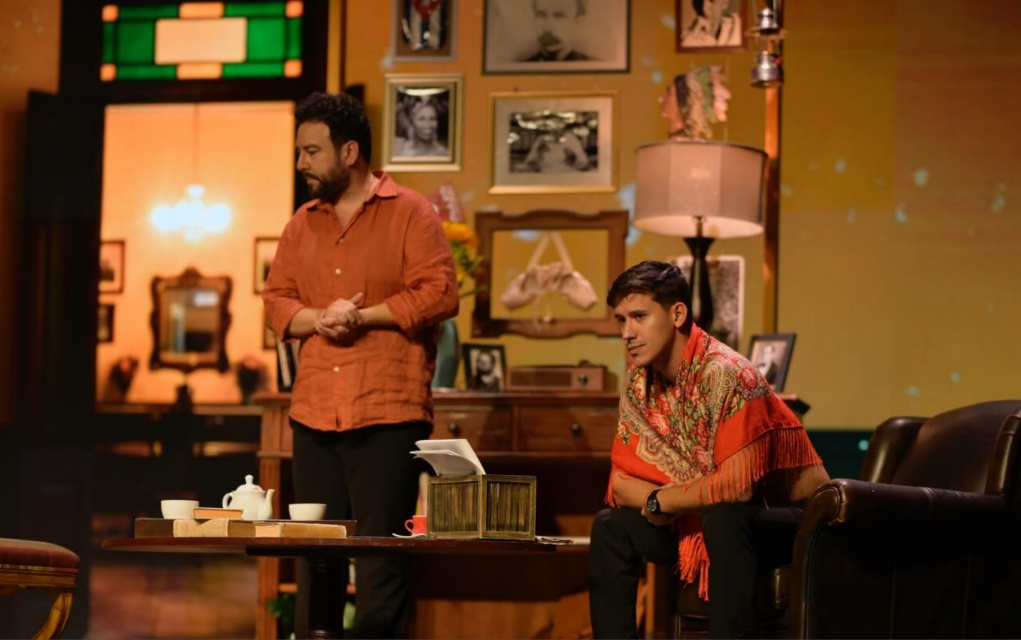
In Suárez’s theatrical adaptation, the conflict between Diego and David ceases to be merely a metaphor for the intolerance of 1990s Cuba, transforming instead into a mirror of the ideological and affective fractures that still run through the nation and its diaspora.
Cuban theater in exile finds one of its most vibrant epicenters in Miami, and in Yusnel Suárez, one of its most restless directors. His most recent adaptation of Strawberry and Chocolate is not an exercise in passive reverence, but a reinterpretation that dares to stretch the original from the experience of exile.
Suárez approaches his work as an act of cultural resistance, from a contemporary, critical, and deeply emotional perspective. His scenic conception integrates live music, choreography, audiovisual resources, and even artificial intelligence to build an immersive theater that delves into the difficult negotiation between the political and the intimate, between ideological loyalty and individual desire.
In his hands, the conflict between Diego and David ceases to be solely a metaphor for the intolerance of 1990s Cuba, becoming instead a mirror of the ideological and affective fractures that still cut across the nation and its diaspora. Havana is not only a physical setting, but an open wound projected onto the collective memory of those who live it and those who left it behind.
Strawberry and Chocolate is a central work of the Cuban cultural imagination. From what creative necessity did you decide to return to it?
I believe the conflict that drives the story is still alive. The relationship between Diego and David, trying to bridge their political, sexual, and personal differences, is very interesting, especially in the context of Havana today. It is a contemporary adaptation of the film set in that national landscape where everything is much more complex, and humanity plays the leading role. Cubans are living through a moment of urgency regarding the importance of exposing the reality of the crisis and the deterioration at all levels our island is experiencing.

Your adaptation dialogues with the original without being trapped by it. How did you find the balance between fidelity, reinterpretation, and creative risk?
The adaptation has worked well because I think the audience relives the essential moments of the film while discovering new subplots and points of view that engage with the original story. Being a version from exile, conceived especially for the Cuban audience in Miami, it functions as a kind of mirror in which those who had to leave Cuba—as in the case of Diego, the protagonist—see themselves reflected. Furthermore, the show is very fast-paced, surprising, always seeking to have laughter meet emotion.
The production avoids nostalgia and constructs a contemporary reading. What dramaturgical decisions were key in that process of updating? What aspects of the original text were you interested in reactivating for a contemporary audience, and which did you decide to transform or shift?
The reality of Cuba is not the same as it was thirty years ago when the film was released. Although society is worn down in many ways by the fierce onslaught of communism, it has evolved on issues such as homosexuality, which is no longer such a strong prejudice. That is why this theatrical production focuses on the intellectual clash between Diego and David and their ideological distances. Diego is a dissident artist convinced that freedom is the way, while David is an indoctrinated university student trapped by the system, who, throughout this story, discovers, with Diego’s help, many truths about life and the country.
Cuba is an island very present in the minds of its emigrants. Our connection to what happens there is constant, and that is why I wanted the play to represent it just as it is, with an almost documentary imprint. The use of visual resources on the screen allows us to place the spectator in real moments and places and to achieve scenes that depict us as we are: broken but fun, alienated but profound. Music, dance, and various elements that draw on the symbolism of our identity also play a part.
The performances sustain the work with remarkable precision and scenic truth. What kind of acting work were you looking for, and how did you develop it during rehearsals?
The cast of this theatrical version of Strawberry and Chocolate consists mostly of actors of the highest professional level, with recognized careers in film, television, radio, and theater. It is led by Susana Pérez and Alberto Pujol, who have the longest track record in the scenic world, followed by somewhat younger figures, though no less important, such as Yuliet Cruz, Roberto San Martín, Jeffry Batista, Yerlin Pérez, Luis Manuel Bangán, who have built their characters with great truthfulness, but above all with grace and depth, seeking to portray our sociocultural identity.
In addition to directing, you take on a leading role on stage. How does the dialogue between director and actor manifest within you throughout the creative process?
Strawberry and Chocolate conveys many things that I, as a Cuban, as an exile, and as an artist, need to express, and the character of Diego says many things that I feel as a person. And yes, it is a challenge to interpret a character who was so successful in the film, but the key lies in being inspired, not copying, in traversing every moment with honesty; after all, there are as many ways of feeling as there are fingerprints on the fingers of men. And as a director, I surrounded myself with a first-rate cast and an excellent creative technical team: Milkos D’Sosa and Shamir Baluja in set design, José Álvarez and Yunior Arronte in musical production, Henry Gual in choreography, and Oscar Molina in lighting design, who supported me in each of their specialties. I want to give special mention to the advice of actress Edith Obregón, who was of great help in overseeing the production in the scenes in which she performed. Personally, I think that acting is listening, responding with sincerity and precision to the scenic context, and this work has very well-written dialogues, very well-presented human conflicts, and if you let yourself be carried away by the story and the atmosphere, the acting will flow. All of us actors on stage understand the recent context of our country very well; we have suffered it firsthand, and that helps a great deal.
Music and the soundtrack function as an active element within the narrative. How did you work on the sound design so that it would function as a structural device within the narrative economy of the work?
Strawberry and Chocolate is my second approach to musical theater in Miami. The first was the adaptation of Los pájaros tirándole a la escopeta, by Rolando Díaz; in both, music is another character. We come from the island of music, where we speak with our bodies and sing as we speak, which is why the songs help us tell the story, to complete the narrative. When you hear classics like “Fiebre de ti,” “Vete de mí,” or “El punto cubano,” to mention just a few that are included in the production, the spectator connects with the character’s feelings, but also with personal memories related to those musical pieces, and if you add to that the interpretive work of the singers and dancers, the impact is even greater.
The scenic rhythm is carefully constructed. What importance does cadence—in acting, music, and visuals—hold for you in the spectator’s experience?
Where I am, there is emotion, joy, rhythm, surprise, entertainment. I conceive my works as a roller coaster of emotions where the spectator feels like a part of it. Theater, which remains the most human art that exists, also has to compete with the dizzying and fleeting visual world of today, and so you have to quickly fill the spectator’s eyes and heart. When they are seated in that chair, you have to consider their attention and make them vibrate, because they, like the actors, the dancers, the music, the set design, or the lighting, are essential for the work to flow.
The art direction integrates screen and artificial intelligence organically within the production. At what point did the decision to incorporate these tools arise, and what did you seek to contribute to the scenic discourse?
I conceive theater as an immersive experience. Having the set transport us to the place where the story takes place is wonderful because of that sense of realism that makes the experience more believable and entertaining.
The use of AI introduces a novel language within Cuban theater. What possibilities and tensions does this intersection between technology and memory open up?
We cannot deny the presence of AI in our lives, and incorporating this tool into the narrative discourse of theater opens an infinite door to creative solutions that audiences greatly enjoy. They make possible moments that would be impossible to achieve due to time and budget constraints, but the best part is creating for the spectator the sensation of having returned to a place in Cuba through those images on the screen.
The inclusion of the character La Polaca, played by Susana Pérez, adds a new symbolic layer to the work. What did you seek to explore with her presence, and how does this character engage with the contemporary reading of Strawberry and Chocolate?
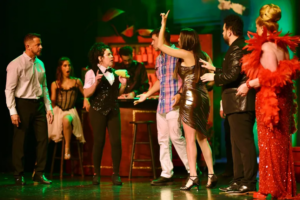
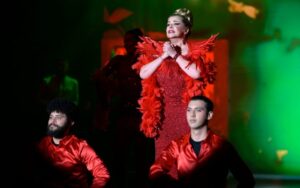
To conceive the theatrical work, I returned to the story that started it all: The Forest, the Wolf, and the New Man, by Senel Paz, and to the film script, of course. In the film script, there was a scene at the ballet that never made the final cut, and it was my inspiration for creating this moment of Cuban cabaret where a drag star triumphs in the underground Havana nights. Susana Pérez has been an inspiration for my work on the stage, and I conceived that moment for her because she is an actress in the fullest sense of the word, capable of interpreting with truthfulness that transgender singer, a survivor of the abuses of the dictatorship, who decided—whether as revenge or as a statement of principles—to stay in Cuba to shine under the very nose of the system that marginalized her. It is one of the most delirious moments of this theatrical version, and also one in which some of the most painful things that we Cubans have had to live through are expressed.
Strawberry and Chocolate is a profoundly political work, but also an intimate one. How did you work with that tension?
Cuba is not explained; it is felt. It is very unsettling to tell our story. In my case, I feel I cannot do justice to how particular we are: politically, culturally, emotionally. We come from a wounded island that has taken refuge in music, in humor, in art, to survive the drama of existing. We have had to navigate all kinds of miseries.
How has the audience reception been, and what readings or reactions have you found most revealing?
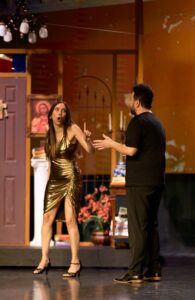
With this work, we have experienced the audience’s reactions extraordinarily. We have received messages of affection and gratitude telling us how they felt during the production. They particularly highlight the laughter the situations provoke and how these intersect with reflections, painful and emotional moments that end in tears. I feel that this work has allowed a large part of the audience to connect with their Cuban essence and rekindle their love for their roots.
After this production, do you feel that a creative cycle is closing, or that a new stage is opening in your work as a director?
Strawberry and Chocolate remains on the bill at the Teatro Trail, but I am already working on my next project, a comedy about partner swapping that I am sure will generate a lot of discussion because of the way it approaches marital relationships. Of course, I would love to continue adapting and reinterpreting for the stage the great stories of Cuban cinema and literature, because it pleases me to keep our culture alive outside the island and to allow the audience to experience their Cubanness. Also, for the opportunity to celebrate the good fortune of being part of one of the few communities of exiles in the world that fills a theater night after night, seeking to enjoy and support Cuban art and its artists.