The last time I saw Damaris Betancourt in person was the summer of 1988. As often happens with the past, I now see only fragments, all quite blurred. I lived at 23rd and 16th; she lived above El Recodo café at F and 3rd. I remember taking a bus from La Pelota to Castillo de Jagua, then walking down G Street. Maybe it was a Saturday or Sunday—my parents were home—and I know it was carnival season, and her mother was out. The rest? All hazy, like the past: a Fito Páez cassette, a Charly García one. It was around 4 or 5 PM. No photos survive. I was 17; she was a year older.
I haven’t seen her since. In fact, years passed without a trace until late 2011—I in Quito, she in Zurich—when Facebook worked its magic and I discovered her photography.
Months ago, we toyed with meeting in Rome or Madrid, but it didn’t happen. Not that it matters; the affection remains, maybe even deepened. It’s the bond of growing old while clinging to something, however small, however distant, that ties us. And it’s not so dire: I know we’ll meet again someday, there’s still time. The best part is we’ve never stopped talking, never stopped asking questions…
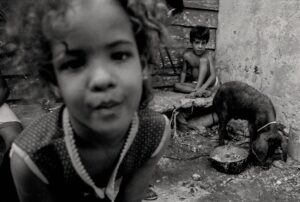
It must have shocked the Swiss visitor who encountered El Fanguito in 1994 at Lucerne’s Arlecchino Gallery—a vision of Cuba, specifically a Havana slum, poles apart from the sanitized narratives the Global North prefers about the island.
Here, we’re talking about poverty without pretense, society’s raw margins—not even a time-worn but still-glamorous colonial city. Just unadorned destitution.
As if that weren’t enough, you’d left Cuba for Zurich a year earlier. You were 22…
I arrived in Zurich one spring day at 22, full of hope and my first photos. I’d started shooting in Cuba to feel free—what greater freedom than wandering Havana with a camera? I was naive until I entered El Fanguito. That experience, and the amorality laid bare by the USSR’s collapse, killed my innocence. When I exhibited these rarely seen Cuban images in Lucerne, I expected outrage. None came. The average Swiss assumes poverty is innate below certain latitudes. And with Cuba, as it happens with issues like the lack of freedom, even faced with data and pictures, people frown and mutter about “the blockade.” They tend to dismiss, relativize, strip the truth of meaning.
For many, poverty in Cuba is a picturesque episode that Cubans navigate with cleverness and creativity. This doesn’t happen, for example, with the countless reports about perennial misery in Africa. It must also be acknowledged that poverty in Cuba manifests peculiarly because it is by design and has become generalized. There is no visibly wealthy class, beyond the political elite, that one might aspire to join someday. From birth, citizens have no other horizon but the directives of the Communist Party and the ration book. Scarcity is the natural state, regardless of an individual’s purchasing power, because where there’s nothing, there’s nothing. So people have adapted to scarcity, resigned themselves to their shortages rather than trying to overcome them, except when they decide to leave the country. Postponement and resignation are the typical Cuban way of life.
Many foreign photographers go to Cuba to capture that photogenic misery, so docile and peculiar, much like the English go on safari in Africa. But in the many features about Cuba I’ve seen in Europe, there’s rarely any profound questioning, let alone doubt about the viability of that system, which is the true cause of this now-idiosyncratic poverty.
Freshly arrived in Europe in 1994, you traveled to Romania. There, you immersed yourself in Timisoara, where exactly five years earlier, change had begun and totalitarianism ended. How did that trip come about? What was its origin?
A Swiss friend with strong religious convictions organized medical aid caravans to Romania every summer. At the time, images from that country—especially of disabled children in cold, filthy orphanages—had shocked public opinion. With substantial donations from institutions and private individuals, she successfully gathered a significant amount of medicine and used (but well-maintained) medical equipment each year to deliver to an orthopedic hospital that served a high-need population.
Romania had been severely affected by polio; isolated cases were still being reported as late as 1992, and many people living with lifelong disabilities relied on that hospital for therapy and treatment. My friend invited me to come along and photograph the journey, and she didn’t have to insist. That’s how I joined this group of young people, mostly students like myself. It became, in a way, my second photography project after the series in El Fanguito and El Callejón de Andrade; a unique opportunity to visit one of those former “brother nations” and experience post-communism firsthand.
Ironically, due to remaining ties between ex-communist countries and Cuba, I was the only one in the group who didn’t need a visa. The journey took days—we traveled in a convoy of old cars that had failed technical inspections and kept breaking down. We crossed Austria into Hungary, and I was immediately struck by that familiar atmosphere I’d glimpsed as a child watching the adventures of The Mézga Family. I remember we took a long break by Lake Balaton, once called “the Mallorca of East Germans,” where Germans from both sides of the Wall would meet for cheap vacations. As we moved southeast, we encountered many kind and generous Hungarians who invited us for snacks in their homes and let us pitch tents in their gardens overnight.
How does a Cuban woman born in 1970 process what she sees when crossing into rural Romania, a country that for 42 years had tried to forcibly build a supposedly better society? What struck you most about those early signs of post-communism?
I carried in my mind the glossy covers of those high-quality magazines that came to Cuba from COMECON, whose paper was excellent for covering books. Before the socialist bloc collapsed, they piled up in kiosks: Soviet Union, Sputnik, Soviet Woman, USSR, Moscow News… and there was also the Romania magazine. I clearly remember one cover with Nicolae Ceaușescu’s photo, imposing in his Prussian blue suit and the immovable face of power. These magazines arrived monthly, showing perfect color photographs of pristine, advanced countries, superior societies, and satisfied citizens.
We all believed our goal was to reach these countries’ level of development. But when I arrived in Timișoara, it was like drawing back a curtain to discover a city stuck between bitterness and melancholy. Discontinuous streets between potholes and cobblestones, rickety trams, prefabricated buildings, hunched pedestrians eaten away by resentment toward a tyrannical system that had oppressed them for 42 years.
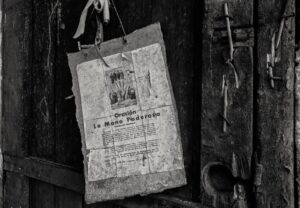
When we reached Bucharest at nightfall, as we moved forward, an immense avenue unexpectedly opened before my eyes—groomed with fountains and lit by endless rows of lamps, which after several blocks led to what was then the People’s Palace, now the Palace of Parliament. A neoclassical, pharaonic construction (at the time the world’s second largest building after the Pentagon) that the dictator erected for himself and never saw completed. Half-naked Roma children wandered the city and immediately identified us as tourists; they came to greet us and see what they could get. It was the first time in my life that I saw street children. Fortunately, the weather was good.
Our final destination was the small town of Eforie Sud, where the orthopedic hospital stood by the Black Sea. It looked more like the abandoned house of a chainsaw murderer. The many houses with adobe walls and thatched roofs made me imagine medieval villages and how harsh winters must have been there.
One of Ceaușescu’s methods of terrorizing Romanians was his so-called austerity policy, under the pretext of paying off state foreign debt from the 1960s. Among the measures was prohibiting heating above 14 degrees Celsius; plus rationing food to, for example, five eggs, half a kilo of meat, the same amount of sugar, one bottle of oil per month, and 300 grams of bread daily. Still more than what Cubans receive today through the ration book system, which just turned 62.
And this was the question that wouldn’t stop buzzing in my head: what, then, had communism built in Romania in its 42 years of existence? We camped in Eforie Sud and waited for the arrival of our truck caravan carrying medicine, medical equipment, and furniture, which had taken a different route and had to go through customs checks. Communism is like a snake that, even after being decapitated, keeps thrashing its tail. The corrupt bureaucracy inherited from the old order remained intact. Despite the invaluable aid we were bringing to that hospital in such deplorable conditions, we weren’t spared from bribes, nor the verbiage, nor the extortion, nor the groping.
I believe we stayed there three weeks; almost 30 years have passed since then. Volunteers came from several regions of Romania, who camped and shared the stay with us. It was overwhelming to see so many young people, otherwise enthusiastic and grateful, suffering serious aftereffects of polio, a disease that had long been eradicated in Cuba. And I want to mention this interesting and little-known fact: in Cuba, the polio vaccination campaign began in 1955, just a few months after virologist Jonas Salk announced the first vaccine in the United States. The one who administered that first dose to a Cuban child was the young doctor Orlando Bosch.
One thing I discovered on that trip: between those Romanians, raised in the prolonged and gloomy European winter, and me, born in the humid and lush subtropics, differences abounded. But our shared communist experience brought us incredibly closer and identified us with each other. The Romanians agreed with me on many things more often than they did with my Swiss friends.
There is a strange link between your series at the orthopedic hospital in Eforie Sud, in southeastern Romania (which reminds me so much of that later film, The Death of Mr. Lazarescu) and the series you made shortly afterward, during a trip to Havana, when in 1998 you visited the Psychiatric Hospital, a collection that in 2021 the publisher Rialta released under the title Ten Days in Mazorra.
When you look at the two series, A Summer in Romania and Ten Days in Mazorra, you discover many common traits that only totalitarianism is capable of instilling even in places as distant and disparate as Cuba and Romania.
It wasn’t my express intention to show similarities, but they exist and inevitably jump out. When I photographed at the Orthopedic Hospital in Eforie Sud, communism had been overthrown five years earlier, but the stench of moth-eaten paper, the assigned comrade, and the collective, constant exercise of pretense were still very much part of the shared legacy. The same as in Cuba. The work of social alchemy that communism has carried out, I believe, has no precedent, above all because it is always imposed, and in every place and every time it has caused an abrupt rupture, a disconnect, a derailment from the natural course in all aspects of life. I think the two series capture that atmosphere. The soul is visible, it reveals itself and speaks to us through features, faces, objects, spaces, shadows, gestures… Totalitarianism always radiates opacity because it creates a sad man.
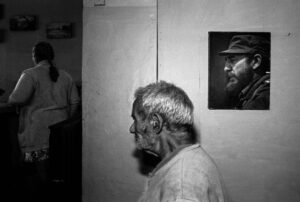
Commander Bernabé Ordaz is survived by the comment that he was a good person, but also by the fact that, under his rule, torture against political dissidents was carried out. How did you fare with him? How was your treatment by the rest of the hospital’s officials?
Mr. Ordaz was, at first glance, a colorful and rather vain man. His hair and beard were dyed jet black, which contrasted with his pale skin. He also wore a wide-brimmed hat, which he never took off, and heeled boots to appear taller. I noticed these details. During our interview with my Swiss colleague, when Ordaz mentioned his age, I seized the moment to tell him he looked much younger. I think I touched his heart there. At the end, I told him I might have to return to take more photos to complete the report for the newspaper where we intended to publish. Then he gave me his direct phone number.
When I called a few days later, he authorized me to continue photographing and “assigned” me a veteran professor who served as the institution’s historian. Ordaz had several secretaries; I believe one was “sane,” but the others were patients. From what I witnessed, the patients adored him. He managed to give each smoking patient two packs of cigarettes daily, which in Mazorra meant nearly everyone. He presented himself as very devoted to the sick; I think that attitude came from his Catholic upbringing and vocation, since he wasn’t a trained psychiatrist but an anesthesiologist. That cult of his image as a benefactor of the sick was also promoted by the institution.
I imagine his way of leading and managing was highly personalized, and the patients felt it was Ordaz, not the institution, who provided for and protected them. Usually, when foreign visitors go to Mazorra, the hospital offers a guided tour showcasing the various treatment areas and patient care facilities. You pass through the wards where they do different manual tasks, called “Ergotherapy.” They walk you across the impeccable lawn, past the baseball field, and take you to a showcase dormitory where everything is incredibly orderly and the terrazzo floor is so polished it dazzles the eyes.
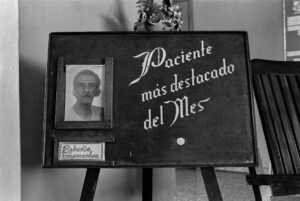
At the end, you reach the auditorium, where they put on a show featuring the choir, the dance troupe, lyrical singing, and culminating with everyone singing a kind of anthem dedicated to Commander Ordaz, which he listens to pleasurably from the front row.
Electroconvulsive therapy divides the world of psychiatry into supporters and critics. It seems very effective in treating severe depression or psychosis where previous drug treatments have failed. Some Mazorra patients told me about their experiences after an electroshock session, and just seeing their faces, you could imagine how terrible it is. It’s known that some psychiatric institutions use this therapy as punishment to control unruly patients, so I’m not surprised by the many testimonies of political dissidents and critical intellectuals subjected to this horror. Unfortunately, I can’t provide direct evidence because, as I’ve mentioned, I was under constant surveillance every day, hour, and minute. Nor do I think State Security was ever concerned about me—that would be presumptuous on my part. Since they controlled what I could or couldn’t photograph, I believe they were confident that those photos could only serve to polish their propaganda machine. But they ignored a great truth: often, what goes unsaid is more eloquent, and what remains unseen is more evident.
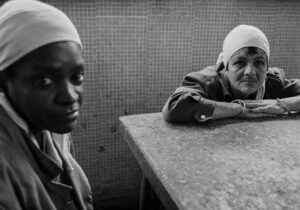
Around that same time, you worked on the production of the documentary Ricardo, Miriam y Fidel (1997) by Christian Frei, about Cuban family emigration and separation, according to the Swiss filmmaker’s vision. It also touches on the visceral political conflict many of us have lived through with our closest loved ones. How did you get involved in that project? How was the filming process?
I was taking a photography course at UPEC [Unión de Periodistas de Cuba] when someone who knew I spoke a little German connected me with Swiss journalists who wanted to do a major report on Cuba. One thing led to another. Some time later, filmmakers from Zurich knocked on my door; they wanted to make a documentary about Radio Rebelde and were starting the research phase. They asked me to help transcribe the interviews they would conduct.
The thing about Radio Rebelde sounded a bit strange to me, but that world was so interesting that of course I accepted. I spent some weeks transcribing interviews for them and also helping them somehow avoid the omnipresent shadow of those two “comrade” production assistants with voracious appetites that ICAIC [Cuban Institute of Cinematographic Art and Industry] had assigned to them. This was in 1992. I already had plans to travel to Switzerland later at the invitation of friends. So the director told me that if I made it to Zurich, I should contact him, as he might have more interviews to transcribe.
Once in Zurich, they confessed to me that the real idea was to make a documentary about a communist father and his dissident daughter who was about to leave the country. The father had been one of the founders of Radio Rebelde, the mythical pirate radio station established by Ernesto Guevara in the Sierra Maestra that became a pro-government voice. In contrast, his daughter Miriam was an avid listener of Radio Martí. So they wanted to show this conflict between father and daughter, accompany her as she left for Miami with her family, while in parallel telling the story of these two radio stations, which shared certain similarities at some point in our history.
In Switzerland, I continued transcribing and then making summaries in my poor German of those interviews with the protagonists, with people involved in the history of Radio Rebelde, the Sierra, and the historical material they had collected. It’s incredible how much visual material exists about those events. After six months in Europe, I returned to Havana, now as part of the team and fully aware of the documentary’s purpose. That’s when I met Ricardo and his wife Ana, Miriam and her family. Wonderful people, unfortunately, trapped in an ideological conflict that ended up separating them.
There are many anecdotes. From police asking the Swiss for their IDs when we filmed exterior scenes, to our adventures in the mountains. A cyclonic storm surprised us at dawn in the Sierra. The force of the winds up there is impressive. That terrain is very clayey; when it rains so heavily, you sink into the mud, and on slopes it’s as slippery as stepping on soap. We had planned to film Ricardo and his friend Evelio Laferté’s visit to the Radio Rebelde Museum, which is at the top of the peak with the same name. I’ll never forget the last stretch, about 300 extremely steep meters where the path was so narrow the Jeeps couldn’t pass. The filming equipment and supplies were brought by Juan Sierra, a local muleteer with a playful little dog named Pal. But on that last stretch, so steep and muddy, not even the mules… So we had to go on foot. Even the Swiss, accustomed to climbing, barely managed to go up. Meanwhile, the mountain men, some almost barefoot, threw the equipment over their shoulders, including an electric generator, and went up fresh. As for me, the vines saved me…
Were you present during the entire filming process in Havana? I see you had access to protected locations belonging to the Council of State. Did you witness the reaction of Ricardo Martínez Víctores, founder of Radio Rebelde and co-protagonist of the film, upon seeing the finished work?
Ricardo Martínez contacted Pedro Álvarez Tabío—that is, the Council of State and the Office of Historical Affairs. This not only facilitated permits to film in sensitive locations like the Sierra Maestra or the former Moncada Barracks but also granted access to archives and provided all the historical material used. I believe officials saw this project as a timely opportunity to polish the Revolution’s image abroad, precisely when the communist bloc had collapsed and the expected changes hadn’t materialized in Cuba. They aimed to revive that epic narrative that once captivated public opinion, this time through the lens of a Swiss filmmaker. It almost worked…
I was present for nearly all the filming in Cuba. Beyond Havana and the Sierra Maestra, we shot in Santiago de Cuba and Bayamo. I couldn’t join Miriam’s flight to Miami, visit the rafters’ museum in Key West, fly in the Cessna with Brothers to the Rescue, or be in Washington D.C., where Radio and TV Martí were then based. Nor could I go to Cudjoe Key, where Fat Albert—the blimp used for TV Martí broadcasts—ascended nightly, since as a Cuban citizen, traveling to the U.S. from Cuba with a Swiss film crew was impossible.
Later, after filming wrapped, budget constraints forced the team to forgo an editor for the initial cut. Because I was the only one who fully understood the linguistic nuances, context, and subtext of the story, they asked me to assist with the first edit. Back in Zurich, I collaborated with director Christian Frei to review and digitize footage from dozens of Betacam tapes. This was the dawn of digital filmmaking—everything felt basic compared to today’s technology.
Resource scarcity pushed Frei—a master of cinematic technique—to pioneer this hybrid analog-digital approach. My prior photography work in El Fanguito had given me some visual storytelling intuition, which helped in the rough cut, though I was a novice in the editing suite. For me, participating was like stepping through a door into another planet. Thankfully, the story’s collective trauma lent itself to intuitive editing. Spending months with that footage felt like reliving it firsthand, and I felt privileged to witness images that few Cubans ever saw.
Some unused scenes were painful to watch: rafters rescued by Brothers to the Rescue and later collected by the U.S. Coast Guard, their faces sunburned, lips cracked, especially the sole woman in the group, who could barely walk. Footage of Radio Martí also struck me; I knew the voices but had never seen the faces. And the nighttime launch of TV Martí’s blimp from Cudjoe Key—pure cinema! After this lengthy process, once the narrative structure was set, we enlisted Cuban-American editor Jorge Abello, who traveled to Zurich to refine the story. Finally, we submitted the film to the Havana Film Festival.
But they banned it. For the Cuban censors, the presence of Radio and TV Martí and the participation of people like Rafael del Pino in the documentary were offensive. As you can imagine, these weren’t pleasant moments, but we were committed to showing both sides of the drama. I remember we went to the Hotel Nacional, where MECLA was headquartered, and left flyers there announcing private screenings of the film, meaning in my home. We invited neighbors, friends, interested strangers, and even Cuban filmmakers… From some of them, I heard the most cowardly comments you could imagine.
The film ultimately premiered at the Visions du Réel festival in Fribourg and was shown in theaters and at various international festivals, including San Sebastián, Chicago, São Paulo, Amsterdam, and Ramallah. When Ricardo agreed to participate and tell his side of the story, he knew both perspectives would be presented in the film. The director firmly intended to show both truths and let the viewer lean toward one or the other, or perhaps find a balance between them. There were passages Ricardo wasn’t entirely comfortable with. But that’s the risk you take when you make brave decisions.
This film combines the epic with personal stories—both that of a father “committed to the process,” as they said for so long, and a daughter who desperately wants to leave the country. The farewell scene is crucial. Nearly 30 years have passed, and yet the goodbyes at the airport door, the lines, the blackouts, and even the pigs raised in bathtubs remain part of our national farce.
The film is a litany of farewells. The last coffee, as you say, is a pivotal scene—for me, the most beautiful, intense, and important, because it condenses into two people and a few minutes the tragic fate we’ve been dealt. Farewells not just to people and affections, but also to places, customs, sensations, reference points…
I remember that day, the crew “took over” Ricardo’s house in Nuevo Vedado early. The room where the scene would take place was prepared—the placement of furniture, sound setup, every detail. The cinematographer and assistant carefully crafted the lighting to create that subdued atmosphere in contrast with the harsh light outside. All done with limited resources. One of my uncles, an electrician, had specially prepared a panel with fluorescent lamps for that scene, which worked perfectly. And suddenly, when filming began, a deep silence fell. The space was filled with tension and that intimate, bluish light. Then Ricardo and Miriam took over the moment; there was an overwhelming weight to their words and gazes, a mastery of gestures and silences that would have made anyone believe they were actors. Everyone was moved—even the Swiss, though hardly any understood Spanish.
The other moment that moved me wasn’t a farewell, but a reunion: Miriam’s arrival at Miami airport. When the door to the arrivals hall opens, she steps ahead of her husband and children. The camera captures her anxious gaze searching the crowd until she spots her childhood friend María Elena, whom she hadn’t seen in over twenty years. Suddenly, she runs to embrace her. They look at each other, hug, kiss, weep… A breathtaking moment.
One thing I want to highlight is the decision to film Miriam and her family six months after they arrived in exile. Ending the film with their Miami arrival would have made for a trite conclusion. It was a sensitive but courageous choice by Frei. We’re talking about a Swiss filmmaker—not exactly a leftist firebrand, but someone striving for equal distance to both sides. Showing Miriam six months later, physically changed and reconsidering many of her ideas in light of her new experience, invited reflection on exile’s drama beyond ideological predispositions. In short, conflicts and hardships don’t end when one “leaves”; on the contrary, new ones emerge.
In 1999, you had two exhibitions in Switzerland. Both shared a central title: Cuba under Construction. What was your aim with this concept? What works did you exhibit? What do you recall about the reception?
January 1999 marked the 40th anniversary of the Cuban Revolution, and I used the occasion to exhibit my Cuba photographs. The show took place at Shedhalle, a prestigious venue with spectacular spaces. Many attended, and we had intense exchanges. Unfortunately, most visitors were driven by curiosity and sympathy rather than deep engagement with the reality depicted. I often say some people take safari vacations, others go to Cuba; it is a mix of leisure and anthropological tourism.
The event was covered in media like the then-renowned (now defunct) magazine Facts and the respected Neue Zürcher Zeitung. Swiss TV also ran a short feature. Months later, I showed the same series at Galerie L’Ancien Manège, a converted armory turned cultural center in La Chaux-de-Fonds, in French-speaking Switzerland.
The title Cuba under Construction suggested that even after decades of revolution, this “new, superior society” remained like a shack with unfinished foundations. My photos—mostly taken in Central Havana, El Fanguito, and Callejón de Andrade—testified that 40 years on, that extraordinary habitat for the “new man” remained unbuilt. Despite (and because of) the lack of freedoms, poverty, inequality, and vulnerability persisted. And so it continues today.
How did your series about the Jewish community in Cuba, which you created in 2000, come about? Where did this interest originate?
I grew up relatively close to Beth Shalom, the synagogue located on I Street between 13 and 15 streets, in El Vedado. As a child, I was always drawn to the building—so modern and airy—and the relief figures adorning the Temple’s door, symbolizing the twelve tribes of Israel. Yet, although everyone called it “the synagogue,” I didn’t know what it meant. The word “Jew,” however, was familiar to me because my grandmother would jokingly call me that—judía!—since I hadn’t been baptized. But as far as I know, I have no actual connection.
The truth is, I enjoyed walking past that synagogue and pausing to look at it; it stood out in the neighborhood. Years later, while studying law, we attended fascinating lectures by Professor Delio Carreras, a man of great knowledge, eloquence, and passion. With him, we traced the history of law from the Code of Hammurabi, the Dharma-shastra, the Twelve Tables… When we reached the Five Books, the Pentateuch, I again became captivated by the Jews. So, one afternoon, on my way home, I passed by the synagogue as usual, but this time the library door was open, and I walked in.
There, surrounded by books and seated behind a desk, was a woman who looked like Barbra Streisand’s older sister. It was Adela Dworin, then the librarian and now president of the Board of the Hebrew Community of Cuba. I began asking questions, and it must have felt like a whirlwind to her, but she kindly invited me to sit and answered everything. Until that moment, the existence of Cuban Jews had been unthinkable to me. Though I’d often heard people refer to “that Polish guy” or “this Polish guy”—their way of referring to Jews—I couldn’t imagine someone walking under that scorching sun dressed in black, with sidelocks, a beard, and a kippah…
Living abroad, I noticed there’s an image of Cubans that I hardly recognize myself in. People love labeling us. I began digging into my origins, trying to clarify my history. In Cuba, we always highlight the Spanish and African legacy, but we often overlook the many other cultures that shaped the nation’s demographic and cultural fabric. I researched the numerous immigrant groups who arrived in Cuba, from the time it was a Spanish captaincy to the Republic era up until 1959. Among them, the Jews stood out to me in a special way. I don’t think we’re fully aware they’ve been part of our history from the beginning.
The first Jew to set foot on the island came with Columbus. His name was Luis de Torres, Yosef Ben Ha Levy Haivri, a converso from Huelva who served as the admiral’s interpreter because he spoke not only Spanish but also Portuguese, Aramaic, Hebrew, Mozarabic, and some Arabic. The expulsion of the Jews coincided with the Discovery; it was logical that many would join the expedition to the Indies. Upon arrival, Columbus sent De Torres and a sailor on a brief exploration of the island. Four days later, they returned laden with offerings from the natives, including tobacco leaves. Luis de Torres was the first European to smoke tobacco. He never returned to Europe; he helped establish the settlement of La Navidad on Hispaniola, where he died. He is credited as the precursor of Judaism in the Americas.
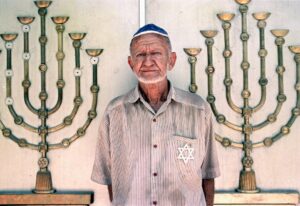
Then I remembered the synagogue—the pull I’d always felt toward that place. What a fantastic, complete story! So I decided to travel to Havana to visit my mother and, while there, photograph Cuba’s Jewish community. As I’d done before, I convinced a journalist friend to join and write about it for a Swiss audience. At the last minute, he couldn’t make it, so I went alone. I returned to Beth Shalom after ten or eleven years, and there she was, sitting in the library: Adela Dworin. She didn’t remember me, but I managed to excite her again, and she spoke with the then-president of the Board, Dr. José Miller, to grant me access to document the community’s life. This was around Passover, April 2000.
Why did it take you over 20 years to develop those negatives? What did your subjects “tell you” when rediscovered after so long?
Back in Switzerland, I spent weeks in my darkroom developing and printing the photos. I tried publishing the story in Das Magazin, one of the few outlets still running long-form pieces. With Cuba-related topics, it’s often the same: sometimes the story feels “too distant,” other times there’s no writer available. In the end, it went unpublished. I tucked it away in a drawer.
Two decades later, during the pandemic’s lull, I began digitizing old negatives to salvage interesting images. Over time, humidity and rough handling make film fragile. Revisiting this story, I started noticing details I’d missed. Weeks passed as I scanned frames and restored what I could. It’s meticulous work—only curiosity staves off the tedium. When I finally selected the strongest images, I regretted not pushing harder back then, not trusting their power enough, having so many doubts. But doubt, not certainty, has always been my compass.
As the faces of Chanivecky, Esquenazi, Mitrani, Gonte, Rosa, Liba, Grandma Raquel—all likely deceased now—appeared on my screen, alongside portraits from Jewish graves in Guanabacoa’s cemeteries, it felt like they were speaking to me. Like I was back there, hearing their stories, their memories… What a privilege, I think now. Boris Beresdivin—I know I took his last living photos. Agonizing in bed, he consented to be photographed. That stays with you. These encounters were fascinating yet heartbreaking. They were elderly, struggling deeply. Beyond neglect, some relied solely on the Board’s meager support. They asked for help; I could do little. Later, in Jamaica, I contacted Chanivecky and Rosa’s son in Kingston to relay a message from his parents. That brought me solace—they’d missed him terribly, their only child, I believe.
Months later, I returned to Havana and visited those I could to deliver prints. It was hard—conditions had worsened, and they’d pinned hopes on me, thinking the report might spotlight their plight. That became one of my great frustrations. Though I never saw them again, I cherish those bonds. They opened their homes to me, sharing hours of immeasurable value. Through them, I learned more about Cuba—and thus, about myself.
The internet is a remarkable tool. A few years ago, I came across news that Salomón Mitrani Barlía, a veteran of Israel’s War of Independence, had married his wife Pilar under Jewish rites in 2007 at age 84, after 55 years of civil marriage, seven children, and eight grandchildren. More recently, one of my former subjects contacted me on Facebook. When I photographed her, she’d been a high school student of 16 or 17; now, a mother of two and a professional living in an Israeli kibbutz. This would make a beautiful follow-up story, telling her story 20 years later. I haven’t given up hope.
In 2000, you’re in Havana documenting the Jewish community, then six years later, you surface with a photographic series on Senegal titled Silent Crisis. What happened in between? What took you to Africa?
At that time, the decline of print media was beginning, and some of the publications most generous to photography were shutting down. I had been writing a monthly column with a journalist for a culinary magazine—I enjoyed it, it was titled roughly “World Cuisine.” We featured portraits of people with interesting stories, which doubled as culinary reports about their places of origin, acknowledging the large population of immigrants and people with diverse cultural backgrounds living in Switzerland. This lasted six months because that magazine also closed. So, with this journalist, with whom I remain friends today, we began searching for a good story to work on together. I dreamed of going to Senegal, I had planned it, and I had a good Senegalese friend then studying at the University of Zurich who had told me much about his small village, his father and his four wives, his 18 siblings… Then the journalist, whose specialty was music, got us included in a promotional tour organized by the record label World Circuit following the release of Orchestra Baobab’s new album after years of retirement.
It was the summer of 2002. This job covered our two flights and the first five days of our stay. We also discovered an interesting hip-hop movement emerging in Dakar, and the magazine Facts bought that story. Additionally, the World Cup was being played, and Senegal, having qualified, would face France. We managed to sell that report to another magazine. These extra jobs allowed us to afford a longer stay. We also organized a report on Senegalese wrestling, the national sport there.
We arrived in Dakar as part of this group of journalists organized by World Circuit and attended the Orquesta Baobab performances in Dakar and Saint-Louis, the former capital. I remember two special moments for me. This orchestra plays many Cuban songs blended with African rhythms—a beautiful musical fusion—but the singers don’t always know the lyrics perfectly; they invent the lyrics, just like we used to do with English-language songs. I remember a lecture by a musicologist about the influence of Cuban music on African music. The man knew everything, right from the earliest Cuban recordings on shellac… I was amazed, just imagine! Back in Cuba, we had always heard about the opposite: Africa’s influence on our music. At some point, they found out I was from Cuba, and their reaction was really touching. Then, one of the singers came over and asked me to write down the lyrics to the songs for him, starting with “La Negra Tomasa”—and I had to invent the lyrics a little too.
After those five days, we said goodbye to the group and stayed in Dakar, relying solely on our luck and the fact that Senegalese people are generally very kind. I remember it as a second initiation journey—the first had been to Zurich. My colleague spoke French well; I could stammer a few words if necessary, but understanding them wasn’t easy. Not everyone speaks French, only those who went to school, or exceptions like our dear late friend, guardian, and taxi driver, Youssou Gueye, who learned it by ear. Over 30 languages are spoken there, but Wolof is the common tongue. Senegal has a semi-desert climate. I remember the dry heat and crystalline light, that swarm of taxis and drivers constantly calling out to us. Prices were rarely fixed; everything had to be negotiated, which I found exhausting. I had never seen so many people so dark-skinned and slender. I had never seen women in flip-flops walk so elegantly across the sand without getting their dresses dirty.
It had been a long time since I’d heard drums as harmonious and powerful as Cuba’s. There, I heard the sabar drums, played before Senegalese wrestling matches—they sound like an orchestra. I photographed the wrestlers up close; they looked like statues, or rather, panthers. Senegal is a fascinating country, which is why we returned—we made four trips in total. Among other stories, we covered soccer academies, Senegalese cuisine (which is excellent), fashion… Our last trip was in 2006, when the migration crisis was just beginning, with young people arriving in wooden boats on the shores of the Canary Islands. We decided to report on the situation independently. We traveled from Dakar to Mbour, the Saloum Delta, Rufisque, Thiaroye-sur-Mer, and more. We managed to publish it in a small independent magazine with a print run of just 500 copies—hence its name, 500Ex. The title was Silent Crisis, though it’s anything but silent now.
Did you visit other countries on the continent? Did your “Cuban experience” help you in any way? What was your biggest cultural shock?
I’ve only been to Senegal and, unfortunately, haven’t returned since 2006. It’s obvious that many of our deepest roots trace back to Africa, specifically West Africa, but it’s also clear that we are not Africans. Nor did I feel they had any special interest in me because I was Cuban. With me, they were kind, attentive, hospitable, mischievous, and warm, just as they were with my Swiss companion.
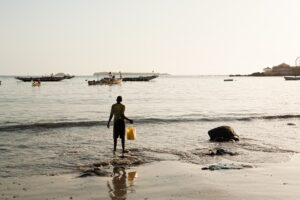
You’ll laugh… Often, people asked if I was from Israel. But what struck me the most was visiting La Maison des Esclaves (The House of Slaves) on Gorée Island, a small island about three kilometers off the coast of Dakar, reachable by a half-hour ferry ride. It’s a two-story building with stairs leading to an inner courtyard. At the back, there’s a second door facing the sea—they call it “the Door of No Return.” Before being shipped off, enslaved Africans—captured, bought, sold, traded, hunted—were brought to this house and, when the time came, forced through that door onto ships bound for the New World. The entire house is chilling; its architecture leaves no doubt about its purpose. Nothing is superfluous; everything is functional. Yet, despite its tragic history, it’s a beautiful building. The Door of No Return is overwhelming. Through it, a blinding glimmer of sea light pours in, along with that breeze… It’s tiny, almost like a slit in the wall. Why so narrow? So only one person could pass at a time, making it easier for slavers to count each captive and maximize cargo space. I stood there for a while, right at the edge of the door, staring at the ocean, wondering how many of my ancestors had walked through it on their way to the Americas.
I would love to return and visit other countries, especially in the south… enigmatic places to me like Botswana, Tanzania, or Namibia—the latter two former colonies of the German Empire. If I do, as I once did with Senegal, I’d want to show a reality different from the usual clichés: hunger, wars, and diseases… The constant victimization of the other doesn’t help anyone rise. But I’m torn between two dilemmas. First, as strange as it may sound, the world isn’t as naive as it was 20 years ago. The speed at which things change is astonishing, especially when they change for the worse. Back then, we didn’t have to fear Islamic State affiliates in Congo and Mozambique, or Boko Haram in Nigeria, or Tuareg rebels in Mali. There was no Chinatown in Dakar, and Russian influence wasn’t spreading like wildfire across the continent as it is today. The current landscape is far more troubling.
The other issue has to do with evolving as a photographer. I think the great English photographer Don McCullin said it: “The Third World doesn’t need more photographers.” If that’s the case, I reconsider that phrase: I already have my Third World, and it’s Cuba. That’s the world I’m most interested in showing, in helping, finally, and together, to reveal its truth.
Your political stance is quite clear: highly critical of the Cuban government, the absence of democracy on the island, its human rights violations… Yet unlike some, you’ve kept visiting the island over these 30 years.
I was born there, I’m from there. One of my grandfathers descended from enslaved people, the other from Creole peasants. I’m more Cuban than any Castro. That’s my right, and as long as I can, I’ll exercise it.
It’s not for me to judge those who have chosen not to return to Cuba. By the same token, I don’t believe anyone should make assumptions about me for my stance. But I find it interesting and even necessary that we discuss this. First and foremost, my compassion and affection go out to those who have suffered terror, imprisonment, loss—and there have been far too many—and I completely understand why they might never want to return.
That said, I want to speak for myself. Refusing to go back to Cuba would, for me, be an act of desertion. It would mean denying myself a right I was born with that no one has the authority to take away. Had I stayed away, I wouldn’t have been able to document the reality of the last 30 years. Our absence from Cuba has left a tremendous void in every aspect, helping to perpetuate and even finance this absurdity, normalizing the blackmail and aberration forced upon us: the idea that being Cuban is conditional on loyalty to the regime.
I don’t know how many of us there are, but imagine if one day two or three million of us decided to stand our ground. We’ve left a vast space that the ruling elite has skillfully occupied, exploited, and manipulated, pushing us out of the picture for far too long. Let me share an anecdote that might explain it better. A while ago, I was on the phone with a Swiss gallerist who also represents several Cuban artists. Someone had recommended her to me. We spoke cordially until she mentioned she had no experience working with “ex-Cubans.” Do you understand what she said? We’ve been erased from the equation and turned into pariahs, to the point where any ignorant person can call those of us who don’t live in Cuba “ex-Cubans.”
A nation is more than an idea, a territory, a feeling, or the sum of qualities and values shared by a group born and raised in the same place. It is the foundation and guarantor of equality before the law and among individuals. That is its essence. Not the palm trees, nor the sea, nor the sky, but the path forged by the presence and contributions of those who came before us, to which each person, in their lifetime, must also add.
A nation is neither pathos nor chimera; it is well-being in every sense. They have stolen so much from us, far more than we realize. This theft goes beyond the material; it is infinitely more brutal, because they have expropriated what never depreciates: our foundations, our past, and our place. And I want to believe we all understand how vital it is for a person to know their past, stand on their roots, and claim their rightful space.
Let’s talk about your 2018 series, Las amigas de mi madre (My Mother’s Friends). You’ve said your mom once wrote to you, shaken by a medical diagnosis one of her friends had received. Soon after, you flew to Havana and began photographing women close to her who were ill and undergoing treatment. Nearly all stare directly at the camera. Many, including your mother, are no longer here…
Almost all of them look at the camera, except for two. Denia, who, between labored breaths, sat for the portrait without her oxygen tank despite her chronic obstructive pulmonary disease. She died just weeks after I took that photo. And Martha Ximeno, a writer, physically frail but fierce in spirit. She’s still alive, but she refused to face the lens, choosing instead to retreat into the green of her garden, a true oasis in Havana’s growing chaos.
They were—and remain—my mother’s friends. Some had known her since before I was born, from that time when your mother’s friends cared for you as if you were their child. A few are still missing from the series, though I don’t know if I’ll be able to include them. Women without superfluous suffixes; some happier than others, but all of them strong-willed. These may not be the most technically perfect portraits, but I assure you they were the hardest to make. You know how Cuban mothers are: “Stop that nonsense!” It’s not easy to approach someone you love and say: “I want to take this portrait because I need to preserve your image for after you’re gone.” Six of the thirteen have already passed away.
Did you return to Havana after your mother’s death?
I arrived in Havana the day after she passed in 2019, engulfed in overwhelming solitude. It was a brief stay, fortunately. Soon after, COVID-19 hit, borders closed, and I didn’t return until late 2022 to settle her affairs. My mother’s death taught me this: death has no purpose. It is eternal, inert, absolute.
Life is determination, willpower. Like the flying fish that leaps from the water, gliding with fierce elegance just above the waves for mere minutes before plunging back into the depths. That’s life: a leap, a purpose, a single attempt that cannot fail. When I finally understood this, I felt immense relief. I know one day I’ll return to those depths and see her again. Until then, I’m learning to carry the void and the vulnerability her absence left behind.
Many people don’t know you’re the daughter of Félix Betancourt, a boxer who made his mark regionally, especially before you were born. What was your relationship like with him? Did you ever photograph him?
My father, Félix Betancourt, was a beautiful boxer to watch; flawless technique, a merciless right hand. In the 1960s, he was a welterweight and light welterweight champion, part of the first generation of Cuban athletes post-1959 to win medals for the country. He competed internationally: the 1962 Central American Games in Kingston, 1966 in San Juan, the 1967 Pan American Games in Winnipeg, in both Germanys, Mexico, Poland, and the 1964 Tokyo Olympics, where he narrowly missed bronze against Tunisia’s Habib Galhia, finishing fifth.
My mother often told me how, when he fought at the Ciudad Deportiva, she’d take me along; she’d make me a little bed in the bleachers while she watched, heart in her throat, though sometimes pitying his opponents. I was too young to remember any of it. His bouts with Andrés Molina, another spectacular boxer, supposedly electrified Havana, sparking fierce debates between fans.
He retired young—unfortunately, in 1972 at just 26 years old—after losing his title to Emilio Correa. My parents separated early. My mother used to say I inherited much from him, especially his temper, which made our relationship challenging at times. Born in Santiago de Cuba in 1945, he died in Havana in 2014, forgotten and disillusioned with the system to which he had devoted his prime athletic years.
He voiced these criticisms publicly, but met only rejection and ingratitude. Only on the day of his death did Granma publish an obituary dubbing him a “glory of Cuban sports,” an honor reserved for the most exceptional. He passed at 68 but left behind an extraordinary record: 120 fights, 14 losses, 2 draws, and 104 wins (90 by knockout, 51 of those in the first round). I did manage to photograph him once.