Things have changed lately in Donaida Pérez’s life. She is no longer the one who receives visits, but the one who visits. She is no longer the one who waits for the food bag, but the one who supplies it. She is no longer the one who waits for a call, but the one who calls. She is no longer the inmate, now she is the released prisoner.
Almost two months ago, she was sitting in the dining room of the Guajamal women’s prison when the head of internal order asked her to accompany her. She was led to a place where government officials and high-ranking officials of the Cuban State Security were gathered. She was told that from now on, she would be released on parole and that she would be part of the list of 553 detainees who would return home after the negotiations between Havana and the Vatican. Initially, public opinion thought that Joe Biden’s administration had intervened in the agreement after the island’s withdrawal from the list of countries sponsoring terrorism on January 14, but, as later transpired, the U.S. government had not participated in the negotiations.
“The news of my release took me by surprise, I did not expect these henchmen to do that,” says Donaida, who on January 15, on the anniversary of her mother’s death and only one day after the announcement of the beginning of the releases, arrived at her Placetas neighborhood dressed in white and was received by her neighbors as a hero, a crowd that welcomed her with kisses and hugs.
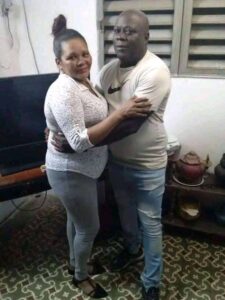
Donaida could not deny that she is happy. How could she not be if she is back in her neighborhood, at the house she has lived in all her life? But neither the neighborhood nor the house is the same as before she voluntarily surrendered to the authorities on July 16, 2021, after participating in the anti-system protests that put in check the government of Miguel Díaz-Canel, and after being sentenced to eight years of imprisonment for public disorder, contempt and affront against a public official. Now in the house is not her husband of more than three decades, she no longer goes to sleep with Loreto Hernández García, sentenced to seven years for also demonstrating the day Placetas joined the national protest.
“I left a part of me in prison,” assures Donaida, 54. “It feels terrible, it feels like dying, I am surrounded by people, my godchildren, my neighbors, but at the same time, I am alone, because my husband is a very important part of my life. But even if that means my life, even if they shoot me in the forehead, I will continue to fight for his freedom and the freedom of all Cuban political prisoners.”
It is a strange feeling she has now. For three years and six months, she was far from Loreto, but somehow close. From the women’s prison, she used to send little pieces of paper, little love notes or messages of any kind to Loreto, who was waiting for them excitedly in his cell. Once her husband even told her: “Oh, my love, I see the tanks of your prison and I think that you are so close and yet so far away.” Now Donaida has to hear from Loreto every 24 days, or wait two months for the conjugal visit.
“This is breaking our souls, but we know have to be strong,” she says. “We will continue to love each other from afar until we can be together, the day God and our Orishas allow it.”
Donaida and her stepdaughter, Rosabel Sánchez Correa, did not doubt that Loreto would be one of those released from prison. He is 54 years old and has constant health problems that have been publicly denounced: he suffers from acute bronchial asthma, heart disease, diabetes, and hypertension. “I feel the same happiness as my father for the release of my stepmother, but at the same time I feel angry to see how my sick father continues to be detained, because it is no secret that his health problems are serious and in the men’s prison in Guamajal there are no conditions to guarantee his care,” says Rosabel.
Donaida is sure that several factors influenced the fact that her husband, who, with her, leads the Association of Free Yorubas, has not been released this time: the racism that weighs on them, the fact that he is the brother of the former political prisoner and Cuban activist Jorge Luis García Pérez and his power of convocation that dragged many in the town to join the demonstration.
Javier Larrondo, director of the NGO Prisoners Defenders, assures that if a common factor can be detected in the released prisoners is that, among the first ones, most of them were prisoners who already had the right to a conditional discharge or even freedom, with sentences that were relatively close to exceed two thirds of its length and, in almost all cases, half of their sentence. Regarding the releases carried out in March, Larrondo explains that people with longer sentences were released from prison, “but they are people the regime has estimated that the political cost to be paid in case of having them released is little or none, which does not mean that they are right.”
Now that Loreto is still in, and she is out, Donaida wonders how free she is, or if they are not, in the long run, both imprisoned. “I’m not free, not at all,” she says. “In short, living in this country is not life, here, there is simply life for the powerful, those who crush the ordinary Cuban. I am not free and I will not be free until I step on the land of freedom or the Castros leave and leave Cuba alone.”
Donaida believes, without any doubt, that last January’s releases “were nothing more than a sham.” “That’s why when I talk about my freedom, I always say the supposed parole, because that was nothing more than a ruse by the regime; they simply exchanged us. It was an exchange, and so much so that there are still many political prisoners in prison. It is something that outrages me greatly, because no person who thinks differently should be in prison, should be repudiated, crushed or hated by their peers.”
Many human rights activists and organizations have denounced the lack of transparency in the releases, a process of which there were hardly any details from the government, which never published a list with the names of those released. After Donald Trump, on his first day as president of the United States, put Cuba back on the list of state sponsors of terrorism, Havana stopped the releases without providing any explanation. Then it resumed them, and last March 11, the People’s Supreme Court announced that they had fulfilled their promise, that is, that they had already reached the agreed number of 553 inmates out of prisons, an operation that Maricela Sosa Ravelo, vice president of the court, called “successful.”
However, Yaxis Cires, Director of Strategies of the Cuban Observatory for Human Rights (OCDH), insists that this “has been a very arbitrary process, but not random.” “Certain patterns can be identified, some to generate division and discouragement or, more cruelly, to redouble the punishment.” The OCDH recorded the release of 212 political prisoners, less than half of those agreed upon. Most of those released were common prisoners. However, the question on everyone’s mind is how much freedom those released now have.
“They talked about releases, but they have not released any of them; rather, their sentences remain intact and they are released under a very severe house arrest regime,” Larrondo assures.
Some have labeled the release process at the beginning of the year as fraudulent. Prisoners Defenders also conducted a study showing that more than 80% of those released from prison were already eligible for conditional release, and dozens were eligible for immediate release. Now, back home, they all are under no shortage of restrictions and rules: the authorities control their movements, some have to do forced labor, they are prevented from posting on social media or engaging in any kind of activism in the country, and they are prohibited from traveling outside the island and must appear before the authorities regularly. Ravelo, the court’s vice-president, made it clear that these were “early releases,” but that these individuals would continue to serve their sentences under certain conditions.
Liván Hernández Sosa keeps the more than six summonses that have come to his house to appear before a judge or the police, since he was released from El Pre prison, in Santa Clara, as part of the agreements with the Catholic Church. “The reason for these appointments is to threaten me, to tell me that if my house continues to be visited by members of the opposition or human rights defenders, and if I continue denouncing the regime, the parole they had given me will be revoked. They told me they could take me to a maximum-security prison anywhere in the country,” said Sosa, 35, who was serving a four-year sentence.
When authorities arrested Sosa after he participated in the July 11 protests in Santa Clara, his son was still a child whom he walked to elementary school every morning. When he returned, three years, eight months, and seven days later, the boy was already someone else. “That’s three years, eight months, and seven days of my life lost that are not going to be recovered in any way,” he says. “When I came back from prison, my son was already in junior high, he was going to school alone, I missed that time, for three years, eight months, and seven days, I missed my son’s growth because of them, and I will never get that back.”
Sosa was among the first inmates to be released. On January 15, 2025, around four in the morning, Major Michel, head of the penitentiary, woke him up to talk to him about “a possible transfer.” “They left me sitting in the visiting area, and around six o’clock in the morning, they told me that I was on parole. At that moment, I was happy because I was free again in a certain way. I was coming home to my wife, my mother, my children. I was going to see people I had not seen for years, I was happy,” he says.
He arrived at his neighborhood in El Condado, in the city of Santa Clara, at dawn, still in the dark. As soon as dawn broke, friends and neighbors began to arrive, celebrating his return home. But Sosa has the same feeling as other political prisoners, detained one day and released the next, with no one to give them back the time lost and under the certainty of having been a “bargaining chip.”
“For me, the releases were a fraud,” he says. “Most of the prisoners who were released were common prisoners, they were not political prisoners. It’s shameful how the government behaved, how they used us as a bargaining chip, because that’s what they did.”
He has also wondered if he is really free, but at this point, he is convinced that he is not. He does not deny that he feels afraid of being taken from his family again, that one day they will arrest him and take him back to “that hell” that are the prisons in Cuba. “I went from being in deprivation of liberty to being imprisoned inside my house, I cannot publish on social networks, I cannot make complaints, I cannot leave Santa Clara, I cannot travel, they watch me, they visit my house at any time, they summon me six and seven times a month. I am not free, I just stopped being in prison to be at home, but I am still a prisoner.”