
Arelis Almares Alberteris, 40, began her daily routine early in the morning, riding her bicycle to the nursing home in the municipality of Urbano Noris, Holguín, where she worked as a physical therapist. In the evening, she would make the same journey back home along a quiet road lined with dense shrubs separating her house from her workplace.
“She lived her days like that and was very happy,” says Nancy Alberteris, her mother, who in January 2023 was optimistic that her daughter had started a new life “away from him and despite him.”
“Him” refers to René Ferias, Arelis’s ex-husband. They had been married for more than twenty years until he discovered that she had begun a new relationship. René didn’t take it well. He stalked her for months, increasingly often and more aggressively. In December 2022, he raped her and threatened to kill her. Arelis immediately went to the municipal police station and filed a report. René was arrested shortly after, having no prior criminal record at the time.
“He shed crocodile tears in front of the officers. He promised he wouldn’t touch or bother her again and that he would leave her alone. My daughter was very noble, and because she cared deeply about that man’s family, she asked that he not be imprisoned and that only a warning letter be issued,” Nancy recounts, avoiding ever mentioning the man’s name.
The police, in violation of Article 17 of Law 142/2021 (“On Criminal Procedure”), knowing the severity of the crimes committed, complied with the victim’s request and did not escalate the case to the prosecutor’s office. This negligence ultimately cost Arelis her life.
Nearly a month later, at 7 a.m. on January 26, 2023, while cycling along the usual path, Arelis was ambushed by her ex-husband, who had spent most of the night outdoors, hiding under a small bridge. He was drunk and armed with a machete.
On September 6 of the same year, a court sentenced René Ferias to life imprisonment for the murder of Arelis Almares Alberteris, with the crime aggravated by having been committed “due to gender-based violence.” According to the independent Gender Observatory of the Alas Tensas magazine (OGAT), this was the fourth fully documented femicide in Cuba in 2023.
On the night of June 13, in the small town of Zulueta, Villa Clara, the electricity went out. The blackout caught 35-year-old Dayris Fuentes Chávez in the middle of the street. In the darkness, she began walking the usual path home, where her 11-year-old daughter was waiting.
She had never worried about walking alone at night in that area. Zulueta, except during its festive “parranda” periods, is a quiet and safe place. In fact, her only concern at the time—more annoyance than worry—was the constant harassment from her ex-boyfriend, a man known locally as “El Mexicano,” who had been pressuring her to rekindle their relationship for months.
“El Mexicano became obsessed with her, following her all over town. If she was at the park, he would show up to harass and threaten her. The same happened if she attended a birthday party or a nightclub. He wouldn’t leave her alone, treating her as if she were his property. Dayris never filed a report because she didn’t trust the police. Zulueta is a small town with only one police sector, and everyone knows everyone’s business. The police were well aware of the situation,” says Y, a childhood friend of Dayris who requested anonymity.
Dayris didn’t make it home that night. The next morning, her body was found along the path. She had been killed with a bladed weapon. The police immediately arrested her ex-boyfriend, who confessed to the crime. According to OGAT, Dayris’s femicide was the 43rd documented case of the year.
In the nearly five months between Arelis’s death and Dayris’s, at least 39 more femicides were committed in Cuba.

The Alarming Numbers
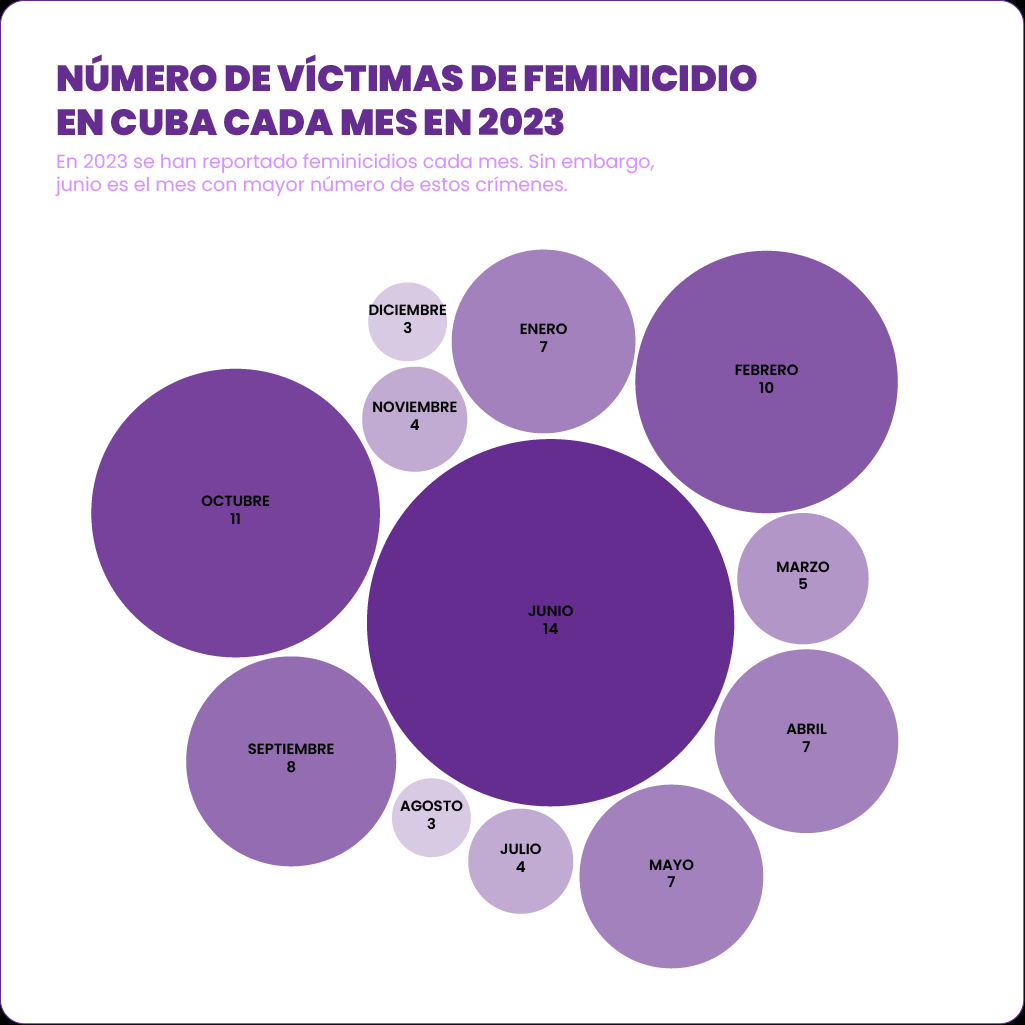
In 2022, at least 36 femicides were reported in Cuba, according to OGAT. In 2023, the number rose to 84 by the time this article was published—an average of one to two cases per week. Additionally, nine attempted femicides were documented.
The official newspaper Granma reported on December 18 that, during the 7th Plenary of the Central Committee of the Cuban Communist Party (PCC), Attorney General Yamila Peña Ojeda disclosed that there were “117 violent deaths of women” in 2023. The provinces with the highest incidences were Matanzas, Havana, and Santiago de Cuba. However, the authorities did not specify whether these deaths were gender-related or call them femicides. They also failed to provide victims’ names or contextual information. This article relies on data published by independent gender observatories.
Unfulfilled Commitments
Since the first Regional Action Plan Conference for the Integration of Women into Economic and Social Development in Latin America, held in Havana in 1977, Cuba has participated in most regional events focused on women’s rights, except those organized by the inter-American system—such as the Belém do Pará Convention (1994)—due to its non-membership.
Cuba is a signatory to the 1979 UN Convention on the Elimination of All Forms of Discrimination Against Women (CEDAW). Yet, despite early advancements in women’s rights, the country has fallen behind in the last decade.
Statistics on gender issues, including femicides, were non-existent until June 2023. Feminist activism and independent efforts to address these problems are criminalized in Cuba. Many activists label the Cuban state itself as “femicidal” for its failure to recognize or combat gender-based violence effectively.
Art curator and activist Yanelys Núñez, based in Madrid, defends this view. “The Cuban state is femicidal because it promotes the immobility of its institutions and criminalizes activism against gender violence,” she says.
It does not encourage nor collaborate with civil society actors who understand the context and work on the ground. If it lacks the will to solve the problem, it is a femicidal State. Elena Larrinaga, director of the feminist activism platform Red Femenina de Cuba and based in Madrid, shares a similar perspective. She stated that:
“One of the State’s obligations is to protect the physical integrity of its citizens. Neglecting this duty makes the state complicit.”
Femicide, A Prohibited Term
Since at least 2019, the recognition of the term “femicide” has been one of the main demands of feminist activism to the Cuban State. However, no response has been given, not even with the legislative changes brought by the new Penal Code, which came into force in 2022. This debate has even involved politically influential figures in the country, such as Mariela Castro Espín, daughter of Raúl Castro, a parliamentary deputy, and the director of the National Center for Sexual Education (CENESEX).
In May 2022, as a deputy, Castro Espín proposed to classify the crime of “femicide” in the Penal Code, which was then being debated in the legislature. To the surprise of many, the Federación de Mujeres Cubanas (FMC)—the state-run organization grouping women in the country and the only legal organization of its kind—publicly dismissed the initiative. According to the organization’s secretary general, Teresa Amarelle, its inclusion was unnecessary as its “interpretation” was already covered in the Penal Code.
Rubén Remigio Ferro, then president of the Tribunal Supremo Popular (Supreme People’s Court), also refused to accept the proposal, arguing that it “broke with the tradition and coherence regarding criminal categories” sought by the new legislation. Ferro stated: “The term ‘femicide’ or ‘feminicide’ is not included because it would require separate classifications for different types of murders, such as ‘infanticide,’ for example.”
Ultimately, “the murder of women due to gender-based violence” was included in the law, not as a crime but as an aggravating factor for murder under Article 345.2, which establishes sentences of 20 to 30 years of imprisonment, life sentences, or the death penalty for perpetrators.
Gender violence according to the Cuban Penal Code:
“A very particular type of violence, rooted in patriarchal culture, which is based on the power imbalance between men and women. As part of this male dominance, violence is used as a control mechanism, supported by sexist stereotypes that generate prejudices, leading to expressions of discrimination based on gender, sexual orientation, morality, symbolism, economics, or property. This negatively impacts individuals’ enjoyment of rights, freedoms, and overall well-being. It manifests in family, workplace, school, political, cultural, and other social settings, with its most widespread, frequent, and significant expression occurring against women.” Annexes (Clause X)
Julio Rodríguez, a practicing Cuban criminal lawyer, has a court hearing today to defend a man who killed his partner after discovering she was unfaithful. This is not the first case of this nature he has handled in his career.
“Someone in the community just told me everyone knew this could happen. It’s a shame. It’s a crime that could have been prevented,” he says.
Rodríguez does not use the term “femicide” or “feminicide” but instead sticks to the terminology defined by law. From a “strictly legal” perspective, he argues, the absence of a specific term does not weaken the legislation.
“If the legal consequences are the same, the words don’t matter. For example, the Penal Code does not include the word ‘parricide,’ but it punishes that crime. Additionally, the law itself defines gender-based violence. The issue is that the definition is too broad, and the law needs to be specific in these cases, like Mexico’s Federal Penal Code, which categorizes femicides based on a series of very concrete characteristics.”
The term “femicide” was formally coined in 1992 in the book Femicide: The Politics of Woman Killing by sociologist Diana Russell and criminologist Jill Radford. According to them, it represents a continuum of antifemale terror ranging from verbal abuse and forced heterosexuality to genital mutilation, resulting in death. However, this is not the most complete or politically impactful definition of the term.
In 1993, Mexican anthropologist Marcela Lagarde developed extensive research on the alarming rise in women’s murders in Ciudad Juárez, Mexico. Her findings expanded Russell and Radford’s concept and “Latinized” the term. For Lagarde, “feminicide” goes beyond the misogyny of individual aggressors; it involves a series of conditions that allow these murders to occur—silence, omission, negligence, and partial or full collusion by authorities responsible for preventing and eradicating such crimes. When Lagarde pointed to the State as an accomplice, femicide gained a political dimension, which is at the core of why the Cuban government resists its formal recognition.
Lagarde’s concept gained international traction, particularly in Latin America. Today, it is embraced by prestigious organizations like CLADEM, which argued in a 2011 report that recognizing femicide as a specific crime helps contextualize these murders and enables more effective public policies to combat and prevent them.
Numbers Matter:
In its 2021 statistical study on femicides, the UN reported that 81,100 women were murdered worldwide that year, with 45,000 of these deaths caused by intimate partners or family members. This translates to five women murdered every hour simply for being women. In Latin America, ECLAC recorded over 4,570 femicide victims that same year, with one in three women reporting physical or sexual violence by a partner or ex-partner.
In December 2015, the UN issued Resolution A/RES/70/176 urging member states to collect, disaggregate, and report feminicide data. In March 2022, it proposed a statistical framework for measuring femicides. Cuba has ignored both initiatives.
The first femicide statistics Cuba provided to an international organization appeared in ECLAC’s 2019 report. These figures, oddly enough, corresponded to 2016, revealing a rate of 0.99 femicides per 100,000 women aged 15 or older—roughly 47 femicides that year. This accounted for 39% of total female homicides in Cuba, higher than the global average (34.48%) and rates in countries like Peru, Chile, and Panama.
In 2021, the Cuban government approved Decree 198/2021, creating the National Program for the Advancement of Women (PAM), spearheaded by the FMC. It aims to “prevent and eliminate discrimination against women” and train officials to incorporate gender considerations into public policy. However, PAM remains largely theoretical, with few concrete actions taken. Its most tangible initiatives include the creation of the Cuba Observatory for Gender Equality (OCIG) and the approval of a Comprehensive Law Against Gender Violence.
The first goal was achieved two years later, albeit with questionable results. There has been no news of the second to date.
The OCIG (Observatory for Gender Equality in Cuba) was created in June 2023 with technical and financial assistance from ECLAC (Economic Commission for Latin America and the Caribbean). Its stated objective was to “collect, process, and make visible indicators and analyze information from a gender and rights perspective related to the situation and position of women and men in Cuban society to strengthen public policies aimed at closing gender gaps.” However, none of this has been fulfilled, and it has only served as a tool for political propaganda.
As of the publication of this report, the gender violence data released by OCIG remains the same as the statistics Cuba presented to ECLAC in 2019. Regarding femicides — identified here as “intentional homicide victims as a consequence of gender violence” — the latest statistics date back to 2022 and are methodologically questionable at best. According to OCIG, there were only 18 femicides in Cuba last year — a conveniently low rate of 0.39 per 100,000 women aged 18 and over. However, this data comes from the Supreme People’s Court’s supplementary statistical records. In other words, the Cuban State only recorded femicides in cases where perpetrators were arrested and convicted, which represents only half of the crimes of this type identified and verified by the OGAT (Gender Observatory of Alas Tensas), at least for 2022. On December 18, the Attorney General’s Office announced that it would begin keeping a real-time record of “violent deaths of women and girls due to gender-related causes” and acknowledged that more than 16,000 women and girls in Cuba live in situations of violence.
The Response: “The Law of Retaliation”
It wasn’t until April 2023 that President Miguel Díaz-Canel publicly addressed gender violence for the first time. His brief statement decreed that his government would maintain a policy of “zero tolerance for sexist violence.” By that time, feminist activists had confirmed 140 femicides committed on the island since 2019. The next time the president mentioned his administration’s “ironclad efforts” to eradicate gender violence was on October 17 of the same year, during an interview where he attempted to downplay his economic failures by contrasting them with unspecified “achievements” in gender issues.
But what has the Cuban government actually done to combat gender violence and, more specifically, femicides?
The facts show that Díaz-Canel’s “ironclad efforts” — aside from a few political propaganda campaigns disguised as progressivism — have been limited to punitive legislation. Despite Articles 42 and 43 of the 2019 Constitution offering the opportunity for a more comprehensive response to this issue, the government’s solution to femicides has been reduced to the Penal Code approved in 2022. This code does not classify femicides as a specific crime but considers them an aggravating factor in murder and over a dozen other offenses. Article 75 of the Code allows courts to increase the maximum penalty by one-third if a crime was committed “as a consequence of gender violence.”
Legal Expert Opinions
Julio Rodríguez, a criminal lawyer in Cuba, believes it wasn’t until 2022 that the Cuban State showed concern about femicides. Since the approval of the new Penal Code, he argues, it’s clear that the authorities are highly interested in severely punishing these crimes.
—It’s evident and public that the State has responded, in some way, to internal demands and those of the Cuban diaspora, which have given this issue political prominence. The State is addressing the matter now, but only through the current penal framework.
Rodríguez asserts that the Cuban government’s approach to femicides reflects a punitive legal policy, which raises serious concerns about the application of the law and justice.
—From a legal standpoint, if there’s a political intention to punish something exemplarily, the punishment is almost always homogeneous and symmetrical. However, law is inherently asymmetrical and must consider specific circumstances, contexts, motives, and diverse factors. In Cuba, there is always an overreach in punitive matters, not just regarding femicides but in any case that is deemed worthy of prosecution and severe punishment. This creates a symmetry where all offenders in a given category of interest face extreme repression or harsh penalties.
For activist Elena Larrinaga, the State’s punitive response to femicides reflects not only a clear political intention to clean up its repressive image but also the natural behavior of a patriarchal and machista structure embedded in public institutions. In this context, she argues, violence is both a solution and the only means of exercising social control.
“What I advocate for is a society where solutions don’t involve confronting violence with more violence. But in Cuba, these alternative practices are unheard of”.
Clinical psychologist Lilian Rosa Burgos believes that part of addressing the issue of femicides involves analyzing the characteristics of the aggressors and the contexts that led them to become perpetrators, as well as attending to the collateral victims of these crimes. Based in the U.S., Burgos has worked for years with women survivors of gender violence and has incorporated a gender perspective into psychotherapy. This experience, she explains, has shown her that punitive approaches, though often equated with justice, are insufficient in eradicating certain behaviors unless accompanied by elements like victim reparations and comprehensive rehabilitation for perpetrators.
“The learning created from a punitive approach is behavior-punishment, which is very limited because it conditions or reinforces actions based on fear. People don’t refrain from doing something because they know it’s wrong but because they fear punishment. This way of controlling behavior is fragile socially”.
Proposed Solutions
Activist Marthadela Tamayo has clear ideas about what actions the Cuban State should take.
“These actions wouldn’t even carry a political cost. They should allow the existence of shelters or safe houses for gender violence victims, create public policies addressing this issue through education at all ages, listen to and allow feminist collectives to operate, and give them their own spaces for education and victim support.”
Similarly, Yanelys Núñez suggests creating a fund to aid female victims of gender-based violence, establishing protocols for cases of disappearances, harassment, and threats, and implementing a more effective gender education program for police and public health workers.
“The solution can’t be harsher penalties but education and prevention. However, there is no political will in Cuba for such an undertaking. The FMC (Federation of Cuban Women) hasn’t even supported these proposals. It claims to represent all Cuban women, but it’s not a feminist organization. It’s merely an arm of the authoritarian policies of the Cuban regime”.
During the creation of the law, the Legislative branch ignored the issue, while official media outlets reacted with hostility. On August 18, 2020, Granma, the official newspaper of the Communist Party of Cuba (PCC), published an article titled Revictimized a Thousand Times, which directly attacked the work Cuban feminist collectives and independent media had been doing. According to the article, discussing femicides in Cuba was “a tactic of U.S.-funded media for the communication war” against the Revolution. Furthermore, it accused those raising awareness of these crimes of “hindering analysis,” “ignoring statistics,” and “undermining the work of true specialists” at a time when the Cuban state neither recognized gender-based murders nor made any effort to conceal its indifference.
When this article was published, the Cuban government had already implemented movement restrictions—including curfews—for several months to curb the impact of the COVID-19 pandemic. Between March 24, when these measures began, and October 15, 2020, at least 17 femicides and three related infanticides occurred in Cuba, all within victims’ homes or family environments. Neither Granma nor any other official media or institution acknowledged them. If we know about these crimes, it is solely due to the work of feminist activists.
During the lockdown months, the feminist platform YoSíTeCreoEnCuba launched a hotline to offer legal and psychological support to Cuban women experiencing violence from partners, ex-partners, or other family members. Over five months, this platform assisted 30 women who were victims of physical, psychological, police, and sexual violence, as well as one case of obstetric violence. Finally, in October of that year, the state established hotline 103—previously used for addiction support—to provide psychological assistance to victims of gender-based violence. However, this service only operated for one year.
The Cuban government has criminalized independent feminist activism and rejected all its demands. Nonetheless, the media reach of these collectives and their assumption—despite minimal resources and no legal recognition—of responsibilities that belong to the state have forced Cuban authorities to take some measures, though still inadequate and superficial, regarding femicides.
In addition to her work with the Red Femenina de Cuba, Elena Larrinaga is an active member of politically oriented organizations like the Observatorio Cubano de Derechos Humanos (OCDH). For both roles, she has faced numerous attacks and defamation from the regime’s repressive and propaganda apparatus. However, she says this has not and will not deter her activism. Larrinaga believes that advocating for women’s rights and safety and fighting for political and civil liberties in Cuba are not mutually exclusive. Through the OCDH, she has brought human rights violation cases in Cuba to international bodies like the European Parliament. Meanwhile, with the Red Femenina de Cuba, she has collaborated with feminist collectives in the Cuban diaspora and foreign organizations such as the Red de Mujeres de la Unión de Partidos Latinoamericanos, Adelante Mujeres, Global Peace Women, and Mujeres Demócratas Cristianas de América.
“Anyone who knows Cuba’s reality understands the government’s ‘divide and conquer’ strategy to isolate and weaken civil society. At some point, I realized that progress could only be made with collective consciousness, and that’s what I’ve pursued. As a woman, I decided to embrace feminist activism, but that doesn’t mean abandoning other causes. On the contrary, I believe in an integrative spirit.”
Yanelys Núñez has also combined political and cultural rights activism with her feminist work. The first attacks she suffered from the regime’s repressive organs occurred in 2018 when she joined the San Isidro Movement in a campaign against Decree 349, which sought to reinforce the legal framework for artistic censorship on the island. This involvement led to her emigration to Spain, where she has collaborated with the Red Femenina de Cuba, the Alianza Cubana por la Inclusión, and OGAT. For Núñez, distance is no excuse to avoid political involvement in Cuba, especially with the internet facilitating joint efforts between activists on and off the island.
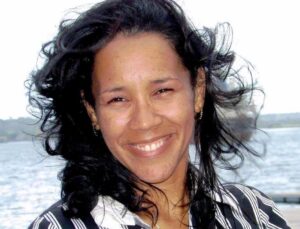
“Feminist activism in Cuba has gradually and organically developed in recent years, especially on social media. Through these platforms, we receive reports of femicides to investigate, but they also help us stay connected from various cities worldwide. Cuba is no longer an island; it’s transnational. In every respect, including activism, we must overcome the divide between ‘inside Cuba’ and ‘outside Cuba,’ especially given the recent waves of migration and exile.”
For her part, Marthadela Tamayo believes feminist activism should not only focus on the government’s attacks but also on the broader political violence women in Cuba face, regardless of whether they identify as feminists.
“We must also denounce the political violence inflicted on human rights defenders, political prisoners, independent journalists, and all women who decide to engage in public life in the country. Women who have gained spaces are punished for it,” she says. Tamayo herself is a frequent target of the regime’s direct attacks. In 2013, she was expelled from her teaching position for holding political ideas contrary to those promoted by the government. Since 2017, she has been subjected to a “regulation,” a term used in Cuba to describe arbitrary travel bans. Over the past three years, Tamayo has endured house arrests, internet outages, and mobile phone service cuts due to her political and feminist activism.
“Comprehensive Law Against Gender Violence Now!”
As in other parts of the world, feminist activism in Cuba has increased its social impact, doing so against the current of the state and with very few resources. One of its most defining and challenging efforts is the work of gender observatories, where collaborators often must operate outside the country.
These observatories base their work on constant tracking of reports on social media or accounts of femicides in Cuba’s independent press. A case file is opened for each suspected incident, which is only confirmed after at least three direct sources verify it. Data is then gathered on aspects such as the weapon used, the crime’s date and location, whether prior harassment complaints existed, and whether the perpetrator had any connection to the victim or a criminal record, restraining order, or police warning.
“This information shows how the country’s police and judicial institutions are functioning. The results are alarming, which is why we’ve made three calls to declare a state of emergency over gender violence in Cuba. The figures we gather are only a subset, so it’s likely there are many cases we haven’t reached,” explains Núñez.
Although these figures do not offer the full scope of reality, registered femicides in Cuba have increased over the last year, as has the organizational capacity of feminist activists and the Gender Observatory of YoSíTeCreoEnCuba and OGAT. This correlation inevitably raises the possibility of a causal relationship. Are more femicides being committed in Cuba, or are independent gender observatories confirming cases that were previously invisible?
Elena Larrinaga finds this question difficult to answer but believes both phenomena likely overlap. Yanelys Núñez, on the other hand, refrains from offering a definitive answer, pointing out the lack of a database tracking femicides before 2019.
“But I think the rise in femicides is partly due to increased violence on the island’s streets and the regime’s severe economic and political crisis. Additionally, with institutions showing indifference, women are more unprotected. All these factors are connected and influence why we’ve recorded more than twice as many cases of femicides in 2022 than the previous year.”
Núñez also emphasizes the undeniable work of Cuban feminists—not just in documenting femicides but also in their social and communication efforts, which have helped people begin to name the phenomenon and report it more frequently. Despite these significant achievements, independent gender observatories still lack resources and maintain a limited network of collaborators. Their efforts, while substantial, remain insufficient to address this problem. Thus, the primary demand of the Cuban feminist movement is comprehensive and effective legal backing from the state: in other words, a Comprehensive Law Against Gender Violence.
In February 2023, the Red Femenina de Cuba released a statement advocating for a “new legal framework” and a Comprehensive Law Against Gender Violence. The text noted that the existing Penal Code was insufficient to address the rise in femicide cases, urging the creation of a legal framework that not only eliminates impunity for manifestations of gender violence but also guarantees “the highest level of protection for victims and their families.”
Just three months later, as authorities boasted about their “achievements” in gender matters by publicizing the 18 sentences handed down to femicide perpetrators in 2022,
YoSíTeCreoEnCuba and the Alas Tensas magazine issued a joint statement. They accused the government of exploiting the femicide issue to promote “punitive populism” and applying “exemplary punishments” to evade its responsibilities regarding prevention, reparation, and guarantees of non-repetition. The statement reiterated several of the Cuban feminist movement’s demands: the classification of femicide as a specific crime, the legalization of activism, and the creation of a Comprehensive Law Against Gender Violence. This year, several activists from the LGBTQ+ community joined this call, also requesting the creation of comprehensive Gender Identity legislation in Parliament. As on previous occasions, the Cuban state ignored these demands.
The insistence on a Comprehensive Law Against Gender Violence stems from the belief that such legislation would lay the groundwork for creating a statistical system that shows real numbers, as well as the causes and context of each femicide. It would also implement prevention and victim support protocols, establish shelters for women and their children, provide early and specialized attention to aggressors, and integrate gender and feminist topics into the public education system. Above all, as Elena Larrinaga points out, such a law would compel the state to address its obligations in preventing femicides.
“We repeatedly call for a law like this because it would be legally binding for the government, opening a path to hold public institutions accountable. It’s the only tool that would allow us to make legal claims. But the state has refused to create it, because until now, it has practiced institutional violence with impunity. It cannot undermine its own foundations. The state, ultimately, is the primary perpetrator at all levels.”

* Originally published in El Estornudo magazine, this text has been translated from Spanish by Fiona Baler.