
It’s been over a quarter of a century since one could walk into a supermarket or pharmacy in the U.S. and hear “Chan Chan” or perhaps “El carretero” as background music. The Buena Vista Social Club phenomenon had spread globally with the speed of fire in Tula’s room. The names of Compay Segundo, Ibrahim Ferrer, Eliades Ochoa, and Omara Portuondo suddenly circulated the world alongside Tom Cruise, Julia Roberts, and Bruce Willis. Over eight million records were sold worldwide, and a documentary (1999) by Wim Wenders, of the same title, was extremely successful. In 1998, the group performed at Carnegie Hall before an ecstatic audience. And now, in 2025, Buena Vista Social Club (BVSC) has been resurrected on the Broadway stage as a musical.
Winner of four Tony Awards, the show has been enthusiastically received by critics and audiences. The musical premiered in late March of this year and is scheduled to run until early January 2026. The story is quite simple, with two narrative threads: one about how the project came together, with Juan de Marcos González seeking out the musicians and singers, and the second tracing the life of Omara Portuondo from her adolescence to her participation in Buena Vista Social Club, culminating in the Carnegie Hall performance.
Of course, in a show of just over two hours, the producers had to simplify, so characters like Compay Segundo (1907-2003), Omara Portuondo (1930), Ibrahim Ferrer (1927-2005), Eliades Ochoa (1946), and Rubén González (1919-2003) appear, but Pío Leyva (1917-2005), Manuel “Puntillita” Licea (1927-2000), Barbarito Torres (1956), Cachaíto López (1933-2009), as well as Ry Cooder (1947) and his son Joachim (1978), do not. These absences do not significantly alter the plot. Where there is a notable change is in the emphasis on the figure of Omara Portuondo, one of the few from the original group still alive, along with Eliades Ochoa and Barbarito Torres. (The trumpeter Manuel “Guajiro” Mirabal passed away last year; 1933-2024).
Omara is the protagonist of the show, which was not the case on the first album, where she only appeared on one track, “Veinte años,” accompanied by Compay Segundo, on backing vocals. She was recording on the second floor of the EGREM studios and was spotted by chance, then invited to participate. She had to travel to Europe that night and, therefore, recorded only one number. The musical begins with Juan de Marcos González trying to convince Omara to join his project, which aims to bring together Cuban musicians and singers to record for Nick Gold’s label, with Ry Cooder as producer. Juan de Marcos praises her, lavishes her with compliments, but she rejects him, though intrigued. Then, little by little, Omara approaches and joins the recording project.
The cast of the Buena Vista Social Club musical is first-rate, and the actress-singer who played Omara Portuondo, Natalie Venetia Belcon, from Trinidad and Tobago, won a Tony Award for her portrayal of the great diva of filin. As an actress, Belcon is excellent; she has a stage presence that exudes an unmistakable power. Her movements and gestures emanate charisma. Before taking on the role of Omara, she did not speak Spanish (let alone Cuban Spanish), so she needed the help of a voice coach to pronounce the lyrics of the songs properly. She did quite well, but there were moments when it wasn’t easy to understand the words she was singing. The singer who played the young Omara, the Puerto Rican Tanairi Sade Vázquez, had better enunciation and, according to some, a better voice. Belcon has a beautiful and resonant voice, but very different from Portuondo’s: it is powerful and projects well to the audience, but it lacks the sweetness of Portuondo’s voice, it doesn’t caress the words with the same finesse, nor does it capture the languor and yearning of the boleros with the same precision as the Cuban singer. In a musical like this, it is difficult to find the right person for the lead role: they must be equal parts actress and singer, and they also have to deliver the dialogue in English but sing the songs in Spanish. I don’t want to engage in fatuous nationalism, but many Cuban (or Puerto Rican) singers could have been selected for the role of Omara. Even with these reservations, Belcon stood out as Omara. Her performance was praiseworthy.
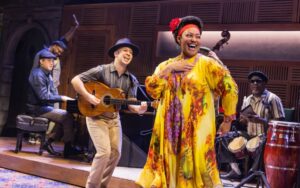
The actor-singers who portrayed Compay Segundo, Ibrahim Ferrer, and Rubén González were well-executed, and the one who played Eliades Ochoa was outstanding. Born in Santiago de Cuba, Ochoa was portrayed by the renowned tresero Renesito Avich. The start of the second act began with “El cuarto de Tula,” and Avich performed a tres solo that left the audience speechless. (We could see this tres virtuosity as an indirect tribute to Barbarito Torres, who did similar things when he played the lute behind his back at concerts). In the first act, the musician who shone was Henry Paz, with his extraordinary flute work during “Candela,” by the great troubadour Faustino Oramas, El Guayabero. The ten-member band was of regal quality: alongside Avich and Paz were David Oquendo (guitar), Jesús Ricardo (trumpet), Leonardo Reyna (piano), three percussionists (Mauricio Herrera, Román Díaz, Javier Díaz), Gustavo Schartz (bass), and Eddie Venegas (trombone): all Cuban except for Schartz (Argentinian) and Venegas (Venezuelan).
The dances and choreography of the musical also won a Tony for Best Choreography, designed by the married couple Patricia Delgado and Justin Peck, both dancers and choreographers, she with the Miami City Ballet and he with the New York City Ballet. The choreography was a mix of modern salsa movements, with touches of classical ballet and contemporary ballet. During “Bruca Maniguá,” they incorporated movements from a dance for Oggún. We could say, with its mix of styles, that the choreography was postmodern. There were moments when the (choreographic) action was too busy and overloaded, with a hustle that sometimes overwhelmed. Still, the dances were very well-executed and highly dynamic, though at times too polished.
Why Buena Vista Again?
In our Latin American cultures, the dead speak to us, and undoubtedly, BVSC is a conversation with the dead. Manuel “Puntillita” Licea, Rubén González, Compay Segundo, Ibrahim Ferrer, Pío Leyva, Orlando “Cachaíto” López, and Manuel “Guajiro” Mirabal have already left us. The miracle that Juan de Marcos González conjured by carrying out the BVSC project, in collaboration with Nick Gold and Ry Cooder, was that of revitalizing a music of yesteryear, but, equally, giving Cuban music a global profile.
We should remember that in the ‘90s, outside of Cuba, two phenomena similar to BVSC occurred: the “rediscovery” of Israel López “Cachao” (1918-2008), driven by Andy García, and a renewed boost to Bebo Valdés’s (1918-2013) career, supported by Paquito D’Rivera. It’s not surprising that on the Buena Vista Social Club album, there are two compositions by Cachao, “Pueblo Nuevo” (1946) and “Buena Vista Social Club” (composed in the ‘40s, recorded in 1958). They are the only instrumentals on the album, and both are danzones.
Juan de Marcos González, the project coordinator and former director of the Sierra Maestra ensemble, explains that there were antecedents that paved the way for BVSC. In 1992, El Guayabero toured Spain, where he was acclaimed. The following year, there was an Encuentro con el Son (Encounter with Son) in Madrid, which featured Celeste Mendoza. In 1994, the initiative Encuentro del Son y el Flamenco (Encounter of Son and Flamenco) was launched (in Seville), with the participation of Compay Segundo and El Guayabero. The following year, the label Nube Negra released an anthology of songs by Compay Segundo and another by Vieja Trova Santiaguera, a band that recorded two more albums with Nube Negra and then three with Virgin Records (1995-2002). Celina González and Eliades Ochoa toured the United Kingdom. The group Sierra Maestra participated in many European clubs or festivals, sparking interest in son and música guajira. Seeing all these events favorable to the dissemination of Cuban music, Juan de Marcos González approached Nick Gold, who had founded the World Circuit Records label, and proposed to him what would become BVSC.
But even in the eighties, various Cuban groups toured the United Kingdom, such as Los Muñequitos de Matanzas, Síntesis, or Carlos Embale with the Septeto Nacional. The Orquesta Revé played at the WOMAD festival (which has celebrated global music and dance since 1982) in 1989. The queen of música guajira, Celina González, had recorded with Nick Gold’s label (Fiesta Guajira, 1987) and, in 1988, gave successful concerts throughout England. In an interview, Nick Gold said he wanted to hire Celina for BVSC, but she cast the cowrie shells (caracoles) and they told her no. Even when they had already gathered many of the musicians to begin the recording, they invited Celina again, and again she consulted the diloggún, and the answer was negative. So Omara Portuondo’s international fame, starting with BVSC, is due to the orishas.
The BVSC project did not emerge in a vacuum within the production and/or distribution of Cuban music. In the nineties and around the time of Buena Vista (i.e., 1996-1999), a good amount of recorded Cuban music was circulating abroad: David Calzado y la Charanga Habanera (Me sube la fiebre), Tata Güines and Miguel Angá (Pasaporte), Jorge Alemañy y Cubanísimo (Cubanísimo and Malembe), Los Van Van (Lo último en vivo, ¡Ampárame! and several others), Los Muñequitos de Matanzas (Congo Yambumba, Vacunao, Ito Eban Echu), Cuban Percussion Kings I (featuring Los Papines, Pello el Afrokán, Carlos Embale), la Orquesta Original de Manzanillo (Original y sin copia), and NG La Banda (Best of NG La Banda). Adalberto Álvarez y su Son recorded ten albums during the nineties. Bebo Valdés himself released three titles between 1994 and 1999, not to mention his collaborations with Diego El Cigala later on. The group Irakere, led by Chucho Valdés, recorded nine albums in the nineties, in addition to touring the U.S., Europe, and Latin America. Between 1995 and 1999, five compact discs of Ernesto Lecuona’s piano music, performed by the American pianist Thomas Tirino, were also released, comprising over 130 pieces. During these years, there was also a surge of interest in sacred music, particularly Yoruba chants, manifested by Grupo Síntesis (Ancestros I, 1992; II, 1993, and III, 2003) and Lázaro Ros (Olorún, among others). So BVSC had to make its way amidst a wealth of dance music, Cuban jazz, Lecuona, and the Afro-religious world. Incredibly, it did and triumphed.
So why not Los Van Van or NG, why not Irakere or Los Muñequitos? The truth is, there is no simple answer, and nostalgia doesn’t fully explain it either. For Cubans of my generation, nostalgia does play an important role in the success of BVSC: it is a way to reconnect with the past (as a child, adolescent, or adult) and our culture. Hearing “Lágrimas negras” transports you to the world of your grandparents, your parents, your uncles and aunts. But for people outside of Cuba, especially Americans, nostalgically reviving the past with the songs of BVSC implies being over fifty, and we know that BVSC was very popular among young people.
Cuba was an ideal tourist destination during the 20th century, and Cuban music had certain waves of popularity in the United States before 1959. In the thirties, the U.S. experienced a rhumba craze (yes, with an ‘h’) that followed the popularity of “El manisero,” and later the mambo launched by Pérez Prado, and, starting in 1954, a boom in the cha-cha-chá. None of these genres features on the original BVSC album. (Perhaps for some listeners, the boleros sung by Nat King Cole in Spanish contributed to forming a certain gringo nostalgia. Cole’s three albums in Spanish –1958, 1959, 1962– sold well in the U.S. and Latin America.) There is no doubt that boleros are an excellent vehicle for nostalgia.
The musical took certain liberties, but I will limit myself to pointing out two. First, one of the narrative threads is the career of Omara Portuondo, which shows a romantic relationship between her and Ibrahim Ferrer. Although there are rumors about this affair in real life, it is openly portrayed in the musical. In terms of structuring the show’s libretto, it makes sense and pairs well with songs like “Veinte años,” “Dos gardenias,” “Murmullo,” “Silencio,” and, of course, “Lágrimas negras.” What is most significant is that Omara and Ibrahim maintained a deep friendship throughout their lives. In Wenders’ film, Ferrer is more prominent: Ibrahim appears in a couple of scenes with his wife, and there is no mention of any romantic relationships with Omara. The film shows Ibrahim’s simplicity and humility; furthermore, the scene of him talking about his Lázaro, dressed in white, is astonishing and of an unforgettable tenderness.
The other case is that of Rubén González. In the musical, he is presented as someone who has almost completely lost his memory; there is even a scene where Omara comes on stage and Rubén doesn’t recognize her. We know that during the production of the album, Rubén was quite lucid—although he had his memory lapses—and in the film (shot in 1998 and early 1999), he appears coherent. Wenders films Rubén talking about his life surrounded by extraordinary trees that not only have an enormous physical presence but also emanate a spiritual power.
When the film Buena Vista Social Club was released in 1999, there was criticism that Wenders’ vision was Eurocentric, that it gave excessive prominence to Ry Cooder, and that it contributed to the fascination with the physical deterioration of Havana that has launched the careers of so many “ruinologists,” not to mention the obsession—especially among photographers—with the famous almendrones (old American cars) that circulate through the streets of the capital. The album’s cover photo underscores this obsession: on the left, Ibrahim Ferrer walks with his white cap, smoking; on the right, on the other side of the street, two almendrones. In the background, buildings in poor condition are camouflaged by shadows. The back cover of the album shows an almendrón parked on the street.
On the positive side, Wenders’ film is a portrait of a city in time. Despite the repeated metaphor that Havana seems like a city frozen in time, the German director captures, through the use of light, tracking shots, and circular takes, something magical, something new. It is the new emerging from the old, from a tradition that is “rescued” but which had never completely disappeared. For example, the most emblematic song on the album, “Chan Chan,” although based on a memory from his youth, was written by Compay Segundo in 1984. Interestingly, the musical does not open with “Chan Chan” (it’s the first track on the album); instead, it is played in the second act, after “El cuarto de Tula” and “La negra Tomasa.”
Barbarito Torres reminds us that the musicians of BVSC were not in a state of abandonment, to paraphrase a line from “Lágrimas negras.” The lute player from Matanzas says, “When people see the BVSC film, they think the musicians on screen had been forgotten in their own country. No one here had been forgotten. The only one who had retired was Pío Leyva. Those who hadn’t retired were touring. Compay Segundo was about to become fashionable again.” Barbarito’s words need a slight correction: it seems that Ibrahim Ferrer and Rubén González were “retired” because they weren’t being hired; for a musician, that constitutes a form of being forgotten. Barbarito has an anecdote that perfectly expresses the fortunate chance of BVSC. Ry Cooder, the producer, had traveled to Cuba in the seventies and was very impressed by Cuban music. On that trip, someone gave him a cassette of música guajira that included the lute. When he returned for the Buena Vista project and met Barbarito Torres, he handed him the tape and said, “Listen to this, I want you to play the lute like this musician.” Barbarito takes it home and, upon listening, realizes it’s a recording of himself. The next day, he replies to Ry Cooder: “Ry, I can easily play like that musician—that’s me!”
Regarding social and historical themes, the musical touches on issues of race and alludes to Batista’s defeat, but without mentioning him. When presenting the Buena Vista social club in Marianao, emphasis is placed on it being a social club for Black people, letting it be known that there was discrimination and certain racial segregation in republican Cuba. (Remember that Nat King Cole, when he traveled to Cuba, wanted to stay at the Hotel Nacional and was denied lodging there.) Even Omara’s sister, Haydée, tells her that the people who gather at the club “are not our kind of people,” with which Omara disagrees. The show features the song “Bruca Maniguá” by Arsenio Rodríguez in each of its two acts. The song does not appear on the original album, but two years later on Buena Vista Social Club Presents Ibrahim Ferrer (1999); such is the case with two other songs in the musical, “Qué bueno baila usted” by Benny Moré and “Silencio” by Rafael Hernández. “Bruca Maniguá” begins like this: “Yo son carabalí / negro de nación / Sin la libertad / no pue’o viví” (I am Carabalí / Black by nation / Without freedom / I cannot live). It continues with a reference to mundele (the white man in Kikongo), who breaks his heart and mistreats him. The chorus repeats at different times “Yényere Bruca Maniguá” or “Aé Chéchere Bruca Maniguá.” Yényere is the word to open the sacred room in Palo ceremonies. Bruca was a term used by slaves from Guinea, meaning “something bad.” Some scholars argue it is a bozal term meaning sorcerer. Maniguá is a variant of manigua (in Spanish, meaning wilderness). Chéchere is an amulet containing soil from the wilderness. The refrain is thus a spell against evil (exploitation, mistreatment), but also a form of protection (the wilderness, the amulet). Of course, for an American audience, all these words are incomprehensible, although another character at least repeats in spoken form “sin la libertad no puedo vivir” (without freedom I cannot live), which indicates at least the general meaning of the song.
The work superficially presents the changes of the late fifties that led to the Fidelista regime. Political instability (and the danger of violence) is what makes Omara’s sister, Haydée, leave for the United States. In the real world, the sisters were on tour in the U.S. during the October Crisis (Cuban Missile Crisis), and Haydée decided to stay while Omara returned to Cuba, where she still lives, at 94 years old. Later, alluding to the migratory dilemmas of Cubans, the character of Compay Segundo says, “Cuba was a country of many types of people: teachers, masons, doctors, workers, and office clerks. Now it is a country of two types of people: those who leave and those who stay.” Although the work grazes certain historical or political themes, it does so in a way that aims not to offend anyone’s sensibilities. Batista and his dictatorship are not mentioned, nor are Fidel Castro and his regime. José Martí is also not mentioned, who is one of the few historical figures loved equally by Cubans of all stripes.
The other element that is largely displaced in the Broadway show is the Special Period. When Cooder, his son, and Nick Gold arrived in Cuba to begin the recordings, the island was still suffering from the constant blackouts and lack of food, clothing, and medicine that would be the norm of those times (and, unfortunately, of these times as well). It wasn’t 1993 or 1994, terrible years as the hardships suffered by the population hit rock bottom, but they were still difficult times. Ibrahim Ferrer alludes to these difficulties a couple of times in the film, and Wenders’ camera at least shows us the streets (and houses) of Havana. Towards the end of the film, “Chan Chan” is played (the encore of the Carnegie Hall concert), and Wenders selects images of Havana and its people. On one wall, we read “This revolution is eternal,” and, a little later, on another wall, the words “We believe in dreams.” The contrast between what we see and what is written on the walls is remarkable, and yet, Compay Segundo’s music prevails.
It seems I keep avoiding the question of “why Buena Vista and why now?” The charm of BVSC, on one hand, is obvious in terms of the extraordinary and, in many cases, danceable music. The BVSC project consists of three albums, all released months apart in 1997: A toda Cuba le gusta, Buena Vista Social Club, and Introducing Rubén González. The first features many of the Buena Vista artists, but the group is under the name Afro-Cuban All Stars. Among the singers are Ibrahim Ferrer, Pío Leyva, and “Puntillita” Licea, but also Raúl Planas and Félix Baloy, two extraordinary voices of popular and dance music. Also present are Rubén González (piano), Cachaíto (bass), Carlos González (bongos), Alberto Virgilio Valdés (maracas), and Guajiro Mirabal (trumpet). As special guests (on one song each), Ry Cooder, Richard Egües, the great flutist from Aragón, and Barbarito Torres. Except for Compay Segundo and Omara Portuondo, the main group of artists is there. A toda Cuba le gusta, with its thirteen musicians, has a broad, big band-like sound, and has memorable songs like “Alto Songo,” “Fiesta de la rumba,” “Los Sitios, asere,” “María Caracoles,” and “Elube Changó,” a composition by Juan de Marcos González. In terms of dance music, this album has the perfect songs for rumbear; this is not to say that the second one (Buena Vista Social Club) can’t be danced to, but as it contains several boleros and a couple of danzones, it has a different character. The third one features Rubén, along with musicians from the previous two (the group is an octet), and has three backing vocalists, but no lead vocals. Most of the compositions are instrumental and include famous songs like “La Engañadora,” a couple of danzones (“Tres lindas cubanas” and “Almendra”), “Siboney,” and three of his own melodies (“Tumbao,” “Melodía del río,” and “Como siento yo”). The third album showcases the great mastery of Rubén González on the keyboard: in short, colossal, to quote Enrique Jorrín. Each album has its own character; the first has a more Habanero sound, the second, more Oriental (referring to the east of Cuba), and the third, a kind of musical tour of Cuba through the piano. The first album is for dancing until dawn, the second until midnight, the third is more for accompanying a Sunday family gathering that starts in the afternoon but could extend into the early evening.
So, why did the second part of the trilogy hit? I think the música guajira sound exerted a very attractive aspect for the public. I also believe the combination of guarachas, sones, danzones, boleros, and música guajira gave it a balance of genres that provided a good sample of Cuban music. Third, it had four incredibly catchy songs: “Chan Chan,” “El cuarto de Tula,” “Candela,” and “El carretero.” Also, the voices of Ibrahim Ferrer, Compay Segundo, “Puntillita,” Eliades Ochoa, and Omara Portuondo contributed to giving it a special and varied sound. And finally, Wenders’ film gave BVSC a second wind, along with the release of Ibrahim Ferrer’s album, also from 1999.
And Now in 2025?
In 2015, as part of its farewell tour, the BVSC performed at Obama’s White House. It was the first group or artist living on the island to perform at the North American presidential residence in fifty years. (Exiled artists like Gloria Estefan, Willy Chirino, and Arturo Sandoval have played at the White House, as has Paquito D’Rivera, along with Wynton Marsalis and the Jazz at Lincoln Center Orchestra.) Many saw this moment as the culmination of Cuban music as a diplomatic instrument, at a juncture where the Obama Administration reestablished diplomatic relations with the Cuban regime. Incredibly, those relations still exist, despite the hardline policies of Trump. During his second presidency, Cubans have been deported, and obtaining visas has become much more difficult. We do not know exactly how cultural exchanges between the two countries will develop, but I am not very optimistic about it.
A decade after its brief concert at the White House, the situation is completely different. Resurrecting BVSC is not just a conversation with the dead, but an effort to revive the spirit of optimism palpable during Obama’s presidency, a formidable if not futile task for the time being. Today, the circumstances are dramatically different, and that revival does not have the same force, or proves ineffective: reviving BVSC runs the danger of becoming a simulation à la Baudrillard. The Cuban economy is in a worse state than during the Special Period, the flow of Cubans leaving the country has increased notably, and the entire country seems forgotten by the whole world. Addressing the topic of Cuba or Cuban culture is safe; it doesn’t get in the way, but this context also lacks an element of provocation.
Nearly thirty years after the three recordings that formed BVSC, we can appreciate how important they were for Cuban music, both inside and outside the country. They were able to give us a tasty sample of several genres of popular music like son, guaracha, música guajira, bolero, rumba, danzón, mambo, and cha-cha-chá. But BVSC is not the whole of Cuban music, period, and along with this, we can set aside the endless arguments about authenticity. We have classical and contemporary music ranging from Caturla and Roldán to Brouwer, Fariñas, Gramatges, Tania León, Juan Piñera, and younger figures like Wilma Alba Cal. We have nueva trova (not so new anymore) and novísima trova, hip-hop, reggaeton, ritual music, and Cuban jazz. The latter is a broad world that groups very diverse voices and artistic visions from Chucho Valdés and Gonzalo Rubalcaba to Omar Sosa and Aruán Ortiz. The richness of Cuban music is not limited to certain genres.
My friend, and an excellent collaborator for Rialta, César Salgado, believes that BVSC is an effort on the part of Broadway to engage with Hispanic themes (and undoubtedly to broaden its audience), an area where it has historically had mixed results (Capeman, West Side Story, and In the Heights, for example). When the actress who played Omara was asked about the themes of the show, she said it was about redemption, having second chances in life, and lost loves. Her insistence on universal themes overshadows the profound cubanía of the phenomenon. This is not to say that such themes are not important in BVSC (they are), but significant cultural and historical contexts are lost. Trying to evade contexts always runs the risk of becoming insipid or exotic.
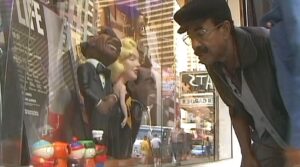
After seeing the Broadway musical, I watched Wim Wenders’ film again. Despite feeling nostalgic and shedding tears (but not black ones) during the show, I left the theater feeling happy and humming the chorus of “El cuarto de Tula.” At the end of Wenders’ film, I was overwhelmed with a deep sadness, not so much for the images of Havana worn down by time and neglect, but because many of the artists I had seen on screen are no longer with us: “Puntillita,” Pío Leyva, Compay, Ibrahim, Cachaíto, Rubén, and “Guajiro.” As enjoyable as it was, what I saw on Broadway was a performance, essentially a simulacrum. In Wenders’ film, Puntillita and Pío Leyva stroll through the streets of New York near Carnegie Hall. They pause to look at items in a souvenir shop window adorned with posters. “Puntillita” points, and the camera shifts to show us bobbleheads of Charlie Chaplin, Laurel and Hardy, the Three Stooges, Marilyn Monroe, Louis Armstrong, and Ray Charles. “Puntillita” tries to jog Pío’s memory when he points to the Armstrong doll, asking who was the greatest trumpeter and who raised his trumpet to the sky, among other things. But Pío remains silent, unresponsive, and “Puntillita” subtly points to another doll, that of Ray Charles. Has the Buena Vista Social Club become a collection of bobblehead dolls, a simulacrum? I’m not sure, but their lives and music still move us with the same slyness, passion, and beauty as almost thirty years ago from the sunny, battered streets of Havana. A phenomenon that continues to astonish us is a testament to the depth, greatness, and mystery of Cuban music.