
The Cuban punk band Porno para Ricardo (PPR) is an experiment in resistance that has survived decades of censorship, exile, and geographical changes. Since its beginnings in the early 2000s, Gorki Águila and Ciro Díaz have kept the band’s essence alive, even while separated by more than 3,800 kilometers, albeit both live in the north of the same continent: Gorki resides in Mexico and Ciro in Canada. Despite the distance, they continue to organize concerts, tours, and creative projects that defy routine.
“The band has always had the characteristic of playing only when we really can,” says Gorki. “We have never disbanded; we simply plan creative activities. Ciro has been a kind of strategist, helping to organize concerts that outmaneuver the repressive machinery in Cuba.”
The upcoming mini-tour of Canada in late October and early November is an example of this flexibility. Toronto and Montreal will be the venues. Since June, when they played at the Metronome Prague Fest, Ciro and Gorki have been working with musicians who have been part of the band over the years and are now in different latitudes.
Internationalist Musicians
At 20 years old, bassist William Retureta requested political asylum in Poland in 2013, after concerts in Prague and Warsaw and two years in the band. He now lives in Prague and works as a photographer, but he plays with the group whenever they are invited to that city, a reference point for PPR in Europe.

Yimel García, another bassist, also decided to stay in Prague this summer after the band played at the Metronome Fest, and is currently seeking asylum. Yimel joined the band when I left in 2017. In 2018, I was forced into exile due to my political activism, and for the past seven years, I have lived in Miami. I was the band’s bassist from 2014 to 2017, and now I will play with them in Canada.
Oscar Pita, the first bassist of Porno Para Ricardo, will also participate in the two concerts in Canada. He is currently a realtor and lives in Kentucky.
Luis David, the first drummer, owner of the dilapidated Río Mar apartment in La Puntilla, where the band rehearsed in its early days in 1998, lives in Canada. Former drummer Renay Kairús also resides in Prague and joined the band for the Metronome festival, a high-profile event featuring major rock artists such as Alanis Morissette and Die Antwoord. So…
The Band Everywhere
Despite the geographical dispersion, the band remains active in international concerts.
“We have a multi-geographical and timeless strategy: we can play with musicians from different eras of the band, who live in different countries, while keeping the main pillars firm. This allows us to adapt and continue connecting with our audience,” explains Ciro. Conscious of this fragmented identity, Ciro has just composed a new song that well defines what we are now: “internationalist” musicians. Not the kind of internationalists that state propaganda imposed on us in hollow speeches, but a different breed, those who survive by traveling with their guitar on their back, those who improvise rehearsals over Zoom, those who cross borders carrying songs instead of slogans.
The dispersion changed us, yes. The ritual of all of us meeting in the same room, adjusting the drums by ear, and rehearsing every Saturday while sharing beers is no longer possible. But, in a way, we are still together, and living in Cuba taught us that—that music is stronger than exile, censorship, or distance.
Rotating Bassists or Multiple Bassists
The issue of the bassists, which is quite curious and seems like a curse, was captured in Ciro’s song, “La de los bajistas,” track 13 of the diptych A mí no me gusta la política pero yo le gusto a ella, compañeros, recorded in Havana in 2008 at La Paja Recold studios. There have been more than six, including myself, throughout the group’s 27 years.
For me, Hebert Domínguez was the best bassist the band has ever had, and, curiously, his departure from Porno Para Ricardo was due to his potential and anticipated abandonment of the group as soon as the band had its first opportunity to travel abroad, which led the Gorki of 2010 to dismiss his preferred musician and send him, literally, to sell guava pastries on the street and to play in salsa orchestras. On the other hand, one must add the excessive and constant harassment and persecution that the political police undertook against him and against his girlfriend at the time, the filmmaker and graphic designer Fabiana Salgado. By one of life’s ironies, Hebert remains on the island, while all the other bassists are outside the country.
Punk in Cuba: Desire, Persecution, and Heresy
Punk, as a subgenre, took almost twenty years to reach Cuba from its origins in 70s England. The list of pioneering bands is short: V.I.H., Eskoria, Rotura, Joker in the 90s; then Akupunktura, Limalla, La Babosa Azul. A handful of names that never managed to consolidate a scene because the state marked them as pariahs and because, culturally, the local audience preferred instrumental virtuosity or the brutality of metal over the minimalist irreverence of punk.
The album Maleconazo Ahora! (2013) functions as a historical document, with 13 songs and testimonies about the popular uprising of August 5, 1994, in Havana. It has been described as “a soundtrack of the post-revolution.” The songs ridicule official symbols and reflect resistance to the codes of power.
With themes full of subversive slogans like “El Maleconazo,” “Yo no trabajo pa’ los Castro,” and even a parodied reggaeton with rappers (“Este año sí se cae”), Maleconazo Ahora! is a manifesto, a sonic arsenal for the liberation of repressed energy, where one hears the voices of opposition artists like El Sexto, David D’Omni, or less well-known rappers, and also of anonymous citizens. The songs ridicule official symbols—CDR murals, proletarian cooking pots, slogans painted on walls—with the mordacity of those who know that subverting the codes of power is another form of resistance.
“We show Cuban music from another perspective, with authenticity and real experience,” says Gorki. “Singing from what we live is different from doing it from a place of privilege; every word has a profound meaning and denounces what is happening in Cuba.”
Ciro reflects on the influence of international music and his eclectic approach: “I don’t even consciously consider myself punk, nor have I been, nor am I one. But I am drawn to the physical energy of punk and post-punk: the drums, the theatricality, the guitar, the voice. That violence and creativity are what keep rock and roll from ever dying. It reforms itself and integrates into new movements.”
Censorship, Creativity, and Survival
In Cuba, censorship was part of the routine. “Any opinion contrary to the official discourse made you look like a lunatic. Even friends would warn you of the risk,” says Gorki. “But that forced us to develop creativity to survive: mincemeat made from plantain peels, condom pizza, absurd inventions to get by. Being anti-communist implies defending freedom totally and constantly.”

Anecdotes abound. “There was a guy in the park at G and 23rd, correcting one of my songs right in front of me, and he even took my guitar from me to tell me that wasn’t how it went,” recalls Ciro. There are rumors that Silvio Rodríguez privately admitted liking Gorki’s song Trova con Distortion. Some students from the EICTV in San Antonio de los Baños assured me the band couldn’t be Cuban.
Rock and Roll, Humor, and Resistance
On the relationship with followers and haters, Ciro says: “At concerts, even those who hate us end up acknowledging the energy of our music. Some even pay the entrance fee just to hate us, but there they are, listening.”
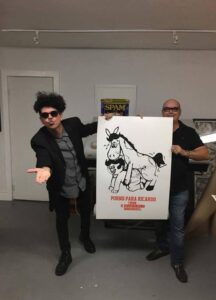
Humor and social criticism are part of the band’s identity. Gorki, a professional poster artist, depicts the horse Palmiche sodomizing Elpidio Valdés in one of the band’s emblematic posters. “Some purists said it was ruining the childhood of Cubans, but it’s part of our way of reflecting reality with humor,” he says. Gorki is 56 years old, born in 1968. Ciro says he is ten years younger, although he clarifies, “This guy [Gorki] ended up with all my hair. He’s a succubus; he absorbs the energy from your scalp and transfers it to himself.” To which Gorki replies: “Or maybe it was Porno para Ricardo, which first gave you gray hairs and then took your hair away.”
On the music industry and the influence of other artists, Gorki remembers his father: “‘Why don’t you make different music? Nobody likes that, right?’ he would ask me. I showed him pictures of Led Zeppelin or Peter Frampton and said, ‘Rock and roll is super profitable, and it’s not going to stop being that way.’ When we got paid for Habana Blues, he told me, ‘Now I will believe in you.’ That support was fundamental.”


On the music they consume and how it influences their creativity, Gorki says: “I listen to everything that comes my way, without rigidity. Some things are interesting, and others leave a lot to be desired, but it all forms part of the influence.” Ciro adds, “The classics don’t need new music to be influential. I’ve always been eclectic and don’t limit myself to specific genres. Rock and roll always has an answer for something, that’s why it never dies. It reforms itself and integrates into new movements.”
Documenting Porno Para Ricardo
Recently, in one of Ciro’s many posts promoting the upcoming concerts, someone said they would like to see the band’s history documented, which suggests that many people don’t know about the existence of some documentaries about the group. The film La Historia me Eyaculará, by filmmaker Ángelo del Castillo, remained unreleased for 15 years, from its completion in 2011 until about three weeks ago, when I uploaded it to my YouTube channel. Before, I could only find a trailer on the (mostly inaccessible) channel of Claudia Cadelo, who was Ciro’s girlfriend at the time. After searching everywhere, I found it in my archives, among old materials and clips of Porno. It had survived on a hard drive I had left in Miami during one of my trips before living here, when I finished Mínimo Gorki, which has a story of its own.
The band disagreed with some of the comparisons suggested in the documentary, including those with the rap duo Los Aldeanos, with whom they had done a feature on La Política in 2010, and with statements by the interviewee, Juanito Camacho, who implied the band was no longer active, right at its peak. Nevertheless, its testimonies and overall proposal, well framed within the history of a generation, end up being more valuable because it is one of the few documentaries made about the band to date.
When I published the documentary on my YouTube channel, which I accompanied with a brief interview with Humberto Manduley, author of Parche, Enciclopedia del Rock en Cuba, Ángelo watched it again and wrote: “In 2010, at just 21 years old, I set out to make a documentary about Porno Para Ricardo, the most uncomfortable and outspoken Cuban punk band of all. I thought I had lost this material, but no; here it is. I was young, camera in hand, with more desire than experience, but with the conviction that their music and attitude had to be recorded. A piece of my life where I learned that punk isn’t recorded, it’s lived.”
In chronological order, next would come Mínimo Gorki, a documentary I started following an exchange with the New York Film Academy, which was later threatened in Cuba for its contact with me, among other reasons. The original material was lost during the search-and-seizure raid by State Security on the El Círculo house-gallery, although later a copy of a preliminary edit appeared, just a rough sketch of what I wanted to do, which my sister Lizabel Mónica had saved on a flash drive. Mínimo Gorki had its official premiere during the #00Bienal de La Habana in May 2018 at the headquarters of the Instituto de Artivismo Hannah Arendt (INSTAR), in Tania Bruguera’s home. Later, in 2023, it was screened at FIU and at The City College of New York.
The concerts in Czechia in 2025 will be part of a documentary directed by Hana Jakrlova, who had already begun Música o Muerte in 2017. Hana followed Gorki’s life until his definitive departure from Cuba in 2024, a moment featured in the material’s second trailer. “It was an adventure,” says Gorki of the band’s reunion in Europe. “Getting together there, seeing how we’ve changed, putting together setlists in a limited time… It was an important moment for our self-esteem and for reconnecting with international fans.”
Hana also filmed the band for the documentary An Unfinished Dialogue between Václav Havel and Oswaldo Payá (2016) by Martin Palous. This material gathers interviews with Rosa María Payá, Orlando Luis Pardo Lazo, Porno Para Ricardo, and Arturo Sandoval, and interweaves their voices with the memory of Václav Havel to reflect on the Cuban dictatorship and the need for new generations of Cubans to look beyond borders to imagine a future different from the one imposed by Castroism.
Forced Exile in Mexico, June 2024
In statements to the press when he left Cuba, Gorki said: “I have never chosen exile. The Castroist hyenas, under coercion, tore me from my land, but not from my roots. For over a year, the repression and police harassment intensified: warning letters, threats of jail for what I publish on Facebook or for my artistic expressions, prohibitions on playing live, and on having an audience. Basically, it’s isolation, coercion, threat, and suffocation to make me leave the country. And yet, it is not even remotely within my plans to renounce my rights: one thing is what the Castroist hyenas think, and another is what I think as a libertarian. It has never crossed my mind to renounce what I consider my rights, even though I am threatened with prison and perhaps with other things.
“What will become of Porno para Ricardo? For me, it is very clear: it will exist until I die. It is part of the dynamic of my life; I can no longer abandon it. There, I have sacrificed and also reaped tremendous fruits. Recently, someone told me that even after my death, the band might continue, and for me, that was one of the greatest compliments an artist can receive. For me, that is a Grammy.”
The visuals for Porno Para Ricardo’s clips were marked at one point by photographer Claudio Fuentes in “Libertad para Danilo,” “Un Día para Cuba” (for the #YoTambiénExijo performance by Tania Bruguera, 2014) or “Lacras Tribuneras” (2017), though always curated by Gorki, who contributes each of the elements to convey his transparent anti-Castrist message, without double meanings.
In the description for “Los cabrones” (2023), from the latest demo tape Se plastican Pasaportes, Gorki writes: “The track, with its exquisite and elevated lyrical poetry, grazes the harsh subject that introduces us to the intricate world inhabited by the bunch of shameless dicks who, in an opportunistic and demagogic manner, adopt the issue of Cuba’s freedom as a lifestyle to keep on taking advantage of people and with everything soft they still have on their backside… Another achievement of the song is that, in a direct and in-your-face manner, it throws its message at you, which leaves no space for those accustomed to reading the metatext and the meta-mess between the lines. It only has what it says, and nothing more… what more do you want?! Guajacones, to the shore.”
“The Castros are a cancer,” says Gorki, “but there are many gullible people playing marbles with the devil, many people distracted by demagogic speeches, many people also making a living off the freedom issue. Cuba is something truly very shameful. And the crackling isn’t pork meat, gentleman. Down with communism!”


The visual style of independent film director Miguel Coyula also appears in Porno Para Ricardo’s imagery: “Adónde está la libertad” (2022), a song by Pappo’s Blues (Argentina), and in his own film Corazón Azul, where Gorki is perhaps a character in the story and appears singing his song “La libertad,” emphasizing the last line: “Everyone in the same cell.”
The Final Vaccination Tour
The two concerts in Canada are scheduled for October 30 in Toronto and November 1 in Montreal, accompanied by the Cuban band AdictoX. Gorki defines this tour as the “vaccination tour against communism”: concerts destined to transmit a message of freedom and resistance, while maintaining the creativity and essence of Porno Para Ricardo. “Concerts to prevent the disease and remove it from those who already have it. We don’t just play music; we deliver a clear message: freedom and resistance, with fun included,” says Gorki.
Tickets have been on sale for two months, and if purchased in advance, the proceeds will help finalize production details and pay for my travel and Gorki’s. Fortunately, Canada granted him a multiple-entry visa; the United States recently denied him one, even though the musician has visited the country more than ten times, and his wife, daughter, and grandson live here. On the other hand, there have been increasing reports of entries via parole by several figures close to the Cuban regime in recent years, even during Trump’s second administration, following the border closure and the persecution of immigrants.
Gorki summarizes the band’s philosophy: “Rock and roll, fun, and anti-Castrism. Let’s continue with music against everything wrong. Let’s make money, have good barbecues, lots of meat, and above all: let’s keep alive the passion for playing and for being free.”
* Many of the quotes in this article are from the live conversation that took place on Instagram on July 18, 2025, as part of the podcast El kiosko del rock, hosted from Caracas by Ernesto Cuerdas Duras, a member of the Venezuelan protest punk band Agente Extraño, who paid tribute to Porno Para Ricardo in 2022 alongside the organizations Provea and CADAL. Ciro also wants to credit his three sponsors to date: Dr. Roger Avila, Yanel Raúl Nieves González, and Miguel Ángel Fernández. In gratitude for them, Gorki has created three personalized posters. You can find Porno Para Ricardo on BandCamp, Spotify, Apple Music, YouTube, Instagram, and Facebook.