When he left the Mar Verde prison this Monday, October 13th, 2025, heading to the international airport in Santiago de Cuba, José Daniel Ferrer, leader of the Patriotic Union of Cuba (UNPACU) and one of the most prominent political prisoners on the island, had finally decided to break “that vicious cycle” he described in an interview for El Estornudo: “they jail you, torture you, pressure you to leave the country; they make you sick, cause you all kinds of problems, beat your family, threaten to evict them from their home,” he said after his release in January of this year (as part of a group of, supposedly, 553 prisoners), thanks to the efforts of Pope Francis and the outgoing US administration of Joe Biden. “Then the Church mediates again, a Democratic administration asks them for something in exchange for removing a measure or punishment, and they free those who never should have been imprisoned.”
Ferrer was back in jail again in late April. For a few months, his house in the Altamira neighborhood had once again become not only a hub of opposition activity in Eastern Cuba, but, primarily, a place where dozens of destitute Santiago residents found a hot meal every day.
Regarding the possibility of going into exile, he had said in January: “I have never contemplated that, nor will I. And I confess: I love my family, I love life too much, my children, my grandchildren, my mother, my wife, and I had never thought about suicide, but in prison I went through a situation and I believed my physical and mental health were deteriorating in an extremely rapid way. I had intense headaches, felt a deafening ringing in my ears that wouldn’t let me sleep, and I even had hallucinations for the first time in my life. I think they drugged me during that time with some kind of substance, because there is no other explanation. So, I considered suicide before surrender. They kept telling me that if I agreed to leave the country, the situation would be resolved and I would be freed. But I told them, my wife, and my family: before surrendering, I will resort to what I have never thought of doing; I prefer to take my own life before renouncing my struggle.”
At a certain point, once again behind bars in Mar Verde—where he stated he refused to wear the mandatory uniform of a common prisoner—, at 55 years old and with his health already affected, José Daniel Ferrer must have understood that, for him, strictly speaking, the path of exile taken by so many Cubans in recent decades was not an option, but rather, if anything, an even harsher and more peremptory variant of it, the one proposed by his captors, whose only alternative was to languish in a dungeon indefinitely. That is to say: banishment.
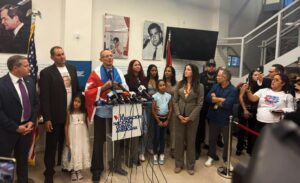
“I never thought I would leave Cuba, but I never thought the regime would last until now,” he said at a press conference, flanked by his family (whom he had not seen until the moment of boarding the plane in Santiago), after landing in Miami around noon the day after he was released.
On the other hand, Ferrer now seems convinced that his departure from the island does not necessarily mean giving up his fight. “My intention upon arriving here is to continue making my modest contribution to the pursuit of greater unity and effectiveness both inside and outside the country,” he said. “The regime must be cornered, the tyranny must be backed into a corner, the political police should not sleep a moment.”
At the headquarters of the Cuban American National Foundation (CANF), he was received as the Bayamo Anthem was sung. Ferrer—his brother to his right; his wife and daughters to his left—then stated he had “mixed feelings” because many other political prisoners remain in Cuban jails; among them, he mentioned Félix Navarro, Maykel “Osorbo” Castillo, and Luis Manuel Otero Alcántara.
Also accompanying Ferrer was Rosa María Payá (to his left, in front), founder and director of the platform Cuba Decide and daughter of Oswaldo Payá, who, until he died in 2012—in a car accident that, according to many voices in the Cuban dissidence, was orchestrated by the Castro regime—was arguably the highest-profile opponent on the island.
Coincidentally, this same Monday, the Cuban political exile Luis Robles, 32 years old, arrived in Madrid. His release was also part of the agreement with Washington and the Vatican on early 2025. Robles had been sentenced to five years in prison simply for displaying, on December 4, 2020, on the crowded San Rafael boulevard in Havana, a sign demanding freedom for the dissident rapper Denis Solís.
Earlier this month, José Daniel Ferrer had publicly announced—via a letter sent from his cell to be transcribed on Facebook—his decision to go into exile, after decades of front-line militancy against the Cuban government, “to ensure the safety of [his] wife and children.”
“During the last four months and nine days, the dictatorship’s viciousness against me has surpassed all limits. The beatings, tortures, humiliations, threats, and extreme conditions. The theft of my food and hygiene products, ordered by the regime’s henchmen. The threats against my wife and children in Cuba have been greater than in any previous time in prison,” detailed Ferrer, who for years has been considered an example of endurance and tenacity within the Cuban opposition.
He also confessed that he had already resolved to go into exile before the “assault” on his house on April 29th 2025 and, therefore, before his last imprisonment. “I made this decision for the safety of my family,” he insisted in the letter, before launching a severe criticism at the very field of Cuban dissidence and exile: “and due to the frustration I felt upon confirming, after leaving prison [in January 2025], the disunity, sectarianism, and lack of effectiveness of the opposition inside and outside of Cuba, in the struggle for the freedom and well-being of our homeland.
In a statement that does not refer to the cause—neither the alleged nor, of course, the real one—of his conviction, nor to the political status of the “Cuban citizen José Daniel Ferrer,” the Cuban Ministry of Foreign Affairs stated that his departure, together with his relatives, to the United States occurred “following a formal request from the government of that country and the express acceptance of Ferrer García.”
The inexplicable circumstance of a Chancellery dedicating an entire official, headed public statement to the departure of a mere “citizen,” a common prisoner who “remained subject to the precautionary measure of provisional detention,” requested even more inexplicably by an enemy government that, in turn, boasts of exercising a zero-tolerance policy towards immigrants who commit crime… All that inexplicability could not be more eloquent.
Between 2003 and 2011, Ferrer was also behind bars following his imprisonment during the so-called Black Spring. In 2010, the majority of the 75 political prisoners from that wave of repression were released thanks to papal mediation. He was one of the few who, at the time, decided not to go into exile and continue the political struggle in Cuba. He was released from prison in March of the following year.
From then on, José Daniel Ferrer continued to be a resolute opponent and, above all, a first-class passenger on the “vicious cycle” of repression.
Until October 13th, 2025, when he became an exile.