Over the past months, Havana has experienced consecutive nights of blackouts that have left the city in a state of visible social exhaustion. Since the fall of the National Electroenergetic System (SEN) on March 4—yet another in a list no one even keeps precise track of anymore—the outages have grown longer and more frequent, with no explanation other than the geopolitical excuse that few people care about now. The general feeling is that the electrical infrastructure is on the verge of collapse every day, and that the so-called “option zero,” that phrase from the Special Period meaning a total absence of fuel, is once again appearing as a ghost stalking the island.
In the neighborhoods, the impact is felt in daily life: refrigerators off, water failing to reach the rooftop tanks, heat building up inside homes, mosquitoes heralding an early spring. Overflowing dumpsters ferment on street corners, and salaries are not enough to face a life that grows more expensive even without electricity. The city seems to move forward with a weariness that shows in people’s gestures, in the way they speak, in the way they look at the clock waiting for the power to return, with the painful certainty that it will not come back for the entire night.
Following that failure of the SEN, blackouts began to last over 12 hours in several municipalities of the capital. Havana, which for years was one of the provinces least affected by outages, entered a cycle of interruptions that impacted most neighborhoods across the entire province. Each night, when daylight fades, the city remains suspended in a darkness that is more than a lack of electrical power; it is a sign that something deeper has completely deteriorated.
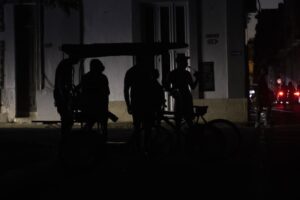
First comes the blackout around lunchtime. Some curses and insults directed at the usual politicians. Several hours pass until night falls, then a brief silence, mixed with the faint hope that electricity will return. As the minutes go by and the heat blends with irksome idleness, the city starts to make noise. At first, a single isolated murmur, constant. Then another. Then ten, twenty, fifty people. Within minutes, an entire neighborhood begins to pulse violently.
There have been no calls or public announcements… no organization is needed. People simply step out onto their balconies or into the streets with pots and wooden spoons. The noise has become a frequent language; the people have found, at least for now, a form of insubordination. Amid all this, the city continues to function somewhere between resignation and resistance. People protest so that the power will return, so they can sleep, so the fan will run, to kill time. When the electricity comes back, the clanging of metal stops immediately. Everyone goes back inside, turns on what they can, charges what they can, and prepares for the next night, because everyone knows there will be another one.
* * *
The protests spread across Havana like a new habit. Each night, when the power went out, the noise began. If not on this block, then the next one up; if not that one, then another. So it goes in Marianao, Diez de Octubre, Arroyo Naranjo, Centro Habana, or El Vedado.
The absence of police has also drawn attention. In neighborhoods where the State’s presence is normally visible, no one was seen this week. Some attribute it to a lack of fuel for transportation; others, to a decision to prioritize more conflictive areas. El Vedado, considered for years a quiet neighborhood, was left in the dark and without surveillance. The general feeling was that everyone had to fend for themselves as best they could. But what can the police do besides repress to no avail? Why send patrols to hassle people if the complaints, the frustration, and the blackouts will continue the next day?
Maritza, a neighbor of 13th and F in El Vedado, summed it up like this: “No one comes here. Not to inform, not to help, not to arrest us. What they post on social media shows all of Havana turned upside down, because now they can’t even take away our internet.” The only time patrols were reported circling different neighborhoods in Plaza de la Revolución was on the night of Thursday, the 12th, and the early morning of Friday the 13th, although several people claim they were carrying out routine checks on vehicles crossing the Almendares Bridge and the Línea Tunnel, something unusual as a police practice. They even checked bicyclists and opened the trunks of every car they stopped. What is certain is that there is a tense atmosphere in the air; fear, perhaps.
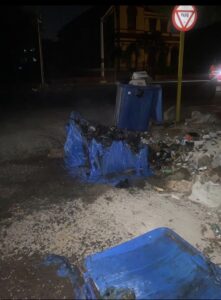
In some places, residents lit piles of trash as a gesture of discontent. At 11th and F in El Vedado, a bin burned three days ago, and the only light on the block was the reflection of the fire. No one called the fire department. After a while, when they arrived, possibly alerted by some neighbor who felt a twinge of remorse or concern upon smelling the odor of burning garbage, only smoking remains and melted plastic were left.
But this has not been the only case. On several corners in El Vedado itself, accumulated trash has ended up as piles of ash. At Línea and J, on the night of last Thursday, the 12th, a bin was also set on fire as part of the protests. The firelight lit up the entire block, according to some neighbors.
Roberto, who was in the dollar-priced line at the CUPET gas station, says he was near the first of the fires and saw it from a distance and from the protection of his car. “It was about time someone did something,” he commented, without surprise. For him, the fire and the pot-banging are a way of saying that patience has run out. However, he also states that he would never dare.
The protests across Havana have not followed a single pattern. In some neighborhoods, people took to the streets with pots and ladles. In others, they stayed on their balconies banging metal. At certain points, the sound transformed into a kind of improvised conga. It was not a celebration, but it was a way of resisting fatigue: the playful mockery of Cubans in the face of adversity.
In Lawton, Diez de Octubre, the tension rose more than in other places. A group of people stopped a train and blocked a street with fire. The image of the motionless train, surrounded by people, circulated among neighbors as a symbol. The police tried to arrive, deploying a presence; possibly the most dynamic response in all the protests up to that point. Even so, the train blocked the passage for quite a while. It was one of the most talked-about moments of the week.
In the community of Mantilla, in the municipality of Arroyo Naranjo, going out to protest each night with a daily pot-banging has also become a habit. There, after throwing trash into the middle of the street to block the passage of cars, residents have set fire to the piles of waste and surrounded them like those performing a pagan ritual.
In Buena Vista, Playa municipality, strong protests have also been recorded as a result of the prolonged power outages. Although they did not reach the magnitude of the events in Lawton or Mantilla, it is another of the neighborhoods where protests have been daily throughout the week.
* * *
In Morón, Ciego de Ávila, the protests were more intense than in Havana. People took to the streets early on March 13 and, after marching throughout the town shouting for freedom, gathered in front of the municipal headquarters of the Communist Party. Some protesters threw stones, while others shattered glass doors and windows to enter the building through any available access point. The headquarters in Morón eventually had part of its furniture set on fire in a large bonfire. Special troops (black berets) responded with arrests, dogs, and baton blows, trying to regain control of the area. During the chaos, a young man was wounded by a gunshot, according to independent journalists. The image of the fifteen-year-old being helped by neighbors spread quickly and became a powerful symbol of the protests.
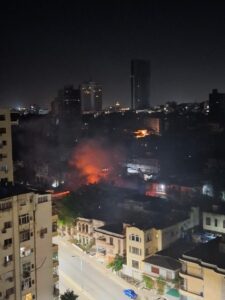
That same morning, Díaz-Canel had held a press conference in which he announced a possible rapprochement with the United States. The geopolitics that no one wants to hear about were repeated once again. Hours later, the country saw images of fire, repression, and protests in Ciego de Ávila. For many, the distance between official discourse and daily reality was starkly exposed.
Starting that night, several municipalities outside Havana and across the country began to show signs of militarization. In Bauta, residents reported the presence of military trucks and patrols driving through the streets, something unusual for a town that normally maintains a quiet pace. In San Antonio de los Baños, where significant protests broke out on July 11, 2021, surveillance has visibly increased and has remained elevated for several days.
The tension was also felt in smaller localities, where people observed troop movements and reinforced checkpoints. There were no major protests like in Morón, but there was an atmosphere of alert. The general feeling was that the country had entered a phase of preventative containment, as if authorities feared that any prolonged blackout could trigger a repeat of what happened in Ciego de Ávila.
On March 16, while all the protests were still unfolding, the National Electroenergetic System collapsed again. Once more. Although no one keeps an exact count of how many times this has happened, what is known is that only twelve days had passed since the last time it occurred. The country is trapped in a cycle it cannot break, but there is a sense that it will not be long before something changes.
* * *
Yackeline works at a Mipyme store at 15th and G, which stays open all night. “The power always goes out when I’m on shift. And without lights, anyone could get in. I get no rest, I’m always afraid,” she said while arranging merchandise, helped by the flashlight on her phone. Her fear is not exaggerated: the avenue is left completely in the dark, the security cameras are off, and she is alone each night.
On another block in El Vedado, Yasser Mario, a medical student, spoke about the heat his 90-year-old grandfather endures during the nights without electricity. “I see him drenched in sweat, and I can’t do anything. This is the fault of those in charge, not us,” he said without raising his voice. For him, the protest was not a political act, but an inevitable reaction.
Havana, and many places in Cuba, reached this point in March with a mix of exhaustion and lucidity. The protests have not changed the electrical situation, but they have left a visible mark: the city understood that silence no longer serves any purpose. Each night, the blackouts repeat, and with them, the sound of pots. It is not a heroic gesture nor an organized movement. It is the chain reaction of accumulated discontent, a way of saying that daily life became unsustainable long ago.
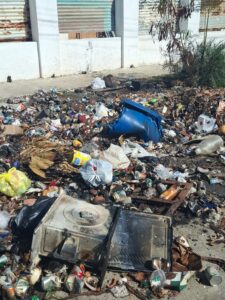
The weariness is evident everywhere. Schools are operating at half capacity, hospitals work with what they have left, and the heat is beginning to be felt even ahead of season. Overflowing dumpsters ominously adorn street corners, and mosquitoes, rats, and diseases multiply. The city, motionless, with a sense of waiting, knows that something has to happen, even if no one knows what. Some speak eagerly of negotiations with the United States, others dream of regime change, others just want to sleep one full night without interruptions.
In many places, when the power returns, the noise stops immediately. The street falls silent, and each neighbor goes back inside. That swift retreat paints a clear picture: the direct protest is against the blackout. But the daily repetition shows that the discontent is no longer an isolated episode, but a routine that has settled into the city, and there is no real reason for the protests to stop… much less when the SEN collapsed again in less than two weeks.
Havana has lived through more than a few days where the noise became routine, where darkness ceased to be an accident, a breakdown at some thermoelectric plant, a blown transformer nearby, the collapse of the entire electrical system. The darkness became a deeper truth; days in which people understood that, even if there are no solutions, silence is no longer useful. And even if tonight the country does not change, health and education do not improve, the trash is not collected, the people are not prioritized, communism does not fall, the pots will keep clanging.