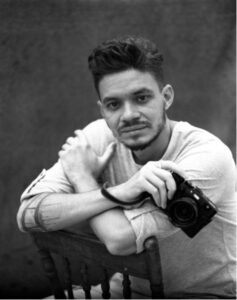
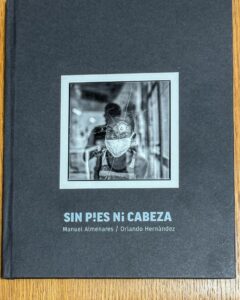
During a visit to Havana on September 2025, I had the pleasure of meeting the Cuban photographer Manuel Almenares, whose work resonates deeply with our mission at SoFLaFoto. On that occasion, we acquired his photobook Sin pies ni cabeza, a work that, although conceptualized in 2023 and considered closer to an artist’s book, is already a valuable part of our collection of Latin American photobooks.
SoFLaFoto’s relationship with Manuel dates back to the COVID-19 pandemic, when we organized and sponsored the online exhibition Hold Still: Pandemic in Havana. Today, a few years after that project, and taking advantage of the framework of the Noviembre Fotográfico event organized by the Fototeca de Cuba in 2025, we publish the content of the conversation we had with Manuel after meeting one afternoon in Havana’s Plaza Vieja. In this dialogue, we address his most recent trajectory, his editorial production, and the ethical and aesthetic challenges of portraying the Cuban reality from his artistic perspective.
On Your Trajectory and Evolution as a Photographer
Could you tell us about your beginnings in documentary photography and what attracted you to portraiture and street photography in Cuba?
Sometimes, the most significant paths are not charted in advance but are revealed unexpectedly, like a flash of possibility in the ordinary course of life. My story with photography was born from one of those fortuitous moments.
In 2014, I found myself working as a messenger for the Greek Orthodox Church in Havana, a simple job within the walls of the Convent of Saint Francis of Assisi. Amid errands and tasks, I witnessed a silent but persistent need: the community longed for someone to capture the essence of their celebrations and the life of the temple with dignity. The images from that time, the product of good intentions but inexperienced hands, failed to hold the memory of that mission.
I, having just finished high school and my Military Service, found myself at the crossroads of someone who has yet to choose a fixed direction. It was in that no man’s land where I glimpsed an opportunity: that of forging a meaningful craft for myself. With courage, I presented my idea to the priest, who did not hesitate to offer his support and encourage me to seek the training I needed.
Thus, I embarked on a search that, like a pilgrimage, led me to the Fototeca de Cuba. And it was there, among negatives and archives, where chance intervened again. My destiny crossed paths with that of Rufino del Valle, a true master of light and shutter. He spoke to me of a dream shared with Professor Ramón Cabrales: the Cabrales del Valle Academy of Art and Photography. That meeting was not a mere coincidence; it was the threshold. Under his tutelage, the world opened before my eyes not only to learn the workings of a camera but to discover the soul of photography: its technique, its history, and its power to eternalize instants.
I was drawn to truth and authenticity. While the studio seemed cold and controlled to me, the Cuban street offers a constant dialogue with chance. Here, people don’t pose; they simply are, with an intensity that is both painful and marvelous.
Portraiture allows me to tell the complete story of a life in a single face. Every wrinkle or gaze is a document of the resistance and joy of these people. And the streets of Havana, with their light and worn architecture, are not a simple background; they are another character, an accomplice that whispers where to find the next story.
Together, portraiture and the street are the most honest way I have to answer an essential question: what is life like for the common man on this island? My camera is the notebook where I jot down that answer, with the utmost respect for the truth and dignity of the Cubans in these Havana neighborhoods.
How has your way of seeing and capturing Havana changed over the last few years?
My work is a living organism, a river that has carved its channel over time. This evolution, more than a merit, is the lifeblood of my self-criticism.
I draw from the classics to illuminate the contemporary. Through black and white and compositions that divert the usual gaze, I seek to unveil the poetic singularity hidden in the everyday.
My camera is an intimate diary of the social, but now I often return home with the shutter untouched. This silence is not failure, but a new ritual: it is the gaze that has become patient, that studies the light and deciphers the secrets of places and faces. Why does the Sacred Heart remain on the same wall for years?
This contemplation is the true studio. It is no longer just about mastering technique, but about maturing that internal eye that knows, with stillness, what deserves to be eternalized. The evolution is not in the craft, but in the way you look.
What photographers, movements, or experiences have influenced your work most lately?
That is a question that makes me look back, not to remain anchored, but to understand where the steps I am taking now come from. Influence is like the afternoon light in Old Havana: it keeps changing, shading everything it touches.
The pillars, the usual ones, the ones that have become inscribed in my way of seeing: Cartier-Bresson, of course. That “decisive moment” here in Cuba is not a theory; it’s a form of survival. Life gives you a second, and if you don’t capture it, the breeze carries it away. And Raúl Cañibano, my friend, our teacher. He taught me that the elegance of black and white is not an aesthetic whim; it is the most honest way to show the texture of Cuban reality, its drama, and its naked beauty.
But lately… lately I have become more contemplative. I already told you that sometimes I go out and don’t shoot. That has led me to look differently, and in that gaze, other ghosts have appeared. Juan Carlos Alom, with his intimate and poetic work on 1990s Cuba and people’s rituals and everyday life. Or the American photographer Matt Black, who manages to turn a street scene into a metaphysical question. From them, I am learning to value the silence within the frame, to seek the story that happens in a minimal gesture, not just in the great street event.
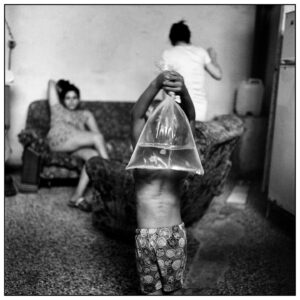
As for movements, I have always been more interested in humanist photography than in any empty formal play. The kind that places the human being at the center. But now I am stealing from new documentary photography, that way of weaving longer stories, of building a narrative with chapters, not just with loose snapshots. My current project, for example, follows the lives of several families in Centro Habana and Habana Vieja who live in the so-called “shelters.” It’s like a serial, and each photo is a paragraph.
But the most important current, the one that never ceases to influence me, is the one flowing out there, on the street. The daily experience of walking without hurry, of listening to the neighbors’ gossip, of seeing how the three o’clock light filters through a house’s blinds and illuminates a dusty picture of Christ. That is my greatest influence. Photographers give me the alphabet, but Cuban life is what writes the poems for me.
On Your Photobooks
In 2023, you published Sin pies ni cabeza, considered closer to an artist’s book. What conceptual and formal motivations led you to conceive it in that way?
Following the prize and grant I received at the Alfredo Sarabia in Memoriam Biennial in 2020, during 2023, I had the opportunity to present a solo exhibition in the galleries of the Fototeca de Cuba. For this curatorial project, Claudia Arcos and I agreed on the idea of showing a broader panorama of my work, one that would not be limited to the photographic essay on the COVID-19 pandemic in Havana, which had earned me that recognition.
One day, while we were curating the exhibition alongside my friend, the critic and writer Orlando Hernández, the selection for Sin Pies ni Cabeza emerged. In the midst of the creative process, Orlando paced the room from one end to the other, observing the photographs laid out on the table. At one point, he called me aside and said, “You know? We have a photobook there.” His words caused me great astonishment, as it was a possibility I had not foreseen. That same day, we left Orlando’s house not only with the curation for the exhibition, but also with the structured idea for a photobook.
Orlando had been particularly struck by a series of images in which feet and heads appeared metamorphosed. That was the main motivation for conceiving the concept of what would become this artist’s book.
That book relies on visual metaphors of disorientation, metamorphosis, and strangeness. What were you trying to convey about life in Centro Habana through those images?
The book is not a document; it’s a heartbeat. I believe I never sought it; it was born over time and evolved with the experience in these places I photographed day after day. It was created with the heart rhythm of Centro Habana, a neighborhood that is like a living organism breathing between ruins and daily resurrections. Through those feet that blend with roots and those heads that dissolve into peeling walls, I wanted to speak of a reality that resists Cartesian logic.
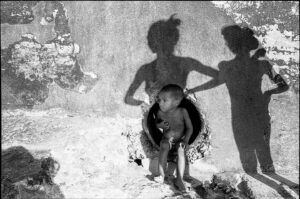
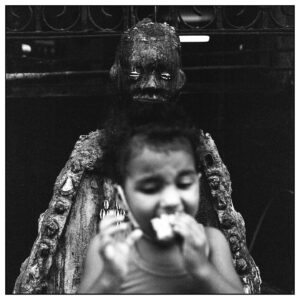
The disorientation is not an effect; it is the very essence of inhabiting a space where time has shattered. Is it not metamorphic a place where a neoclassical column holds a clothesline with faded garments, where an abandoned piano becomes a birdcage? I did not impose the strangeness; it was already there, in the gaze of the child looking through a cracked pane of glass.
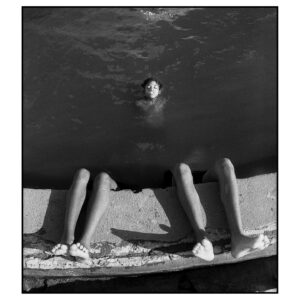
I did not want to convey a message, but to share a fever. It is the fever of surviving in a landscape that constantly blurs and reinvents itself. Those feet without clear paths and those heads without fixed horizons are the portrait of an obstinate dignity: that of those who, like the fragments of my…
You are currently about to publish El monte de Manuel Almenares, the fruit of almost a decade of work on Monte Street and its surroundings. What does this project mean to you, and how does it differ from your previous book?
El monte… This project is like a root I have been digging with my fingernails for ten years. It is a shared biography with this street that pulses between Centro Habana and Chinatown. If Sin Pies ni Cabeza was a lightning bolt of intuition, a discovery in the darkroom of curatorship, El monte is the slow breath of one who learns to listen to the murmur of the stones.
Here lies an essential difference: the first was born from astonishment at the fragmented body; this one is born from coexistence with the intact soul of a place. Monte Street is not photographed; it is inhabited. I have walked its porticos, I have celebrated its saints on the sidewalk. This book does not have “shots”; it has witnesses.
It also represents a way to safeguard the work of a decade dedicated to photography in Old Havana and Centro Habana and to establish a pause to reflect more deeply on the direction I wish to take now with my work. I feel an urgent need for this backstage to expand beyond the Havana neighborhoods. It is not my intention to conclude my work in these places, which are so dear to me, but the creation of El monte will serve as a turning point for me to begin anew and tell other stories.
In the end, if the first book asked, “Where are we?” this one attempts to answer, “Here we are.” It is my love letter to the stubbornness of living in Cuba. When you open it, you won’t see photos: you will smell the wet asphalt after the rain, you will hear the laughter of children running down the street, and you will feel the weight of the sun on the stone. It is almost a decade turned into territory.
What was the process of selecting and editing the images for El monte like?
I printed about two hundred images in postcard format and began assembling the book dummy. In the end, I selected approximately ninety images from this first large selection. In this case, I also wanted to do something more classic in terms of a photobook. I was also interested in playing a lot with the reading of one image next to another, so that, even if they were not taken in the same place or moment, they would tell a story; perhaps with a bit of dark humor, or simply forming diptychs that transcended what a single image could convey.
For this project, I also used a text by my friend Orlando Hernández titled Manuel Almenares o la (poca) importancia de ser pelirrojo. A text that, as he says, “is my way of seeing and telling things.” I feel very identified with Orlando, and I believe that’s why we have an excellent working relationship and friendship. The editorial design is by Lisandra Álvarez. At the end, I placed an index of images where I added the exact address where each picture was taken.
What criteria did you apply to structure the book’s narrative?
To build the foundations of this dummy, I immediately turned to the fundamental pillars of my library: Robert Frank’s The Americans, Ernesto Bazán’s Bazán Cuba, and Sergio Larraín’s Valparaíso. My goal was a classic and solid editorial concept, and it was in the work of these masters of author photography that I found the inspiration and conceptual foundation.
Once the final selection was finished and refined, I shared the dummy with talented photographers and friends: Raúl Cañibano, the American photographer Peter Turnley, and Orlando Hernández himself. Their perspectives and advice were decisive for the final revision of the photobook.
What new narrative layers does the photobook format add compared to the exhibition you presented at the Fototeca de Cuba in 2023?
The exhibition at the Fototeca… that was like a shout. They were powerful images, yes, the ones needed to fill a wall and hit you like a punch in the face as you pass by.
But the photobook… the photobook is the intimate conversation that comes after the shout. It is where the story breathes at its own pace.
In the exhibition, the photos were condemned to their order on the wall. In the book, I force the viewer to walk with me down my street. I give them the rhythm of my steps. I can place a close-up of an absurd detail next to a portrait that looks at it straight on… and suddenly, a moment of black humor that you only understand if you turn the page. That is the first thing: the “rhythm.” The book gives you control of time.
The second is “trust.” In a gallery, people quickly glance at it. Here, the person holding the book in their hands has already accepted an invitation into my world. That’s why I take the risk of placing diptychs that on a wall would seem nonsense… a photo of a skinny dog in Centro Habana next to a reflection in a puddle that looks like that same dog. In an exhibition, people would walk right past it. In the book, they stop. The page permits them to look for the connection.
And lastly, there is “memory.” In an exhibition, the photo is just the image. Here, by including the index with the exact streets and years… it is as if I’m giving them the keys to my personal archive. It is no longer just “a photo of Havana.” It is “the corner of Lamparilla and Compostela, in 2019, when the power went out for the third time that week.” I am giving the exact coordinates of my memory. That adds a layer of truth that the wall cannot provide.
The book is not better than the exhibition. It is something else. It is the version of the story I tell you while conversing with a rum in hand after everyone else has left. The exhibition was the speech; the book is the secret.
How do you see photobook production within the Cuban photography scene?
Sometimes I think of the capital importance of great figures in Cuban photography—like María Eugenia Haya, Mario Díaz, Alfredo Sarabia (father), among many others—having a photobook to safeguard their work. An object that would give them permanence, that would make their gaze transcend and reach new generations of young photographers. That way, that young person, eager for images, instead of first looking online for foreign photographers, could go to the National Library or any art museum in Cuba and find, tangible and alive, the legacy of their own masters.
In the Cuban photography scene, the photobook has long been “the unattainable dream and, at the same time, the obsession.” We all have a book project in a drawer, or in our heads. The reason is simple: it’s the way to give permanence to a body of work, to contextualize it, to keep it from being carried away by Havana’s humid wind.
My perspective is optimistic yet grounded in reality. Photobook production in Cuba is moving from dream to reality. It has improved in quality, ambition, and presence. With the emergence of small and medium-sized enterprises, the current context allows for the existence of some specialized printing workshops in the capital, where a catalog or photobook can be reproduced with very acceptable quality.
The photobook is, after all, the best way to tell the story of this island of ours, so complex and beautiful. And as I always say: “a photo can show a moment, but a photobook tells you why that moment matters.”
On the Context and Representation of Your Work
In contemporary Cuban documentary photography, some critics point out that sometimes too much emphasis is placed on precariousness or material shortages. In your case, how do you handle the line between documenting that reality and, at the same time, showing the human, cultural, and emotional richness of the neighborhoods you photograph?
It’s true, some look at Havana and only see what is missing: the flaking paint, the scarce resources. But that is a superficial gaze, like photographing only the peel of a fruit without tasting its sweetness.
I see “symbols,” I handle that line with a very clear conviction: “I do not go to the neighborhoods to ‘extract’ images; I go to converse with my people.” My lens is not a scanner that only registers shortages; it is another guest on the porch, sitting down to hear stories.
I’ll explain it with examples from my own work:
- When I photograph a child playing barefoot in the street with an improvised baseball bat and a torn glove, the focus is not on the poverty of the object, but on the “absolute wealth of the gesture”: the passion in their eyes, the perfect pitching technique, the complicity with their friends. That broken bat has more dignity and more history than the most expensive equipment.
My method is simple, but deep:
- “Time as an ally”: I am not a “safari” photographer. I return again and again. I have a coffee, share a drink, listen to the reparto music at full volume. People stop seeing me as “the photographer” and see me as “the redhead with the camera,” something more personal. Only then, when naturalness blossoms, do I shoot.
- “Dignity above all”: I never ask someone to pose in a false situation or to exaggerate their reality to make a “powerful photo.” That would be a betrayal. I document their lives with the same respect with which I would document the life of my family.
In the end, my work is not about poverty. It is about “resistance.” It is about the incredible capacity of Cubans to invent, laugh, dance, and create community even when the ground feels unsteady. Material precariousness is a fact, an undeniable context, but it is not the protagonist of the story.
The true protagonist is the indomitable spirit that, against all odds, continues to sing, love, and dream in these neighborhoods full of soul. And that, dear critic, is the deepest wealth my camera attempts, humbly, to capture.
There is the critical concept of “poverty porn” (poverty porn), which emerged in Latin America to question the exploitation of misery as a visual resource. I don’t pose it as an accusation, but as a current framework for debate: what is your opinion of that notion applied to photography in general?
“Pornomiseria”… what a harsh and accurate word. I am not offended that you mention it; on the contrary, it is a debate we must have as witnesses of our times and as ethical human beings.
I’ll tell you clearly: that notion is absolutely valid and necessary. It is the antibody our profession generates against the virus of the colonial, cold, and extractivist gaze.
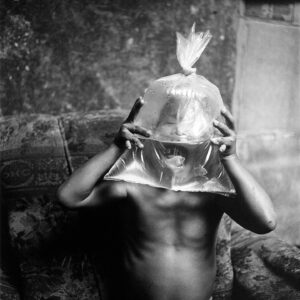
What does photography become when it falls into “pornomiseria”? It becomes a “spectacle of others’ pain.” It is the photographer who turns up out of the blue, shoots their roll (or their memory card) with the voracity of a tourist on a human safari, and leaves without leaving anything behind, without understanding anything. That image is later consumed in a distant gallery or on a social network with a pitying like or an easy tear. Misery is sold as an exotic product, and the portrayed subject is nothing more than a decorative object in someone else’s drama.
I have seen it. The photographer who forces the situation, who asks the child to put on the dirtiest clothes, who instructs the elderly person to look at the camera with an exaggerated sadness. That is not documenting; it is “directing a fiction of pain.” It is theft disguised as art. You steal the subject’s dignity to turn it into your trophy, your “powerful work.”
I repeat my creed: “complicity, not colonization.”
- I do not go to “capture” an image; I go to “share” a fragment of a life.
- I do not seek “the misery”; I seek “the truth” of that person, which can be one of pain, but also of joy, pride, resistance, love.
- My camera is not a weapon to extract something; it is a “bridge” to establish a dialogue.
You see me photographing in a solar (tenement) and might think: “There’s Almenares, again with the poverty.” But you don’t see the hours I spent before taking out the camera, drinking coffee, hearing the real problems, the real joys. You don’t see that I show them the photos afterwards, that they laugh, discuss, recognize themselves. Photography is the end of a process, not the beginning of an extraction.
“Pornomiseria” is the symptom of a photographer who does not love their subject, who sees them as a means to an end (an exhibition, a prize, recognition). Dignified photography, the kind I aspire to make, is born from a photographer who feels a part of what they portray, who feels a tremendous responsibility with each click.
In the end, the difference lies in the “gaze.” Is it a gaze that objectifies or a gaze that embraces? Is it a gaze of superiority or a gaze of equality? “Pornomiseria” is the first. We, who believe in photography as an act of love and memory, fight every day for the second.
That is why my motto has always been: “Do not do unto others what you would not have done unto you.” Put yourself on the other side of the lens. How would you like to be portrayed in your most vulnerable moment? As an object of pity or as a human being with intact dignity? The answer to that question defines everything.
Faced with a global perspective, where communities exist living in conditions even harsher than in Cuba, what do you believe is uniquely contributed by showing the Havana reality through your lens?
The unique aspect of my testimony is that it denies the cliché of the suffering, passive people. The Havana I portray “does not ask for pity; it demands respect.”
Faced with other extremely harsh realities in the world, the Cuban one has this irreplicable nuance: it is the struggle for dignity after a revolution that promised so much and failed. It is the daily epic of a people who chose a difficult path and do not kneel, even if they stumble.
In the end, my archive will not just be a collection of pretty images. It will be proof that in a very specific corner of the Caribbean, the human being managed not only to survive but to “create beauty with what they had at hand.” And that is what the world needs to see: not our pain, but our immense power of transformation.
Looking Forward
Looking to the future, what projects or visual investigations are you interested in developing in the photobook format or other mediums?
After so many years in the boiling pot of Havana, I feel a pull towards the land, towards the silence of the countryside. A photobook… no, a “visual logbook of the depths of rural Cuba.” That would be my future, long-term project.
I also long to confer the dignity of the book on some projects, begun a few years ago, that sleep in the half-light of the unfinished. I believe this would be the noblest way to grant them eternity, to seal their themes with a clasp of closure and beauty. It would be the act of giving them a brief, yet enduring, conclusion.
This is the case of Flor de Monte, a work that dives into the murky waters and shadowy pleasures of prostitution in Havana. Or Isleño, an intimate series that reflects on the sacred bond between birth, motherhood, and the omnipresent sea that cradles my city.
Thank you very much, Manuel, for this profound dialogue about your work and contemporary Cuban photographic production. It has been a pleasure for me on behalf of SoFLaFoto.