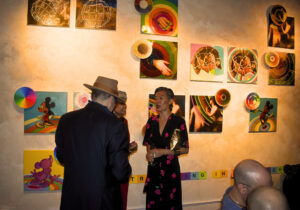
We met at the Salomon Arts Gallery in the well-known Tribeca neighborhood. In the summer of 2024, in this very place, Consuelo Castañeda had gathered several of her pieces for the exhibition Traveling in the Light (Part 1), a moment she wanted to turn into more of a party than a show, with musicians at the piano, tequila shots, friends, gallery owners, apprentices, and art critics. Now, the gallery is empty, and only a few of her famous Pinocchios and Mickey Mouses remain, along with the plans for her projects, some polyhedrons, and other works that form part of her latest exhibition in New York.
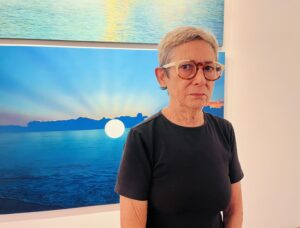
In Consuelo’s monochromatic and austere outfit, only her playful speckled, bone-colored glasses stand out. I’ll tell you now that in this interview, Consuelo will overturn everything that has been said about her: she’s not an artist, she’s certainly not an artist from the ‘80s, and she’s not as extroverted as some might think.
Once, a few years ago, I showed up at midnight at La Tropical brewery in Miami, where a band was playing for a handful of scattered people, and I spotted Consuelo from afar, alone, dancing alone, singing alone, feeling alone under Florida’s clear night sky. That’s the image I’ve kept of her to this day.
“People think I’m very sociable, and I am, I know a lot of people,” she says. “But I also have a side that’s very monastic; I work many hours alone, in silence, and I don’t tolerate others’ judgments much.”
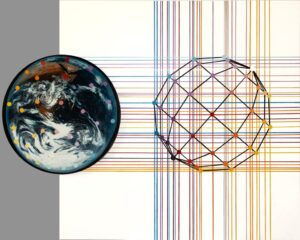
Those familiar with her work know that she’s a jack-of-all-trades, moving from painting to space, from history to light, from letters to colors, from icons to architecture, from graphic design to installations, breaking the two-dimensional plane—and often doing all of this at once. They also know she was a member of the art collective Equipo Hexágono, a renowned professor at the Higher Institute of Art (ISA), a lover of archives, and that she’s begun studying Artificial Intelligence. What almost no one knows, nor should they, is that Consuelo is astigmatic and farsighted, which is why she almost never knows what the moon truly looks like.
“If I tell you the moon is beautiful, I’m lying because I always see it double.”
Consuelo is very “particular”; she’s slow when she creates and likes to work on canvases measuring 60 by 60 centimeters, just enough to avoid having to climb a ladder, the perfect space where her 1.5-meter, barely over 100-pound frame can move easily. Sometimes you’ll spot her near Lincoln Road, biking in shorts and flip-flops through the avenues of Miami Beach, the place that’s been her home since she moved to the U.S. Another thing Consuelo will contest is that she’s an exile and that her work may not even be considered Cuban art. But let’s get to the root: who really is Consuelo Castañeda?
“I come from a working-class neighborhood, a ghetto in Luyanó, a district bordering Havana Bay, an urban neoclassical place where freed Black people worked in the port. A place of warehouses, industrial, heavily marked by the railroad. That’s where I was born, a poor neighborhood. My mom was a single mother; my dad was a sailor, and I saw him sporadically. My mom had me quite late, around 40. She was a seamstress, very skilled with her hands. She taught me one thing in life: that I don’t need anything because I can create it myself. In that neighborhood, because of the environment, almost all the kids were enrolled in music schools. My first attempt was to study music; I took the tests at Amadeo Roldán. The girls mostly chose piano, but I picked percussion and violin. It was significant because, even though I was very young, around seven or eight years old, I was already drawing, and I told my mom I didn’t like that school because I didn’t like being compared to others or the competitive nature of that education system. I waited until I was old enough to enter San Alejandro, around 12 years old.”
Many have said that Consuelo is a scholar of Umberto Eco’s semiotics, a lover of Jean Baudrillard’s America, conceptual artists, and that Paul Virilio showed her the path to technology and cybernetics. From her time at ISA, Consuelo inherited the pedagogy of her Russian professors. She then went on to teach names like Tomás Esson, Luis Gómez, Magdalena Campos, and Lázaro Saavedra. When the ‘90s began in Cuba, Consuelo moved to Mexico and then to the United States.
“I left when the Special Period was about to start, and they executed Ochoa. I remember watching the summary trial they broadcasted, while I had hemorrhagic conjunctivitis, and it hit me hard. Just days before, they were about to give that man control of the army. A major repression against intellectuals was on the horizon.”
Sometime later, after hearing about her mother’s death, Consuelo tried to return to Cuba, but she was denied entry.
“A month after my mom’s death, they finally let me in. I remember all my friends and their mothers came to meet me at the airport. But the void I felt was immense. They took my house; a military man lives there now. I’ve never even visited—it’s something I’ve erased. I wasn’t there for my mom’s funeral, and in a way, I’m glad because I didn’t have to carry that strong memory, but it was still unacceptable to me. I had my bags packed, plane tickets ready, and it never happened. That caused me to go almost 17 years without returning.”
She never knew the reasons. Consuelo will say it was a “total violation of human rights.” “That’s the only explanation I found because it’s not even related to the content or central themes of my work. I’ve never characterized myself by taking militant stances. I never knew why, and I found it very unfair.”
Amid the excitement of 2016, Consuelo returned to Cuba with her exhibition CCC 2016, which was hosted by the Orígenes Gallery. “That was a moment of hope for all of us. I went with the dream of working there. One reason was that the younger generation had no idea what my work was, and I’ve never stopped, so their references were only from the beginning. They silence people’s activity. That has changed a lot now, thanks to communication possibilities through the Internet, but back then, they would silence you, and it was as if you didn’t exist. That bothered me, hence the exhibition.”
Her return took place during the Obama era, a time of repatriation, of the return of artists, intellectuals, entrepreneurs, and nostalgic people—categories Consuelo constantly avoids. She even rejects being called an artist, and when I call her that, she will correct me without hesitation. If I ask her how I should address her instead, she’ll say: “entity, creative being.” So, I say, “creative being.” “See how easy that was?” she says rhetorically.
“I refuse to be called an artist because creative activity is very limited, and you’re pigeonholing me, putting me into a niche that I’ve broken out of. It’s taken me a lot of reading, a lot of learning, to escape that. In general, I advise almost no one to call themselves an artist, but to consider themselves a creative being. I remember when I started, some people said, ‘No, she’s not an artist, she’s a designer,’ because I did art appointments, or because they thought of design as something second-rate, when I think a designer has a more complete understanding of the communication process, knows when the work becomes obsolete, when it decays, and how to recycle the material. An artist doesn’t think about that because they see themselves as the authority.”
But the artist Joseph Kosuth said you were a “post-postmodern artist.” What do you say about that? Do you accept it?
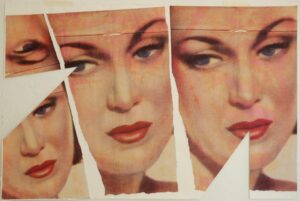
I was stunned; it made me reflect. An artist like him, who works conceptually, who made a piece called “One and Three Chairs,” for someone like him to see my work, which is painted, going back to traditional tools because that’s the school I come from… Yes, I am post-postmodern, absolutely, but unknowingly so. I was using the springs of tradition but injecting it with a conceptual intention that Kosuth appreciated. I revitalized conceptual aspects within the typical craftsmanship of postmodern art; it was like turning the wheel twice. I liked that a lot, which is why I let it ride.
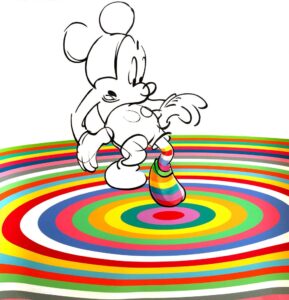
Mickey Mouse, Pinocchio, Popeye are some of your characters. How are they born? Why that appropriation of American cartoon pop icons?
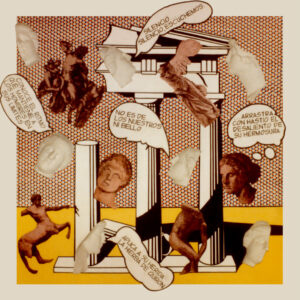
Those are characters from my childhood. When I came to the United States, I bought a piggy bank that was a Betty Boop figure. Then I cut out an image of Diego Rivera from a Frida Kahlo painting and stuck it on Betty Boop. That’s when I made my first iconography of American cartoons, which I called Betty Kahlo. Then came the Popeyes. It was in the painting Who Lends Arms to the Venus de Milo? that I used Popeye’s arm for the first time. When I arrived in the U.S. and people said I was a communist, I made the first Popeye with a sickle and hammer. When people said Consuelo was a drug addict, I made the one with the marijuana plant. Later, I was doing an exhibition called Finding the Self, and there I made the third Popeye with an image of himself, meaning, you label yourself as an engineer, as an artist, limiting who you are, giving a vision of yourself to society or satisfying the vision society has of you. Mickey was born when my niece came into the world. I made small editions for the baby shower, which I later gave to the children. I give a lot of works to children. That way, I’m ensuring 60 years of information about my work. Pinocchio came later. Sometimes I say that these characters need to rest.
You don’t have a gallery yet. Why would someone break with that kind of institution?
I don’t have a gallery, nor do I want one. I’ve already been through that experience, and I’m very happy to be out of it. It’s a lot of work for a creator to return to marketing; it’s a different activity and a different art. It limits your development a lot. The dynamic of galleries is like a marriage—you have to make two, five, ten-year commitments. It’s too much, and I feel like I don’t have the time. Also, it’s not like before when they guaranteed you steady income so you could live off it, now you have to keep searching for it. Buyers approach you, and you’re constantly in that attitude of betrayal with the gallerist. The support galleries provide is very little. Before, you’d do an exhibition, and at least two pieces from each show would be sold, but now no. Now, practically the gallery as a marketing space has become a real estate operation.
After leaving Cuba, you began working with the artist Quisqueya Henríquez, who recently passed away. How does it feel to say goodbye to those who were essential, to friends, to lovers?
It’s delicate. Even this trip I gifted myself to New York is a little bit to ease that pain in my mind. These were very important people who, in a very quick way, even younger than me, are leaving. Yes, it affects me emotionally. Quisqueya is one of the most intelligent people I’ve ever known. Irreplaceable. One of those people you’d ask, ‘Hey, what book did Lyotard write this in?’ and she’d say, ‘Such and such book, such and such page.’ On that level. With extreme delicacy in crafting her work, conceptually very demanding. She created beautiful work that people don’t even know about. The same thing happens with Arturo Cuenca’s work—there’s no center grouping these works, and they’re left scattered. I’m even worried about my own work, which is why I prefer it to stay in the hands of friends.
Everyone talks about the mythical eighties in Cuba, and you’re part of that generation, but you don’t like being placed there. What’s the issue with the eighties?
No, because I’m not dead. When I die, then you can say, ‘Well, she’s from the eighties.’ But if I’m still active, don’t place me in any category. If I were repeating the same thing, like some of my colleagues who unfortunately keep doing the same stamp, like a brand, but that’s not my case. I fill myself with uncertainties, with doubts, I get nervous, I take my time, I spend my life searching for new things within myself. So how can you say I’m from the eighties? Those are labels; archives need other ways of organization.
But yes, I come from there, I was trained with that group of creators. I think the change we made was significant in many ways. There was a big wave of censorship in the sixties when Cuba was at the top of modernity; many artists were going to study in Europe. By the time I was training, there was a gap. They created art schools, brought in teachers from the countryside, people who painted birds, harmless nature—what I call the zoo of ignorance. We, a group of young people, were concerned about other things, and we brought in content that was banned. Sexuality was banned, religion—both Christian and African—was banned. Cultural policy in Cuba, as now, was closely connected to the centers of power in the United States. Yes, there was a change, and it was a much more cultured generation.
About the artistic production of younger generations, how do you see what’s being created? Which names would you highlight?
It’s impressive what’s being done; I love the work of many creators. Yornel Martínez is one of my favorites, very conceptual, and a great lover of archives. I like Chino Novo a lot. Hamlet Lavastida. I’m fascinated by the work of Carlos Garaicoa and Alexandre Arrechea; of the women, I like Susana Pilar. There are a lot I like; still, I see something in them, which is embedded in our DNA, and that is resolving conceptualizations through objects. Very few are performers. Generally, they generate objects—beautiful ideas—but they manifest in a very traditional way. I see that as very widespread. First, a drawing, then they move on to the three-dimensional object, and very rarely do they work with space, very rarely do they move into cybernetic planes, although some do.
Is your creative activity Cuban?
The concept of nation is a modern concept, and luckily, I’ve tried to go beyond those limits. It’s always important where you come from; you’re marked by it. I love eating my beans and yuca, but my culinary culture depends on what I’ve experienced outside of Cuba. I’m not fixated, because of where I come from, on thinking that it’s the best, it’s the most important thing for me. And the same goes for everything else.
When I went back that time, I went with many projects that were frustrating for the same reasons they always were. So I said, ‘Hey, I don’t have the time or the life to get involved in this effort.’ I went with the idea of developing a cybernetic center. But I lost my enthusiasm, honestly. Now I have no motivation. All those people I met and found so intelligent are also gone. Generally, I deny almost nothing in my life. That’s why I don’t have a nostalgic attitude toward Cuba, and I’ve never encouraged it. I’m not even one of those people who consider themselves an exile, because yes, you are in the sense that you’re punished for leaving your country, something that doesn’t happen to other immigrants. But I would have left anyway and at any time in history.”
* This interview was originally published en Spanish in El Estornudo magazine. It has now been translated into English by Fiona Baler.