One. At the end of February 2020, the 39th edition of the Arco fair opened in Madrid. For the first time, the event had no guest country and was conceived as a tribute to Félix González-Torres, a Cuban-Puerto Rican-American artist who, among other issues, had tackled AIDS, a disease from which he died in 1996 at the age of 39.
A few days after that premiere, COVID-19 was already ravaging the world, confinement was decreed and hospitals were overwhelmed at the same speed as museums were emptied. In fact, the pavilion that had hosted the fair was turned into an improvised emergency hospital. The place where, a few days before, the hierarchs of Contemporary Art had been showing off, was crammed with beds for the victims of the pandemic. An image so overwhelming that it demanded no interpretation or metaphor.
But the world of culture, at once, intertwined disease, metaphor, and interpretation, finding a theoretical vein to explain what was happening. Quickly, the computation of any work that had recreated the unknown plague-cholera-yellow fever-syphilis-melancholy-cancer-craziness-aids-epidemic exploded. Competing relentlessly to overwhelm the networks and all kinds of media that would allow us to reflect the terror of a deadly virus that the authorities had dismissed, in its beginnings, as a passing cold.
Many artists, obstinate in an agonizing overproduction, decided to launch messages for tomorrow, while they contemplated, aghast, the number of cinemas, museums, companies, and theaters that also “died” next to them during those days.
The confinement indeed allowed the possibility of discarding mediations—from directors, collectors, curators, gallery owners—to connect directly with the recipients of the works. Only the combination of fear and confinement far outweighed that tenuous consolation; and the urge to bequeath something of transcendence in the face of imminent death from which no one seemed to be exempt was stronger.
During the days and nights that sequenced a quarantine, Geandy Pavón turned his reclusion into a set as implausible and, at the same time, as true as the tribulations we were living. For him and Imara López, the confinement space became a theater of operations. A private Decameron, reduced to two people, although multiplied by four when compared to the ten days that covered Boccaccio’s work in the fourteenth century.
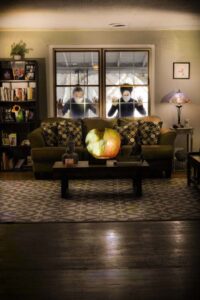
Those forty days and forty nights became the time of a world on the fringes of the world. A bunker from which, nevertheless, its protagonists set out to go far in an imaginary way. Accompanied by Freud and Baltasar Gracián, Ramón Gómez de la Serna and Roland Barthes, a provision of the OAS and the detention in Cuba of journalist Mónica Baró, Murillo and Caspar Fiedrich, Dalí Eco and Arcimboldo and Narciso, Umberto, Adam and Eve, pop and Hans Castorp, René Peña and Plato, Émile Durkheim and Pasqual Quignard, Perseus and Blanchot, Velázquez and Aeropagite, Lydia Cabrera and the mermaids…
The resulting book narrates three quarantines: that of Geandy Pavón, Imara López, and Jorge Brioso, who, later, locked himself up for another forty days to write about the images of this confinement. In other words, he stretched the quarantine in time, just as the artists had imagined its extension in space. Even if this brought with it the anguish that to remember is also to die again.
By cloistering himself to write about the images of confinement, Brioso freed the protagonists from their confinement. The problem is that, by returning to that place, he has now hung over us the ritornello of that prison, of the mourning for so many people who died without the least funereal dignity.
If Pavón “photographs a time that does not flow,” Brioso reconstructs the splinters of that time once it has been set in motion. Without failing to recognize, at any moment, the photographer’s challenge: a time that does not flow is already, so to speak, photographic: pure pose in front of the camera. Especially during that month and ten days with “the world back to front and the canon upside down.”
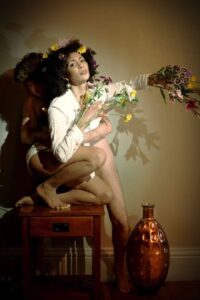
Two. What do we see in a book like Cuarentena 40 días & 40 noches [Quarantine. 40 Days and 40 Nights] (published in Spanish by Rialta Ediciones, Fluxus Collection, 2024)? We see Pavón reading a book about photography, in the umpteenth tautology about the stillness of those moments; and the model’s legs violating the photo, in the style of Antonioni in Blow-Up.
We see the revenge of a mirror on the photographer who is about to capture the image. Donald Trump in the midst of our enclosed lovers. Some mystical portraits made in the 21st century. Reflections—in this case not of a golden eye—in some food remains. The everyday as a pose and the pose as an everyday act.
We see theater, pure theater. And life inside a camera obscura. The motionless turned into silent movies. We see death, the hysteria of being part of the history of art. We see chance, premonition, the macabre.
We see Charlotte Corday and Marat, that friend of the people who could not even go out to the corner, and the return of the Roman Empire, the rebirth of the clinic, the sinister that is concealed in beauty.
We see virgins, the hopeful and the forensic, the marks of Christ’s nails and Buñuel, the golden rain and the dollar. We see Oshún and Yemayá. A blossoming flower, our protagonists looking at themselves through the window. We see trash and art books, many colors and black and white without nuances, condemnations and promises, nudity and disguise.
We see the numerology of a time that does not pass and some glimpse of survival.
Three. What do we read in a book like Cuarentena? We read the keys to understand the strangeness of the images, that it is possible to approach a book built as a succession of remakes, the unresolved struggle between when and why.
We read that it is possible, amid this cataract of images, to die without leaving a trace, that the silenced image is an almost perfect form of language, and that sometimes, in extreme cases, the one who is looking is death.
We read that a great portrait can only come from a cultivator of filth, that there are times when the camera is more accurate than the gaze.
We read that there is a Cuban eye.
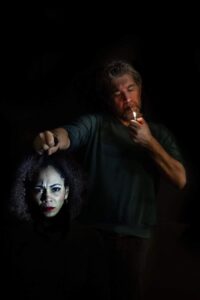
We read that photographic artifice is very close to crime, that this series by Geandy Pavon is a eulogy of the shadow, that each artist invents his morality, that there are bodies with the shape of time.
We read about the controversial relationship of icons with their penumbra, that a lens always captures the reality that nests inside every simulacrum, that a photographer Ulysses is possible or that photography is capable of functioning as a disassembly of the family album.
We read that the best Photoshop is the one that imitates Photoshop but without Photoshop; that the dignification of B movies and television shows encourages works like Pavón’s, that a photographer can be the elephant in the room, or that a set is nothing more than an oasis.
We read that photography must create a reality to “capture” it. We read that in the pandemic everything stopped, except for politics (and repression).
We read that every mirror is a hindrance to transparency.
Four. Cuarentena concludes with entelechies that are, at the same time, the recovery of the Geandy Pavón who paints or draws, and the Geandy Pavón who talks about his work, before and after these forty days. (I do not know if this epilogue is necessary, although I do know that we need to breathe and these entelechies grant us that chance).
Cuarentena transcends that fateful moment in the recent history of mankind—that pandemic—and forces us to confront a fundamental question about what writing can be like in the age of the image. An era in which, contrary to so many complaints, we read and write more than ever. A book that joins other volumes, also recent, such as Anti-Oculus: A Philosohy of Escape, (by the Acid Horizon collective), Operational Images: From the Visual to the Invisual (Jussi Parikka), Plasticity: The Promise Explosion (Catherine Malabou and other authors), La imagen que no acaba nunca (Roger Canals), La imagen incesante (Jordi Balló and Mercè Oliva), Desbordar el espejo: la fotografía, de la alquimia al algoritmo (Joan Fontcuberta), or La performatividad de las imágenes (Andrea Soto Calderón).
In all of them, the idea that an image is worth a thousand words is overturned. Among other things because, as Cuarentena shows us, a word and an image are simply worth what they are worth. It all depends on their place in the arena and the noise of this era that has already consumed a quarter of the 21st century without resolving—perhaps because that impossibility governs us—the tension between the visual image and writing.