
When Kenny Lemes took his own life in his apartment, the world was steeped in poetry.
An artist, during his lifetime, dyes fabrics, glass, trees, meadows, and butterfly wings. There’s a kind of artist whose life spills over—the tiny, extraordinary shapes around us smeared with their being.
The dye is sometimes frost, grime under fingernails, makeup, acne, sleep crust, keloids, or the memory of a set table. Turning away from pain is useless.
February 14, 2025
Alexander Diego Gil presented his performance, Epitaph, on February 14. Another is the title for the poem that crossed his mind when he asked someone in the audience to hand him the basil: “and to place a sprig of basil beside the next suicide.” The artistic experience invoked the Cuban poet who took his own life at 39 on that same date.
Kenny Lemes reacted to a photo of the performance on Instagram, writing to me: “I’ll go take pictures of him now.” I didn’t know if he meant Ángel Escobar, Soleida Ríos, or Alexander Diego Gil. I didn’t know if he meant Havana, bodies leaning and writhing, miraculous static, rue herb, or maybe the macao, that crab hiding inside a conch shell. Nor did I know about the exquisite corpse in Alexander’s mind, a tattoo written with verses plucked from the Complete Poetry by the audience.
When Alexander was unjustly detained for taking to the streets on July 11, 2021, they shaved his head. Now his head is shielded by poetry. I can only remember that morning as a Kenny Lemes photograph.
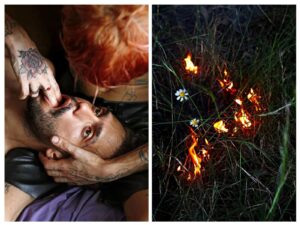
Inventing Life
We always talked about his photographs. Also about language, love, or politics. I have the sense Kenny preferred improbable dialogues, questions, or ideas that couldn’t be reduced to a reaction or a sticker. I was deeply moved reading that only honesty interested him: “As a photographer (and a person), I’m interested in honesty, not truth.” It’s a bold statement for this era of livestreams, open calls, and smoke screens, where every declaration risks an expiration date dictated by others. Truth is like gum dangling from the mouths of power and its narratives. Honesty, though, stains windowpanes, fogs up eyeglasses, is a tear that burns. We spoke of weeping, which I suppose is the shape that holds all languages.
At 39, Kenny dyed the world with honesty. I receive the news as tragedy—his absence now an infinite one—and I begin to trace the contours of that tragedy in his friends, in those who bared themselves before him, in this stretch of time ruled by unease.
On February 28, the planets aligned after so long; this phenomenon won’t recur for centuries. I don’t know what to expect from Saturn, Mercury, Neptune, Venus, Uranus, Jupiter, or Mars. I don’t know what to expect from this world now tinged with absence, too.
Kenny’s photographs are marked by unbearable beauty, the kind only possible when one looks (and is looked at) without filters. I think of portraits where nudity is a concept that allows “discovery,” “lifting that veil of grace,” in settings where theatricality, nature, and death coexist. Narratives that don’t reproduce commercial, hollow, or “corrected” prettiness of spaces and bodies but are seduced by the latent, its ferocity. The photographer distances himself from what’s packaged and sold; his photos don’t rest on easy answers. His process borrows from simulacrum the idea of becoming another, and from beauty, the impact of its shadow.
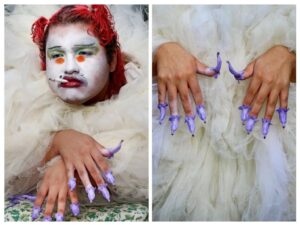
When I read Ghost Image by French photographer and writer Hervé Guibert, I was captivated by this invention:
[…] a fabulous invention I dreamed of that also terrified me, imagining it could be used against me: thought-reading glasses. Later, I stumbled upon a more or less salacious ad for glasses that see through clothing, that undress you. I imagined photography could merge these two powers and was tempted to make a self-portrait…
In Kenny, there’s a kindred impulse. He wrote: “I keep reaffirming that everything one does is a selfie. Play of shadows, adornments, and performance. It’s all projection and reflection. This isn’t Marcelo. This is me under the disguise of the human I was assigned.”
The echoes of his work reverberate as “self-portrait.” This performativity of the self entails swallowing, but also fascination. The resonances of that search, outside “artistic” hierarchies or “authority,” unfold through contagion. That’s why they manifest subalternity, queerness, and sexual dissidence in a state of “projection and reflection,” of care.
In the portraits of Chilean photographer Paz Errázuriz, I noticed serenity as a form of support. Despite the defiant presence of her subjects, there’s a tension that stretches the moment. With Kenny, I feel that the energy of his portraits relies on a drawn-out approach—the instant of the photo might vanish if petals fell from lips, if the dress dried, if hair untangled. But nothing so trivial can happen now; they’re forever bound in that snapshot. There’s room for disobedience, for rumination, for “being me.” The tension pierces the viewer.
How much wounds tell us, the amputated, the surgery. How much dignity, resistance, and respect stammer through skin’s traces, scars, tattoos, the split, the prosthesis. Absence is eloquent: a slash, another way to memorize the physiognomy of what we evade, that sibylline face and its fantasies. How much of himself, of Kenny, of his hungers and sleeplessness, rests in his images.
In the textual fragments he preserved, stories and insults fuse; there’s room for laughter and defiance toward canons or paradigms like family, morality, or heterosexuality. Space to defend the power of pain, of monsters, of sex work, fatness, or solitude. Each word-tattoo, each reclamation, each scrawl composes a total poem stitched together by freedom.
Maybe, as in Alexander Diego Gil’s performance, I transcribe them uncorrected, hoping to find Kenny in a random manifesto-poem:
Respect, Versace, Sit on my face, impurity, How can an angel break my heart?, Perra sorprendente curvilínea elocuente, this is the first day of my life, Mi refugio, Putita, nacidx para morir, malo, Estoy agonizando, pobre diabla, Reivindico mi derecho a ser un monstruo, Decepcionar a mi familia is my passion, Policia, DIOS, Just don’t do it, sensible, Todo es terror y belleza, Furia trans, Perdón x estar triste, blessed, controls my mind, he vivido toda la vida añorando ternura, fantasy, la premiere fomme Orlando, NOT OK, te amo.
From his book Mariposas que vuelan de noche, I remember a post where the meticulously edited pages appeared submerged in a stream. In that water’s tremor lay the fragility of his corpus. To sink, lean, rise, let the current carry you. I read the collage: “Todo es terror y belleza”—what a profound affinity I feel for an artist who binds the spiritual, the irrational, the delicacy of a dead animal or flowers.
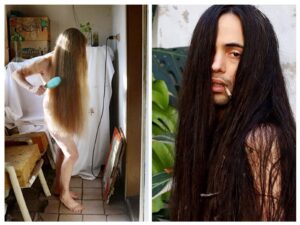
Kenny knew I’d write about his photos. Knew his photos would lay territories bare. Where injustice, discrimination, racism, and repudiation thrive. Where dictatorship, regime, catastrophe reign. Where freedom demands clawing at stone. But also where monsters stir us or night runs us over, where the suicidal poet invades the performer’s body, where hours drool and put on makeup so nightmares weigh less.
The bodies in Kenny’s photographs torment those who’d send to the stocks or the pyre any corporeality escaping their norm. They torment those who use words like “pretty” or “pure” for art, who forget to face the mirror each morning and never recognize the violence in their remarks. That’s why Kenny always clapped back at transphobic, homophobic, classist, and racist critiques.
Some experiences surpass assumption, imagination, or provocation. Like in Roy Sigüenza’s poem Mi vida es como si me golpearan con ella: “It was raining, then, and it rains; it rains to suit my taste for sadness, alone, writing like a seeker, not like someone who writes.” A poem that’s made me cradle sadness, pain, and admiration for Kenny these days. Kenny, who reacted to it with private messages:
I feel like a guy who takes photos like a seeker, not like someone who takes photos.
Invented memories.
You know.
Literature.
Inventing life.
So it weighs a little less.
There’s proof his work sought to invent life. There was no other way. Invention is where cracks and crevices emerge, between sheets, roots, lost objects, in the drunkenness of searching, self-seeking, pure inventions. Rereading these lines, I hesitate to recount the first time the world stopped being tangible or desirable to me, the times you bled, the torn, the absurd, the condition of being a passerby. The seeker’s task is the hardest of all. Thinking of him: “A glass of water has cut my voice.”
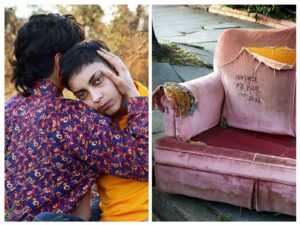
Love Has the Scent of Death
At twelve, he left Cuba. Kenny Lemes is Cuban and has lived in Argentina far longer than on this little Caribbean island, incomprehensible to those who experience it for a day, just as much as to those who endure it for a century.
In a post from August 18, 2019, I read: “Cuba always makes me think of Hieronymus Bosch. Man’s sharpest fears are all sprawled in the street, exposed on every corner.”
His relationship with his birthplace was never distant but visceral. His request for his ashes to return keeps rewriting a history of escapes, returns, of the hero, the seeker—there’s something in this journey that doesn’t conclude, as tender as it is severe, as honest as it is poetic, as epic as a love kiss.
He told me he was in love with someone close to me. He was sure I’d make them laugh. I tend to clown around when I’m drunk or in good spirits. “With Martica, you laugh or you laugh.” Around him, you’d have to discard everyday masks—maybe keep only the hedonistic ones, the gasping, the dramatic. Gadgets are allowed, but only the kind that spark, jarring to the gut and knees, fleeting as a bruise. I asked who it was, who he meant. He said I’d find out. In a post from August 27, 2022: pills, bearded irises in a glass, The Devil’s Playground by Nan Goldin. “Love has the scent of death.” In the photograph from August 18, 2019, the slaughtered animals jut from the plastic bag, legs on asphalt, faith. “Love has the scent of death.” Invented memories now, dyed with a bitter chuckle, we invent a country, a world, a flammable dye, a saliva dye, absences, pneuma, terror, and beauty. “Love has the scent of death.” After love: death, poetry, or honesty—this thing staining our organs and teeth, inventions, a needle that lodges and releases inside us, aligned planets, supernatural photos, life beyond.