In his book Historia natural de los cuentos de miedo (1974), the Spanish psychiatrist and essayist Rafael Llopis quotes the inescapable Algernon Blackwood, speaking, with a substantial pinch of objectivity, about one of his characters and the “self” that could or should afflict it, so to speak. Blackwood writes, undoubtedly settled in the most archaic levels of the psyche: “With the irresistible force of a deep tide, yet blurred as if by incalculable time and distance, the magical memory, long forgotten, arose of a time when he was happy and complete, when he was natural.”
One wonders where the limits of the self’s naturalness lie, especially when the self depends, in its becoming, on the revulsive agitation of memory and the re-readings it fosters. And one continues to wonder, regarding all this, what consciousness is, how it exists and to what extent, and in what way the self (the subject’s identity) depends on its own consciousness, or on a set of rhizomes that come and go (I apologize if this metaphor is, for the moment, imprecise).
I drop these reflections in advance, preceded by Blackwood’s words, because cinema has difficulty creating works (this does not mean there aren’t many, at least since Ingmar Bergman released Persona in 1966) of genuine artistic height that are also seriously engaged with these dilemmas. Foe (2023), the film by Garth Davis, speaks to us (and questions with sense and rigor) about the indispensable originality of the self, about the absolutely necessary “primordiality” of the self in its articulation with the “primordiality” of the human. Its framework is inspired by the novel of the same name by Iain Reid, a writer halfway between science fiction and what is often called weird fiction.
We are in the Midwest in 2065, and there is climate-related devastation: intense heat waves, fires, droughts, and almost total rainfall. Humanity is dying out, but the option remains to produce food and other things in gigantic factories located in outer space.
In an old house, in the middle of a sort of prairie with remains of vegetation and dead trees, live Hen (Saoirse Ronan) and Junior (Paul Mescal). They are a young but worn-out married couple. Both have lost a good deal of passion and interest. They barely communicate cordially, and the bored bewilderment on their faces indicates that there is, for example, very little sex anymore. They also sleep separately. She loves the piano, often plays it, but it bothers him. The piano is in the attic, stowed away among useless junk.
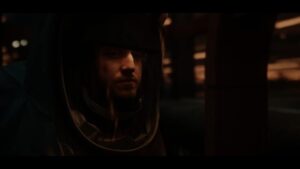
Then, at the beginning of one night, the tedium and darkness are interrupted by the headlights of a car. It is a soft-spoken visitor who knocks on the door and identifies himself affably. Everything is strange. He is a government envoy, and his name is Terrance. He comes to inform the couple that Junior has been selected to enter a program for candidates who would go to space to work, after passing a multitude of tests that would last a year or perhaps more. There are tense dialogues, many questions (especially about where this whole mess of a summons, almost of a military character, to work in space came from), and the visitor asks for calm, trust, and goodwill. Junior’s trip, only if he is approved, is far from happening, and so a year passes. But in reality, that year is extraordinary and normal, strange and common, unusual and ordinary.
Before the visitor says goodbye and leaves them living their usual life, which is no longer usual, he tells Junior not to worry. Hen would be well taken care of by his double. An artificial creature (and here we begin to wonder why Terrance is so confident in his expectation that Junior 2 would be as efficient, in every sense, as Junior 1, or simply Junior) in whose brain (and in its self-consciousness?) the same memories, feelings, and emotions of Junior would be stored, emulsified.
The year passes, I repeat, and magic happens: Junior reconciles with Hen’s piano, with her body, with the beautiful intimacy of having her naked and embraced in bed, with the need to be close and share and talk about the future, and both assume that something in their wills, in the face of imminent separation, has worked the miracle of trying to recover what was lost.
Junior didn’t like Hen playing the piano. Now he does. The music Hen plays sounds like a temperamental Philip Glass, with a romantic touch. The piano is a turning point because in the piano, and in the act of playing it, lies the gateway to sensations and feelings that were no longer there and that can either be lost again or recovered through a process of visceral, “cellular” memorization. Undoubtedly, the pathos of the piano constitutes an invitation on several levels.
Terrance returns after a year and announces that the dialogue-interrogations are in their final phase and have been successful. But the new questions are so twisted and labyrinthine that they leave the sensation of a chilling depth known only to Terrance. For example, he dares to ask Junior what Hen asks for (regarding sex), what she prefers. Junior calls him sick. The visitor shrugs and confesses that he likes to observe people, to weigh the deepest parts of their minds. Junior clarifies that he too likes to observe, to examine, and that from this activity he concludes that the human being is dirty, careless, nauseating, lazy, detached. Then he begins to punch the wall until he bleeds. Hen comes, startled, but Terrance doesn’t let her in. It is a private spectacle, as far as he is concerned, saturated with information. He smiles happily to see Junior in a state of extreme violence (of extreme meditation) that allows him to evaluate, in some sense, the state and usefulness of the “transferable” information for the double, the artifice that would take Junior’s place. One assumes Terrance is asking himself, assertively, how prepared the double would then be to be who it is, or to develop the complex imposture that awaits it.
At the same time, however, it is worth asking what happens when the self and its self-consciousness fill with analepsis and prolepsis, all of it announced from the realm of dreams or from the lucidity of wakefulness. It is also legitimate to ask why Junior assumes this critical stance towards the human, the human being as a species. What drives him to that limit, tinged with a mixture of rage and affront. As if Junior, in that instant, were not Junior or were above himself, perhaps invaded by a prophetic spirit on the verge of the philosophical.
“What you bring here,” he says arrogantly to Terrance, referring to that double he finds implausible and hateful, “won’t be like me. I am irreplaceable.”
The twist occurs when Terrance, at the conclusion of these complicated interviews, forces Junior and Hen to probe, separately, their options for recalibrating their identities. And by this point in the film, the question manifests itself: what is really happening?
The film thus reaches its resolution sequence: Junior watches Hen drive away in Terrance’s car, is bewildered, and observes some intruders in the distance, out in the field. He goes out, loads a shotgun, and suddenly we see ships flying over the house. The contrast is strong. Junior and Hen’s house is a wooden farmhouse built in the 1870s.
A man (dressed in a very formal suit) approaches Junior, apprehends him, hits him skillfully, and subdues him with a very precise twist. And, suddenly, a circular light starts blinking under the skin of Junior’s neck. Dizzy, he approaches a house into which several people are entering.
Hen had confessed to Terrance that she would leave that place, in search of a less uncertain future, and that she would leave a blank letter for Junior, because in the absence of words would be all the words he would need. And, next, we see Hen cutting her hair. And then Junior enters and embraces her with enthusiastic tenderness and tells her he has missed her very much. What does this indicate? Why does he say that if they have just seen each other? Here there is a short circuit: the one embracing Hen is the “real” Junior, just returned from space. The “other,” the one with the chilling light in his neck, is about to stumble into a monstrous revelation.
What kind of compassion could the viewer of Foe feel when they understand that, from his deep self, the double is completely prevented from seeing that he is only a copy of the real Junior, and that he has been deceived? Prevented from seeing himself as a copy because his self is too perfect and too real. Terrance has made him see all along, and Hen too, that they were both preparing for Junior’s departure to space, when in truth Junior had already left. But only Hen knows that this Junior with the light in his neck is an improved copy. In fact, she is more radical: she chooses the double.
Garth Davis films the following sequence with fierce precision. It is, ultimately, the central sequence of the film, a work whose merit, as cinema, lies in the fact that the “indeterminate” and speechless segments of the action are, in reality, the most significant. I am referring to the sequence in which the double, tied to the ground with metal cords, illuminated like an artifact that attracts upon itself the immense curiosity of the attendants and is not his own master, receives the “due” (Terrance is very indulgent here) explanation: Junior, before leaving, gave “all” his “information” to Terrance (he takes the tests, grants the interviews, submits to meticulous interrogations) and agrees with him not to tell Hen, and, of course, not the double either, that they are all actually starring in an identity experiment, a crucial test about the degree of humanity a double of that type could reach in such a situation (a marriage), and without knowing he is a double. However, a cardinal doubt immediately arises here: even knowing he is a double, and having in his body and mind the totality of a dense sensory, emotional, and intellectual experience, could that “derived” Junior manage to equal the “original” Junior, or would he easily surpass him, without the slightest adversity?
Part of the premises of the question has to do, then, with technology and temporality. The double suffers from an irremediable posteriority. And there, on the ground, desperate, incredulous, confused, and tortured by a brutal anguish, he cries. Junior watches him with cold curiosity. “The resemblance is incredible,” he murmurs and smiles. The double is little more than a thing of transitory utility.
“Who would not linger in death before mirrors?” writes Paul Celan. Junior looks at Junior. An assistant approaches and injects just that, death, into the double’s neck. He moans and continues to cry until he falls silent. And they cover him with a plastic shroud connected to a vacuum pump.
All behavior is quantum behavior. Things, phenomena, and people possess a dual identity. One, when they are observed. Another, when they are not. The difference seems obvious and even simple.
Foe speaks, from speculation, about the limitless cruelty manifested in man’s arrogance, about that haughtiness that springs from the act of “believing oneself” a “natural” human in the absence of proof about Creation. “Derived” humans will have to accept, whether they want to or not, a constant, inexorable segregation, even if they are, as humans, improved copies. It is Hen who, beyond accepting her returned husband, has experienced that improvement. In fact, when they speak for the first time, Junior reveals his jealousy. She and the double have had sex.
The enormously complicated question that escapes from there could be this: would the human being always manage to concentrate its “humanity” within themselves, fenced in by its limits (whatever they may be), even if its science allows it to fabricate “artifices” of impeccable functionality in whom there would also be a consciousness of self, a self-consciousness, and, consequently, a self capable of holding a purer identity within a purer humanism?
The dilemma of God’s existence is close by.
In the final minutes of Foe, the word “murder” is not used, nor is there an explicit recollection of the violent events (before dying, the double calls out inconsolably for Hen, and she breaks down) just experienced. Junior complains about the effects of real gravity, and Hen helps him. He reproaches her for her infidelity, and she explains that she fell in love again with what they had lost and the double was able to give back to her. Suddenly, the sound of rain is heard, and Hen goes out into the rain and calls, happily, for Junior. And then he understands, or suspects, that the enthusiasm she wants to share with him is not something that belongs to him. She is elated by the way the other would have embraced the experience of the rain.
Later, Hen returns to the piano. But at the end of the piece, she destroys the keyboard with a shovel. Ultimately, for whom does she play, who truly listens to her?
Junior sees Hen’s farewell letter. He looks for her, but she is not there. Car headlights are reflected in the windows. And then Hen returns. Or rather appears. Or presents herself. Everything flows. Until we see Hen (the original Hen, of course) on an airplane, and we understand that Junior has been left with his wife’s double. A double to his measure, we assume, and gifted by Terrance. A double tailored to an existence that the “human” Hen rejects and abandons.
And so ends Foe, a work where the “impostor” does not know they are one, or does not qualify as such, and in which that which we call the human experiences an unfathomable “crisis” (an active judgment, as the archaic Greeks would say) before the parameters of its legitimacy and before the certainties of the self.