
One. Henri Michaux liked to think of the artist as someone who resists the impulse to leave no traces. César Aira complicates this statement in El arqueólogo [The Archaeologist], his most recent novel, whose protagonist—the most important specialist in Moldova—reads Epicurus too late, regretting not having known how to “live in hiding.” For his failure in that other art which, contrary to what Michaux proposed, consists of knowing how to hide one’s tracks. In that situation, our archaeologist concludes that deep excavation is as defining of his profession as the treasures extracted from the subsoil that leave their mark on the epidermis of the world.
Devastated by the intensity with which he has taken on his work, Aira’s archaeologist feels emptied by this vocation into which he had poured blood, “that of the veins as much as the metaphorical one.” After all, this archaeology, “understood as the poetry of the past, was all very well, but when set in motion in the present all its rhymes transformed into the threatening creaks of heavy machinery.” If, for the mythical Leo S. Klejn, Soviet archaeology constituted a “hidden science,” for this illustrious Moldovan, it is nothing other than “one of the forms of impatience” and even a “curse.” A knowledge, moreover, that was trivialized ever since the opening of Tutankhamun’s tomb, coinciding with the rise of mass journalism.
Always attentive to airographies, Antonio Jiménez Morato has already written about El arqueólogo, drawing lines between this book and The Famous Magician. The Spanish critic is not wrong, as these books address the adventures of two characters who are forced to feign, not what they are not, but, precisely, what they are.
Although meditations on his trade are scattered throughout the novel, these are not the only ones that fill the mosaic of concerns of an archaeologist who still finds time to reflect on reading, photography, drawing, fame, the meaning of life, and the ambiguous nature of dreams.
Hammering on this repertoire, as happens in almost all of the Argentine writer’s works, his comings and goings about art are recurrent. As mere creation of fiction or as—note Duchamp— “the eternally unfinished.”
As photography or—attention this time to Artaud—as a kind of “real unreality.” As drawing in decay, from which archaeological truth is still shored up, or as “oneiric format.” As a career or as a “fixer of vertigos.”
Tempted by “far-fetched allegories,” for Aira, an acquaintance can take the form of an idea, and a woman can be inhabited by a stranger. At the same time, urban progress can be translated as a string of processions from which giant architects swoop down on cities “in a destructive frenzy.”
The Library or the Museum does not escape his gaze. Always capitalized, delineating their respective systems.
With these elements, it is not difficult for the archaeologist imagined by Aira to share the impulses of Duchamp or Rimbaud; those that push you to the temporary or definitive abandonment of your art.
Two. César Aira is, probably, the writer who has most circumnavigated art in general, and Contemporary Art (also capitalized and systemic) in particular. It is no exaggeration to consider him a consummate artist and master of the ready-made. On a path relatively inverse to Duchamp’s, Aira manages to place artists, artworks, museums, and art events in another place—the book—where they acquire a meaning different from the one we assumed for them.
An expert in the processes of reproduction in the history of art, Aira constructs from these a literary body of work that can be read as an outsider canon. A lateral journey through names and works ranging from the well-known (Leonardo, Duchamp) to the more mysterious (Rugendas, Humboldt’s painter), without forgetting the unclassifiable (like Copi), as well as others sprung from his imagination. Aira, it must be said, knows it is essential to distance himself from the solemnity that usually accompanies artists in catalogues and specialized magazines.
This isn’t about CVs, but about lives…
About a lightning bolt that makes creative genius explode, a Mona Lisa whose portrait drips and floods the world, an art student dyed green who unsettles her surroundings, a terrifying bee that wanders through a writers’ conference, an alter ego who returns to his hometown through the films seen in childhood…
And all this, by discarding the idea that visual works are there to illustrate the texts or that writing is limited to operating as a mere footnote to the images.
Aira knows that what Humboldt sees is different from what the painter Rugendas sees (whose sketches the German scientist uses for his theories). Therefore, what he bequeaths to us is a play of mirrors, a gaze upon other gazes. In the manner of an artist, he confronts the dilemma between the artisanal and new technologies, as well as the crossroads between fidelity to the accepted history and the act of rewriting a new one. What happened and what would have happened if…
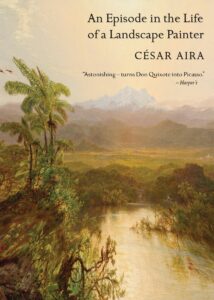
Let us think about An Episode in the Life of a Landscape Painter. Here, in a single landscape, a collision takes place between art, nature, points of view, the perspectives of the text, and those of painting, explanation, and exposition. Also, a repertoire of questions about the artist’s gift and the circumstance of its unleashing, the impulse to travel, and the impulse to stay. (The Argentine artist Gonzalo Elvira has transferred this work to his painting.)
Let us think about Mil gotas [A Thousand Drops]. In this novel, those drops of paint that compose the most famous artwork in history “escape” from the painting, launched into their particular adventures and scattered “across the five continents.” Together they form the Mona Lisa, but separately they acquire that rare and fragile condition of individual entities. It so happens that three young Chinese illustrators (Coco Wang, Peng, and San Er) drew their own version of the text.
Let us consider Artforum. By now, it is clear that Aira is one of the most accomplished practitioners of the ready-made in its entire history. Although this virtue involves both following and betraying (the influence and its overcoming) in relation to Marcel Duchamp. If the ready-made usually involves the adoration of an object placed in a space where it is not expected, Aira adds a twist by constructing a plot in which the protagonist pursues having a famous magazine—the quintessential object among art publications—become a subject and fall in love with him. Like each of his books, this one is a machine for re-signifying. How is art situated in writing? How does writing function on a visual level? How does that symbiosis give rise to a third language that is neither art nor literature, but contains both dimensions?
Let us think about the book The Miracle Cures of Dr. Aira. That narrative in which intuition is above rationality, the gaze comes before technology, the grotesque ahead of pretension. With this fake (or not) doctor, dragging the conviction that all true art happens in extremis.
Three. Today, art is so scarce in mystery that it perhaps only leaves us with more or less curious episodes. Like that twilight chapter where museums no longer house the exhibition but have become, themselves, the exhibition. This change does not affect César Aira’s art too much; his books can offer extraordinary exhibitions but can rarely be compared to a museum: a jíbaro spirit always remains in them, an ephemeral place where irony draws its boundaries.
Let’s say that César Aira is the opposite of Orhan Pamuk’s The Museum of Innocence (a beautiful book that, however, sometimes borders on being a museum of naivety). So, rather than accumulating the life tragicomedies of his protagonists, Aira chooses to release them in plain sight. In the end, what do we prefer? To be an artist or to possess art? The gift or the property? This disquisition marks his story “Picasso,” in which power, fame, and money intersect. What do you desire: to “be” Picasso or to “have” a Picasso? “To be or not to be” on Shakespeare’s string? Or “To have or have not” in Hemingway’s retort?
For reasons not always clear, though not hard to understand either, I am sometimes accompanied by a book by César Aira, composed of two seemingly very different chapters: On Contemporary Art, followed by Trip to Havana (The English edition contains only the first text). Here, as on other occasions, our writer hits the nail on the head: Contemporary Art and Cuba behave as two sides of the same coin, where the illusions, failures, and alibis of a long era nest. That which spans from 1917 (with Duchamp and the Bolsheviks turning the world and art upside down) to the 21st century, in which revolution—political and aesthetic—finds no apparent place and dedicates itself to clamoring in the wilderness its ruin or defeat. Here, we have to contend with a revolution that has come to inhabit any Museum of Contemporary Art in the world and a writer, José Lezama Lima, who no longer inhabits his house, that ramshackle museum dedicated to him by what remains of that revolution.
If Cortázar introduced Lezama Lima to the world—see his essay “To Reach Lezama Lima”—Aira sets himself a less heroic, though equally arduous, goal: to arrive on foot, walking through a Havana without sublimation, to the dead poet’s museum.
In an art world bent on eternalizing museums to the same extent that it simulates their critique, the directors seem dedicated to paraphrasing Fidel Castro’s famous phrase about the revolution: “Within the museum, everything; outside the museum, nothing.”
The interesting thing is that Aira does not subordinate the survival of art to the survival of the museum. It doesn’t matter if it is metabolic or situated. Sovereign or expanded. Public and private. If it functions in laboratory mode or a Blockbuster plan. As a house of the muses or as a hotel for nitwits.
Social or elitist. Mainstream or fringe. About the result or the process. In conservation and in progress. In war and in peace…
The museums gasp like fish on the sand.
Are they out of their habitat? Not necessarily. This “gasping” has become, precisely, their habitat. That moaning from which they seek—cyanotic—to become themselves an intelligible art capable of persisting in the heart of words.
*This text was originally published in Spanish in the print version of Segno magazine. It was reproduced in Rialta with the required permission.