Danay Nápoles proposes a sort of erotism, the erotism of faciality. Her discourse (logos) is realized as a de-recognition of bodies. Mental bodies. Architectural bodies. Bodies of gas. Naples needs to look directly at the sky in the hope of seeing the scene as a whole, that is, to see more and more clearly. This need is anything but placid. It is a game with something that flees.
Danay Nápoles deconstructs “natural” landscapes and turns them into fictive polygons. She transforms them into mutant spaces. She identifies them as springs where we perceive ourselves.
The gaze as an autochthonous, autotelic, possibly redemptive faculty of the mind. Naples emancipates an unprejudiced gaze. A gaze that (also) listens. Photography as a conative gesture. For Danay Nápoles, photographing is like playing a game of mirrors where each individuation is implemented in an expanded self. Expanded (also) towards herself.
Danay Nápoles understands each face as a possible world. She is interested in determining (and not only that) the political territory of the face. We are talking about a dimension. A machinic dimension where subjectivity is articulated not from the edges but from an essential epicenter.
Expanded (also) towards other landscapes that are passages where there are no factual faces, but still they are implied. A skylight. A body-swallower. A memory-swallower. A slot machine. It gives the impression, sometimes, that those skies photographed (facialized) by Danay Nápoles hide other ruin-formed skies. Ruin-formed bodies. Ruin-formed memories.
Danay Nápoles gives a face to what is in ruins. She bestows a face on the world. “Everything that rises falls, / and everything dies in contact with what has fallen,” says Pascal Quignard. Danay Nápoles photographs that place between what is rising and what is falling. That in-between place. Halfway. That exact place.
We are inside an exhibition, inside your first personal exhibition in Madrid. Human Mind is composed of images from several series, isn’t it?
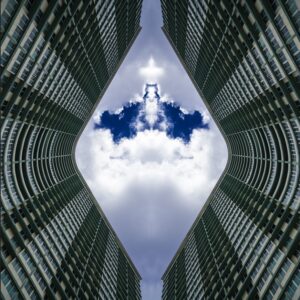
Yes, here you can find images from the series Human Mind, which gives its title to the exhibition. It is a series that I have been developing since 2020. I discovered it through photographs of architecture and interiors I was taking. One day I saw the stain. A stain that reminded me of the Rorschach test. The initial idea was to make ten images: Test 1, Test 2, Test 3… I’m interested in seeing ourselves in those stains.
Were the pictures taken in Havana?
Initially, yes. But now I am taking them in different cities. In addition to the ten images taken in Havana, I would like to take ten in each of the cities I choose.
Danay, I remember there was a time when you traveled around several Latin American cities photographing art deco buildings. That is to say, your photographic research on architecture began quite some time ago. What is the relationship between that research and the Human Mind series? Are they related?
Totally. The photographs I took in several cities in Argentina, Chile, Brazil… were a great learning experience.
And what happened with that series of photographs?
Many of them were shown and others I haven’t exhibited yet.
You take both analog and digital photos…
Yes, but I mainly work digitally. Although I have done analog photography, I prefer digital as it is more inexpensive.
I’ve seen you taking pictures in the street, here in the Lavapiés neighborhood with an analog camera, taking pictures of people. In fact, portraiture is perhaps the genre that people identify with you the most. Portraiture is something that accompanies you. What are you interested in capturing?
Portraiture has been with me since the beginning, since my first series. It’s very interesting how I connect with people. You saw me that day doing “neighborhood portraits,” as I call them. It’s a series I’ve done in different neighborhoods of Madrid. I try to connect with people. I don’t look for specific people. I think everyone has the possibility of being photographed. The portrait comes out of a connection.
However, my perception is that in this exhibition you do not portray an exteriority but an interiority. In fact, you show two self-portraits. Two self-portraits you took when you were pregnant. Do you usually take self-portraits?
I have a series of self-portraits. This is the first time I have shown these images. I also show belly buttons that to me connect with the root, with that connection with life.
You’re talking about the series The Navel of the World…
Yes.
You explore that idea of origin…
And of the body. It’s a series I made during pregnancy. The origin. The birth. The root. A new beginning. A new life.
Tell me about the Skylight series. I feel that Skylight is closely related to the Human Mind series, this idea of portraying shapes, stains…
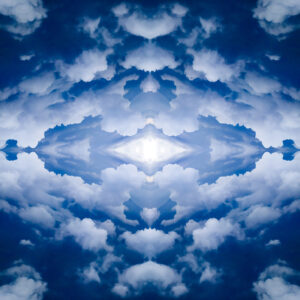
Yes, in this case, there are the clouds, but Skylight is an idea that emerged from the need to keep dreaming. It arose as a search, as a need to keep on beating. In other pieces of this series, you can find any image, it doesn’t have to be a piece of the sky. They are universes. It is a dream that you can reach.

It is urging contemplation in some way.
Exactly.
Danay, I feel that in that re-tying—the sky or the contexts that surround you—there is also a need to expand the notion of portrait. The portrait not only in relation to the human face but to the faciliaty of the environment. I am interested in the portrait as faces that accompany us and are not even part of the human body. Architectures as faces. The sky as faces. Vegetation as faces. In your case, I would like to explore this idea of the face as something expanded. Would you also be interested in thinking of it that way?
Yes, it is interesting to see it that way.
‘The Root of the Body,’ from the series ‘The Navel of the World,’ Danay Nápoles
These three series we have talked about, Human Mind, The Navel of the World, and Skylight generate a sort of counterpoint. On one side we see that permanent exteriority, and on the other, there is a return to that inner place…
It’s more intimate. I see it that way too. I also included the series Natural Polygons. Everything has a connection. With Natural Polygons I reconnected with nature. Here in Madrid, I miss the sea very much. It is through this search and this absence that Natural Polygons is born.
You remind me of Saint-John Perse with those “roads woven of sky and of sea”; like that “sea as a sky.” Your search for the sky is also a search for the sea.
Yes, you are right.