I have not been back to Cuba in five years. Last time, I flew from Mexico to Havana and rushed through a weekend of which I have hardly any memories. By 2019, I had already become a foreigner in my hometown, just as I had long been in Guadalajara, and as I am now here, in Montreal. However, an arcane root still connected me to Havana’s affective spatiality. To its night, to those steeps’ streets that push you to the very edge of the Malecón, to the corners where boys go around while they discuss “reparto”[1], soccer, about how bad things are. Back then, Cuba was different, and I didn’t think about the rotundity of what I was losing. There had not been a pandemic. Cubans had not taken to the streets driven by despair, precariousness, and the real possibility of a system change. The president had not issued a fratricidal order of combat on national television. The jails were not full of 11J demonstrators[2]. My friends had not left.
That Cuba no longer exists. Although it is possible, of course, that what we had then was the feral claw of our youth. The need to inhabit another world, a physical urgency, refractory to any attempt at domestication. Now I think of the night of those years, while in one of the rooms of the Centre Clark, the photographic reel of my generation runs unstoppable. I identify the faces, the gestures, the smell of bodies in movement. La fiesta vigilada (2015-2024), a video by photographer Leandro Feal, is part of the exhibition Nuit éternelle, désobéissance esthétique, curated by Amed Aroche, an artist and independent curator based in Montreal. One after another, the snapshots of a decade accumulate in the darkness and shape a map in which spaces have ceased to belong to omnipotent state power. At that hour, and installed in the heart of the party, no one doubts about the subversive potential of the night. An alternative territoriality that seeks to found new ways of being in the world is thus configured. The kids dance, smoke, kiss, and smile at the camera. I appear in some of these photos; I see myself passing by, and I hardly recognize the person I was.
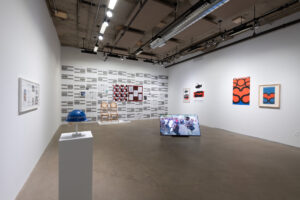
Nuit éternelle…, Aroche explains, is structured based on two different approaches to the figure of the night. On the one hand, it functions as a metaphor for the asphyxiating and liberticidal totalitarianism of the Cuban regime; on the other, it points to the dissensual nature of nocturnal space-time. Thus, both conceptualizations ultimately illustrate how power and resistance appropriate and contest the nation’s times and spaces. But we already know the history of power; we have learned it from very early on. Before school, the press and public speeches, it seeps, like a damp stain, into the domestic weaving of everyday life. Doctrine begins by manufacturing normality wherever the system exposes its flaws. Relativize the lack of freedoms, say, inequality, violence, hunger. To normalize, to normalize. Normalize the imprisoned friends, the emigrated friends, the drained island.
“There’s no one left in Cuba,” I think, still sitting in front of Feal’s video. But that’s a half-truth. There are many people left, of course. Those inside and outside participate in a geography that is defined from dissimilar scales, depths of field, and intensities. The undisciplined energy of these photos crosses the punctual time of the generations. And, in doing so, it accumulates in itself the many inflections in which we all exercise resistance. It teaches us something that no one else does: that the body is the first terrain of political action, that gestures of emancipation connect us to others by becoming “private acts of solidarity with the future.”[3] The party of the night, even under surveillance, snatches from power quotas of sovereignty that have no return. How do you stop a body that suddenly discovers that it is alive?
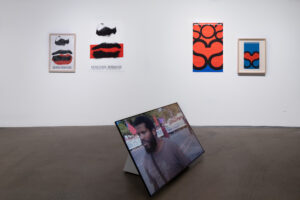
The exhibition in front of meabout this type of dissident gesture. The night, more than a thematic axis, serves as a device for deterritorializing the narratives about today’s Cuban reality. This is crystal clear from the title, which includes one of the central concepts of the project, namely, the notion of “aesthetic disobedience.” In the accompanying text of the curatorial proposal, Amed explains that Cuban artists he interviewed during the research that led to Nuit éternelle… repeatedly mentioned such an idea. Perhaps what interests me most about the principle of aesthetic disobedience is its appeal, more or less explicit, to the re-qualification of what we understand by the praxis of political resistance. In this sense, it seems to point to an action characterized by the small scale, improvisation, the rupture of times, the punctual appropriations of public space, and contingency. Sometimes it reaches the frontality, but it is not the power that sets its agenda.
As I walk among the pieces that make up the exhibition (artworks by Luis Manuel Otero Alcántara, Raychel Carrión, Liliam Dooley, Ernesto Oroza, Lester Álvarez, Kevin Ávila, Leandro Feal), I discover that many of the elements in dispute are of a discursive, identitarian, and spatial nature and are linked to historical memory and civic performativity. Each gesture, however, demands to be read within a web of relationships that includes not only authority and its regulatory framework, but also the potential of individual and collective imagination when it comes to generating new territorialities. Some years ago, amid an intense period of repression against the San Isidro Movement (MSI)[4], Cuban activist and intellectual Anamely Ramos called for the implementation of small initiatives of political contestation that, as a whole, would have a tangible impact on the functioning of the Cuban governmental machinery. The image, then, was that of the pebbles we throw into the water for the mere pleasure of witnessing the formation of waves. A single stone constitutes a one-time event, but the juxtaposition of several, Ramos pointed out, generates structural movements.
Nuit éternelle… can be understood in relation to those “geographies of resistance”[5] systematized by Steve Pile and Michael Keith several years ago, and which are regularly implemented by Cubans both inside and outside. From those conceptualizations, I rescue, in the first place, the autonomy granted to “resistant political subjectivities,” to the extent that they are not always interested in the implementation of territorial reconquest processes, but in the foundation of spatialities with their specific dynamics. These strategies have been key for many social actors in recent Cuba who have proposed inhabiting enclaves dismissed by the state and trying out new models of community within. The example of social media and its impact on the country’s political life is perhaps the most representative of all due to the reach that the July 11, 2021, demonstrations –massively disseminated through Facebook– had among Cubans. But it is not the only one. Months earlier, a group of young people belonging to the San Isidro Movement had decided to barricade themselves in a Havana house (the home of the artist Luis Manuel Otero Alcántara) in protest against the arbitrary detention of one of its members. What happened there, the reality they tried to build amidst government repression, put in crisis the traditional distribution of civic spatiality. Instead of taking over the sites colonized by the official machinery, these activists proposed alternative formulations of the public, now connected to affections, individual bodies, and the domestic space.
On the other hand, I emphasized the importance, within the geographies of resistance, of recognizing the roles of the context when it comes to semantizing dissensual actions. How a gesture is loaded with meanings depending on the space in which it is developed and how much it can influence the configuration of unauthorized territorialities. Fallas de origen (2008), the video-performance by Raychel Carrión, is framed in a scenario in which these questions are fundamental. International Workers Day’ march in Cuba constitutes one of the events in which the state continually stages its legitimacy in the face of the citizenry. Here, as in so many other ceremonial events, its symbolic capital is reactivated through the narrative correction of reality. Having a monopoly on public space allows it to hijack the voice of civil society. There is no more alienating experience than speaking on behalf of power by “playing” the role of ourselves. To this theatrical representation, Carrión alters a presumably minor variable that, nevertheless, dislocates something essential to its dramaturgy. I am speaking, specifically, of the slowing down of the epic time of the Cuban Revolution. As if it were a constitutional failure, this “systems error” reveals the artificiality of the event and draws attention to the abyss that opens up between the times of political power and those of the individual subject. We should not lose sight of the fact that the deceleration, in this framework, emphasizes the importance of relationality, respect, and empathy.
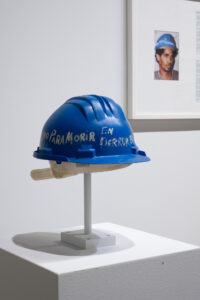
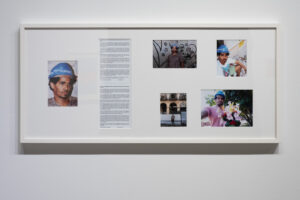
Empathy, I repeat several times in front of the work of the artist Luis Manuel Otero Alcántara. I do it for Luis Manuel and for the Cuban girls to whom his piece pays homage. Luis Manuel has been imprisoned since 2021 because of his political activism and his work’s involvement with impoverished and racialized neighborhoods in Havana. The girls María Karla, Rocío, and Lisnavy died in 2020 due to the collapse of a building balcony in the process of demolition. Despite the government’s dismissal of the event as an accident, many members of civil society pointed to the responsibilities of officialdom in the matter. One of the verticals that runs through Otero’s work is precisely empathy, the need to put his body in the place of others, in the place where they are most vulnerable. That is why he addresses the community and not the state. This repositioning of the gaze grants new possibilities to the map of the nation, now encrypted in the bodies that resist and generate networks of solidarity. For several days, the artist walked the Havana streets with the protective helmet I have in front of me, on which is written: “Children were born to be happy, not to die in collapses.” Those of us who, from the outside, followed the action through social media believed that in Luis Manuel the country could begin to heal. Cuba in a concrete body that seeks to restore what is broken through small-scale but relationally significant social interventions.
Within the principles that structure these deterritorialization initiatives of totalitarian hegemony, collective imagination plays a key role. This is related not only to the rewriting of official narratives, the crisis of institutional historical memory and the truth of its archives, but also to the ability of Cubans to evade the surveillance of power and propose contingent strategies of resistance. This element will be a constant in the exhibition, manifesting in the different artists’ operations and the relevance given by the curator to the political spatiality of futurity. We only have to focus on one of the literary referents that the project orbits: “La noche no será eterna,” (The night won’t last forever) by Oswaldo Payá, a text on Cuba that, according to Aroche, “(…) opens the door to imagining a possible democratic future, revealing a perspective of change a possible dawn.”[6]
Imagination implies overcoming the epistemological fence of a present regulated by doctrine. To de-automatize the signifiers and the roles that we all take within the scheme of the country. Inevitably, I return to the American writer Saidiya Hartman and that methodology of historical restoration she calls “critical fabulation.”[7] Hartman writes from the realm of transatlantic slavery and its multiple horrors, but the urgency to oppose the violence consubstantial to the colonial archive reverberates in all subaltern discursivities. Narrating counter-histories, she argues, is the only fair way to write a present/future traversed by unresolved violence.
What could be the writings of a post-totalitarian Cuba? Is it possible to dodge the censorship machinery? How to dislocate the order of things that also rules our formulations about the future? The processual installation Biblioteca para lomo-lectorxs (2019-2024), by Lester Alvarez and Kevin Avila, offers the possibility to think about these and other issues. The authors’ proposal is simple yet powerful: what titles would Cubans publish if we had the opportunity to choose our readings/writings in freedom? Our margin of action seems minimal since the choice is limited to a few words. However, on more than a few occasions, the grounds for resistance tend to be punctual. A sentence is enough, a syntagma is enough. Once the mechanism of imagination is in motion, titles become acid devices of disobedience through which power is exposed: its fictions, its disciplinary anxieties, its congenital mediocrity. As it is an artwork in continuous expansion (the one that participates in the exhibition was made in 2024 at the University of Montreal), its contents end up transcending the wire fence of Cuban totalitarianism and go deep into contexts in which power wears other disguises. Because power is always the same. And, more than learning to name it, we must learn to circumvent it.
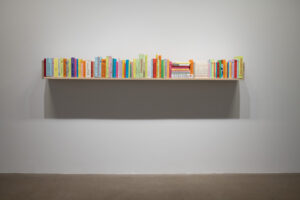
Titles accumulate in this insurgent library. They speak the awakened language of those who inhabit the margins and insist on founding a place of their own where space is already distributed. These, I tell myself, are the unborn books of the kids who turned Havana nights into the realm of subversion and enjoyment. Although they exist only as mere attempts at narrativity, they oppose the memory of the official archive. They delegitimize their tales, but also the voice that narrates. Voice and archive go hand in hand: both configure national and identity imaginaries as if they were a physical property. But this property, of course, is not physical but ideological, and its violent nature is given both by what it documents and by what it silences. Aroche is aware of this; that’s why the archive, within the exhibition, functions as that record of political temporalities which is inherent to protest art and, in turn, makes visible how its narratives are validated, reproduced, and reactivated from a complex network of institutions and agents that contribute to consolidating the fiction of its neutrality.
Quodlibet (Exposicuba) by Ernesto Oroza (an artwork resulting from the dialogue between the artist and the curator) refutes this alleged neutrality by disavowing the truth of the post-revolutionary Cuban archive. To do so, he dismantles the image of the country that the regime exported to the world for more than sixty years and contrasts it with those of two of the leading contemporary political artists: Hamlet Lavastida and Luis Manuel Otero. Cuba’s participation in Montreal’s Expo 67 would work for the young Cuban state “en tant que vaisseau propagandiste envahissant.”[8] All efforts, during those years, were focused on create the Revolution symbol. Its elaboration implied the abduction of the diverse territorialities and meanings associated with the nation. Lavastida and Otero revisit this process of meaning production. They deconstruct the symbolic artifact and restore the gap between country and doctrine. In that gap, they slip, as a counter-memory of the present, the police control mechanisms that guarantee the perpetuation of the symbol, its daily staging. Against the backdrop of the Cuban Pavilion in Montreal, designed to promote the system’s virtues, is projected that Lavastida’s Penitentiary Republic, which, like rust, infects the body of the nation from its entrails. A Republic that monitors, criminalizes, and punishes.
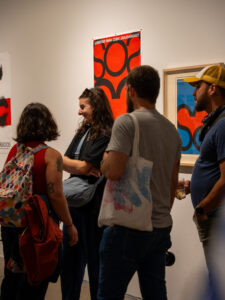
Before, I talked about empathy, although the term, after so much rhetorical manipulation, has begun to empty. For us, however, any solution must pass by there. Because the place of people –the place of the human– is where history happens, or where it should. A symbol founded without taking that premise into account is doomed to fail. To fail us all. That is why, when Lilian Dooley intervenes in revolutionary posters to speak to us Cubans, what she is doing, first of all, is an act of empathy. And she does it through images created in state institutions. The authorship, the aesthetic result, and the artistic object are issues that remain at the second level. What matters, Dooley has commented, is what the pieces she redesigns are used for. That’s the key: her works denounce, protest, dismantle, but also place Cubans in the national conversation. They summon us to look at others and to think about the country through them.
These are the fragmented geographies of today’s Cuba. And this has to do with the dispersion of Cubans, but, above all, with an idea of the future capable of including diversity. In his introduction to “Geographies of Resistance,” Steve Pile, returning to Michel de Certeau, argues that the spaces of domination are well demarcated and exclusionary by definition; those of resistance, on the other hand, are discontinuous, intermittent, opaque.[9] To deterritorialize the nation means to litigate those spaces that totalitarianism has appropriated (the affections, the public sphere, the historical memory, the story about us) and to reinvent them from the simultaneity of the bodies/experiences that make up the community. A new cartography implies reconnecting the isolated points based on logics that have little relation to the symbol stability. Like the stream that Neddy Merrill, in The Swimmer, conceived by threading together the swimming pools of the houses in his neighborhood, we must reweave the threads that link us.
This makes Nuit éternelle… visible: other geographies on the system margins, elastic spatialities that power doesn’t control. It does not know how. It does not understand its modes of articulation, produced in frequencies not registered by the radar. I speak of imagination, of care, of desires to change things, of unauthorized narratives, of attentive listening. I speak of young people of all times, determined to abolish the laws of daytime life, the socially regulated time, and to transform the night into a tool for emancipation. Putting the body at the center, which is, I repeat, where history happens. A body that enjoys and suffers, is exposed and hides, dissents and is punished. In that adjustment of perspective, in that displacement that goes from the signifier ossification to the irreducibility of the bodies, lies the future of a diverse Cuba in which we all can participate.
Notes:
[1] The “reparto” is a Cuban musical genre that originated from reggaeton and is very popular among young people. It incorporates slang, reflects the country’s everyday reality, and the imaginaries of a large Cuban youth segment.
[2] On July 11, 2021, in many Cuban cities, a series of popular demonstrations took place demanding improved living conditions and a change of the political system on the island.
[3] Kathryn Yusoff, “Un gesto del tiempo,” in Un gesto del tiempo, ed. Pablo Duarte (Gris Tormenta, 2024).
[4] Civic and cultural movement founded by a group of Cuban activists, artists and intellectuals interested in the defense of liberties and civil rights in Cuba.
[5] Steve Pile and Michael Keith, ed., Geographies of Resistance (Routledge Taylor & Francis Group, 2009).
[6] Amed Aroche, Nuit éternelle, désobéissance esthétique, exh. cat., (Centre Clark, 2025).
[7] Saidiya V. Hartman, “Venus in Two Acts,” Small Axe: A Caribbean Journal of Criticism 12, no. 2 (2008): 11, https://muse.jhu.edu/article/241115.
[8] Oroza, Ernesto, Quodlibet, exh. cat., (Centre Clark, 2025).
[9] Michael Keith, “Introduction,” in Geographies of Resistance, ed. Steve Pile and Michael Keith (Routledge Taylor & Francis Group, 2009), 15.