Exile is also that: erasing the mark of origin.
Severo Sarduy
Severo Sarduy’s life is a winding, complex tapestry. Hence the documentary Severo secreto, by directors Oneyda González and Gustavo Pérez Fernández, remarkably weaves the threads of the Cuban writer’s biography. Oneyda and Gustavo are from Camagüey, like Sarduy. Gustavo Pérez Fernández was born in Camagüey in 1962 and currently lives in Miami. Poet, photographer, and filmmaker. Aunar lo imprevisible is a compilation of his poetic work, which was published by Ediciones Unión, Havana (2010). His photos have been exhibited in Cuba, Italy, Belgium, Portugal, and the United States. His documentaries include Todas iban a ser reinas, Transitando, Ave María, and Severo secreto, his most recent foray into audiovisuals. Oneyda González was born in Camagüey in 1961. Her project Severo secreto won the Cinergia award and participated in the Talent Campus Screenwriting Workshop, Guadalajara (2012). She obtained the Friends of the Princeton Library Research Grant (2015) and the Norwegian Fund for Cuban Cinema (2016). She recently published the book Severo secreto. Una biografía coral sobre Severo Sarduy, (Rialta Ediciones, 2022) and El lazo infinito (2023), Octavio Paz Poetry Prize, Akashic Books, Brooklyn, 2023. We would like to express our deep gratitude to Oneyda and Gustavo for having accepted this invitation and for their generosity in sharing the permanence of their words.
We place ourselves in the context of the writer’s biography, in the trajectory of a literary career, and in the possible recovery of its meaning. We thus see that the documentary Severo secreto begins with a quote from Sarduy: “The life of a man, evidently, begins long before his birth and perhaps continues after his death.” With this in mind, my first question has to do with Sarduy’s closeness and the path that he was leading you down, via the documentary project. To what extent did the writer’s presence accompany you? I mean, as one of the interviewees, Gladys del Pilar Castellanos, says: “Severo is here with us.”
G/O. I think Sarduy was on our path, that we missed him and were looking for him even before we met him. So, when we found him, he was not a stranger to us, but we knew that the discovery was radically important and soon his figure became very close to us: on the one hand, the resolution we took, on the other hand, the need, the desire that Sarduy also had for the island and that has not diminished, rather we think it is expanding: we were in need of a reference like that. We also believe that in some way he remained “attentive” to the path we chose, because it would have been very difficult to do something so demanding without his collaboration, without asking ourselves how he would see it before giving us the go-ahead. That from our side, but there was no lack of wise readers, friends, and different admirers who followed attentively our steps with “their” Severo.
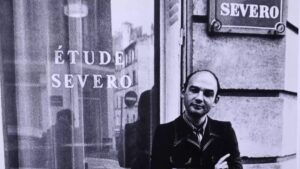
The thing is Sarduy had to accompany us, either through the people and objects that spoke to us of his life or his literary and plastic creation. His name opened doors so we could start with the project, and later helped to sustain the rhythm during the research process. It is convenient to say that at the beginning it was quite complex, because, somehow, it was necessary to overcome certain “tests” to be perceived as reliable investigators of a mythical figure like Severo Sarduy already was.
Everything was evolving and reaching greater consistency when we finally obtained his Complete Works and it was possible to read them as a whole because, at the beginning, we only knew some of his texts; once we finished that first reading, we could have a more realistic idea regarding the dimension of his work. On the other hand, although we were not going to make a purely aesthetic study, neither was it going to be of an exclusive biographical interest: from the beginning we wanted to get closer to the human being whose character had conquered us with his familiarity, his unusual friendliness and, especially, for being the creator of an admirable work.
In short, we wanted his presence to be felt in Cuba: who Severo Sarduy was in many other dimensions. We had the commitment to continue, as it was said, each in their way, by some of the interviewees, and even before when his name caught our attention and the first question we asked ourselves was: why was a Cuban writer (Camagüeyano, at that) with a work and a personality of universal interest “unknown” to us?
It was very strange for me too, with a diploma in literary studies and working in the field of culture, in the same small town where he was born a few years ago! I felt that something was being hidden from us, but rather than finding out why it had happened (and it was already quite obvious), we had a higher purpose: to transform that reality by following the traces that were beginning to become visible. Soon allies appeared: people who had known him and wanted to talk about Sarduy. And it was very curious, because it was more of an open secret, so we realized he was not as unknown as we thought at the beginning.
Many people of his generation remembered him from high school, for example. Some wanted to share their experiences and, when they mentioned him, they would give exhaustive descriptions, giving details about the way he was, his appearance or his character; sometimes without giving us time to ask them. Others would stop to say that Sarduy himself was very generous, that he was very elegant and neat. That he was very serious and committed to his studies, to his family, and his friends. Everything was coming out at the same time, so we decided to record everything that was of interest. It was clear that his acquaintances were willing to collaborate and we confirmed that Sarduy was a being of unusual brightness and friendliness.
Thus, the solidity of his character and the sensation of closeness that people were transmitting to us, managed to captivate us and was key for our confidence to grow and to decide to do something to overcome the unjust silence. It seemed certain that “he was there with us” and that he himself consented to talk about himself, to be visible again in his city and in his country (through these people who kept that memory), that charming way of being that he had and was worth sharing. A curiosity in the midst of it all was that capacity of his to play with seriousness or to work with the greatest fun. Finally, he did not believe in rigid concepts, whether they were about things or people.
Something that caught my attention is the juxtaposition of dissimilar elements at the beginning of the documentary, which has to do with Severo Sarduy’s archive at Princeton. These objects represent Sarduy’s aesthetic and define the narrative tonality of the documentary. “The biography of a man is a rather arbitrary cut,” Sarduy is heard to say at the beginning as the curator arranges the objects from the archive in a tableau. Thus, any biography or narration cannot avoid the mark of the cut. But the masterful thing about the documentary is that the cut is the most admirable thing because the story begins in Europe, in Paris, and ends in Cuba, in Camagüey. How did you determine the narrative thread to follow Sarduy’s footsteps?
G/O. Your words can distinguish the symbolism of the objects that belonged to Severo Sarduy and that were useful to give meaning to the story of his life, even though we present them at the beginning wrapped in a halo of mystery. It was key from that moment to expose the dimension of his work and character so that people would ask themselves questions that we had already asked ourselves. And because at the beginning the character had to conquer the viewer, to convince them of the pleasure they would derive from getting to know him better. And that, from there on, we could tell them where that will, that friendliness, had come from. To discover how he decided, on his own, to go after his dreams, searching for a freer and more open space. This allowed us to give the story a somewhat Sarduyan structure. We had to bring him back! And I say this a bit jokingly (because it is a phrase that is often repeated), but also seriously, because knowing the dimension of his legacy, one feels an attraction in contrast to the “oblivion” that persisted within the island even then.
They are there only to achieve that attraction from the beginning and to distinguish within the whole the enigma of this being, who, seeming to be a magician, was, without doubt, also a worker: a laborer. And that, with this prologue-like exposition, the “I” of the character would appear little by little. It must have been like that from the beginning, because otherwise, we would have probably discarded the marbles, for example, after considering them charming (a simple object of childhood and that’s it); we decided, then, to take advantage of the significant value they would have as part of the construction of the character because of the symbolism behind them: the expression of that “eternal child” that his relatives, friends and acquaintances saw in Severo Sarduy.
With this, we also celebrated the archival work because we were surprised to see the marbles there, included among his personal objects, which is an assessment in the context of his image as a writer. Did Sarduy (still) play marbles, or did he just want to remind us that he came from a playful environment? Or did he keep them when he saw that his mother kept them? Or was he one of those people whose childhood objects are a kind of amulet? A protection? Who knows!
That is why it was feasible to articulate the object to the orb of the poet (of the artist) and, in this way, to appreciate the object and its reflection: intelligence-amusement, a mixture of gestures the writer never abandons. There is thus, a tight synthesis (also expressive) where, through the images, the spectator attends Sarduy’s probable rites and, thanks to it, his objects still accompany us. Finally, we also played. I, for example, who was a librarian (and archivist), saw it as the possibility of taking advantage of the material and its history. Either because of the appreciation and care his family showed them (initially), or because of the affection that Sarduy shows by preserving them: this man not only played marbles and showed it to us, but in a way he was “playing” until the end: as we know, Severo always maintained a playful attitude.
There is, in addition, a male gaze (of another boy) who, like almost every boy, played marbles, who was thrilled to see them when we arrived at Princeton and immediately consented-participated in the mixture of both aspects. But I insist: I would also like it to be an ode to the scientific and, again, playful condition of the investigative process, which on certain occasions can manifest itself in great beauty. How the hands of an expert curator of his archive take Sarduy’s objects is so delicate and tender (I would say maternal), it is nothing but care. So now, seeing it through your eyes, I think that image shows appreciation—and lots of it—for the researcher’s job. It is a form of recognition to all those people who do a generally anonymous, solitary, yet joyful, and especially sensitive work, no doubt. I could not let them out of the film, even if the marbles seemed to be only the object of a child’s game. And that is why they are there, together with (archeological) objects that, among many other things, Sarduy brought back from his trips to Asia. With this act of humility, difficult at times, not only we imposed on ourselves a rigor—not limited to the historical—for the representation on screen of Severo Sarduy’s life, but together with the iconography he collected over time and the testimonies of his acquaintances, the being we had imagined and whose existence we had verified during the research process should emerge without straying far from who he was historically. We were mediators aware of the challenge we faced and we dealt with the subject very often to make sure that, by choosing to follow in the writer’s footsteps, we had chosen that this was “his” documentary, so, in a way, it was Sarduy himself who suggested that these objects should be in the film.
Right after the image you described, we see a newspaper clipping announcing “Sarduy’s death without having returned to Cuba.” That is the drama that immediately becomes the point of view of the documentary: Severo Sarduy always wanted to return to the island (especially to Camagüey), but, according to the testimonies, he did not make the decision in time “and then, it was too late.” From this essential conflict in his life, the narration of the film starts: with his longing for a return (desired and postponed) until the end; now, for good!
The documentary is structured in three parts:
The first part: “He finished his career”: describes Severo’s arrival in Paris with a scholarship from the Cuban government. His adaptation, enthusiasm, and growing success. It portrays the character in his years of splendor. The writer’s conflict in separating himself from his family and his country indefinitely is presented and discussed.
The second part: “Come mortal and consider”: we learn about Severo’s origins, the spiritual substratum of his family, his region, and his country. We see his entry into Havana’s high culture scene and the creative activity where he quickly inserts himself in the best of literary circles; and the very rapid arrival of the triumph of the Revolution, shortly after which he obtains a scholarship to study in Europe.
The third part: “What are his accomplishments”: evaluates Sarduy’s legacy: his work, and his personality. The conflict is resumed by unfolding the character of the exiled writer (and the silencing of his work on the island) until consolidating the point of view of the narration: the recognition in the face of an exclusion, which is contrary to freedom, from where the urgency of spreading his life and his work within the island originates.
Now, why start at the end? The answer is simple: we did it to say, from the beginning, who we are talking about: to present the character already in his fullness of life and work, which was an important condition to attract the viewer (especially the Cuban) who paradoxically knew less about him. The Sarduy who is known there is the one who has already reached creative maturity and has obtained enough relevance to make it urgent to increase his visibility inside the island.
In the scenarios of the documentary, there is a transatlantic collection: Camagüey, Havana, Spain, Paris, New York, Miami, among other places. What difficulties did you have to overcome in all these scenarios that, in a versatile way, converge in the texture of Severo secreto?
G/O. We knew that the production of the project was going to be a challenge beyond our strength due to the practical conditions that the shooting would demand and the very limited infrastructure we had. It was almost unthinkable for us to attempt it on our own, among other things because of the vastness of the journey if we were to follow Sarduy’s footsteps; in particular, what was going to happen outside Cuba. But we didn’t want to stop and, once it reached the necessary solidity to apply for financing, we contacted the producer (Rita González), whom we knew from previous works, and she sent the project to different film funds. Some time later, that same year, we managed to obtain the Cinergia and Ibermedia grants. Rita was in charge of scheduling a careful shooting plan and contacting the persons to be interviewed, especially those we would meet in Europe, an essential scenario for the story.
When this possibility became a reality, we realized that the most difficult part was not Camagüey, not even Havana, where we were limited to our resources. What was really complicated would be to coexist with the climate of Paris without the minimum conditions to face the rain or the cold. And, along with that, keeping our poise, and resisting the anxiety of a possible technical failure (always a threat) due to the very limited filming equipment we had, two of the constants that hurt us and that we managed to overcome by dint of tenacity. In this aspect, the participation and friendship of the people who accompanied us from the beginning were essential, among them Adonis Liranza (Cuban producer based in Paris), who was our most efficient collaborator, our guide, our translator, and, definitely, a great friend.
As a result of new attempts to move forward with the project, in 2015 we obtained the Friends of the Princeton Library Scholarship, and when we arrived at that University another surprise awaited us, this time, definitely, a miracle: there it was, untouched, Severo’s visual archive, the one that François Wahl offered us in Chantilly and that, for technical reasons, we were unable to film and we already thought it was lost.
Very close to the end, we applied for funds from the Norwegian Embassy in Havana, whose support allowed us to face the post-production of image and sound. Filmmaking is complex anywhere in the world, but the importance of telling this story led us to trust and put all our will into it (for ten years!) without the many obstacles managing to stop us.
On the subject of the people who knew Sarduy and who tell their stories in the documentary, one can perceive a feeling of warmth on the part of several interlocutors when they talk about the writer from Camagüey. Did you foresee that feeling of intimacy and joy resurfacing in the documentary?
G/O. It’s wonderful that you felt that sense of closeness. We had references about his charm and confirmed it from the start when we talked to his classmates in Camagüey. You have to see the testimonies of Gladys Castellanos and Dr. Agramonte, which, as you say, are really delightful. They began to study medicine with Sarduy and had been together since high school, so that was a friendship forged during their adolescence and it was already a very familiar bond: a small group of Camagüeyanos in Havana.
This warmth grew as we met new characters or moved to other contexts. And it just happened every time. Undoubtedly, he was a human being of an attractive and warmth-generating character: a funny dancer and a great conversationalist, for the sharpness of his views, the comprehensiveness of his topics, and the mischievousness in which he wrapped almost everything. It is also said that he was a kind of monk when he set out to do a job or face a complex situation. But yes, the answer is that there was always laughter in a conversation with Sarduy. A resounding and brilliant laughter.
Another exceptional point is the collation of Sarduy’s archive. There are several archives in the documentary and they overlap dynamically and subtly: there is the pictorial archive, the textual archive, the photographic archive, and the audiovisual archive, among others. I think the archival work you have done can be described as outstanding. What was it like to work with the alignment of all these materials for the decisive imprint of the documentary? What findings or disagreements did you have in relation to the collation of the archive? Of the archives?
G/O. Although working with the archive was indeed a reward for such an incessant search, it was an extensive, laborious, and even exhausting process because it was difficult for us to give up on something. And because the combinations were determined by what we had already managed to articulate. That is why I believe that more than “aligned,” the treatment of that immense material was perhaps also “baroque”; and the consequence of an obsession, of a commitment: that the film should look like Sarduy. At the same time, this gave us some freedom and the option that, to a certain extent, it could also show a playful nuance. So there was a marriage between the narrative strategies: the structure helped the archive become an ally of the story, whose almost mathematical order would only be disrupted on occasion conferring a looseness to the discourse. The great gift came with the Princeton scholarship, which allowed us to read Sarduy’s correspondence with his family and access his pictorial work treasured by the university, which served in principle to give it a visual, Sarduyan imprint. Thanks, also, to many of the people we interviewed who offered us their small memories of Sarduy: photos, dedicated books, letters, or a simple anecdote that referred us to a place that we filmed later on purpose. All this expanded the archive, the visuality of Severo secreto.
There is a beautiful example that we owe to the poet Manuel Díaz Martínez, who, during a pause in the interview, told us that the Centro Atlántico de Arte Moderno de Las Palmas de Gran Canaria had a piece by Severo Sarduy in its collection, and we went to record it without wasting time to incorporate it into the film, both for its beauty and usefulness in working with the image but also for the affection with which this friend from his youth, in Havana, insisted that we go to see it and record it so that it would be in the story. The decision to include whatever was most revealing or gave a particular meaning to the film prevailed. Finally, the collation of this immense archive benefited from the professional and very sensitive eye of our editor for many years: Yoan Wilcox Portel, a talented young man. An indispensable human being as a friend and in the creation of Severo secreto, among other films.
In that sense, Severo secreto stands as a great archive, since there is a treasure trove of testimonies, of original gestures that complement the writer’s secret biography. Did you think, at some point, the documentary would also become an unavoidable archive for those interested in Sarduy’s work?
G/O. The enthusiasm to make sure Sarduy was better known motivated us from the beginning to the end of the process. Whenever we came across a discovery, we always looked very carefully for the destiny we were going to give to that kind of treasure. It is something that we kept in mind and that grew during the ten years of research, shooting and post-production of the film. So yes, we think that the documentary Severo secreto is a valuable document for anyone who wants to approach his life and work from other perspectives. There is his humanity, there is also the cultural environment in which he lived in Cuba as well as in Paris. This has been recently expanded with the book Severo secreto: Una biografía coral sobre Severo Sarduy, published by Rialta Ediciones, where more than 30 interviews conducted for the documentary and nearly 100 images collected throughout the process are gathered in full.
Nelda Castillo’s commentary towards the end of Severo secreto is very moving. It is the rescue of a writer whose erasure from the annals of Cuban literature persists. Nelda’s commentary grows in importance as we get closer to the biography’s journey landing on the island; there, you intertwined it with the image of a person chiseling on the wall, carving Severo Sarduy’s face on a wall in Camagüey. Does that visual metaphor correspond to the fact of leaving an inscription of Severo on the island as an ultimate, symbolic desire of the author to return to his native country?
G/O. That’s a good observation because one of the things we set out to do, from the beginning, was to find out in what part of the city Sarduy was born. Long before we thought we would do an investigation, the end of which could be the shooting of a documentary, we knew the number of the house where he was born: located in a central area that we often frequented without knowing it yet. It is the street where the Teatro Principal is located. Also, one of the scenarios where various events occurred (and still do), including carnivals, which, like other of the most central streets, was not precisely very chaste; especially thinking that it was named after Father Valencia, pious and very notable Spanish priest settled in the city and almost a Camagüeyano. We were lucky that, on that same street, very close to where the writer was born, there was at that time a house in ruins that inspired the idea of the fretwork so that his image remained there as a kind of clue for the passerby, but also from where a curiosity about that face could arise.
In 2022, Rialta Ediciones, in Querétaro, published the book Severo secreto. Una biografía coral. How was the process of transcribing the interviews from the documentary for the book?
G/O. The selection of the fragments to be included in the documentary began with the transcription of all the interviews we had conducted. When we noticed that some fragments of really important testimonies would be left out, we started to nurture this idea that it would be convenient to gather the interviews in their entirety and publish them in book format to take advantage of all that value that would otherwise have been lost. Once this was done, we had to put the interviews in order, which gave concrete form to the idea of picking up the basic structure (in three parts) that the documentary originally had.
Almost at the end of our dialogue, I would like to know if Sarduy’s work has changed your vision or your sense of what it means to be Cuban.
G/O. Sarduy has definitely complicated our lives, for the better. This means that, in the first place, he has managed to intensify our curiosity about our origins, which is already a lot. He acts as an antidote to the strategies of concealment of many of the values that belong to us as a nation. His personality and his work have the virtue of broadening our way of relating to each other, which should be nothing more and nothing less than the acceptance of the other. And, in addition, he gives us back a vision of what is Cuban, which is at the same time human and which we often ignore or have failed to appreciate and put into daily practice.
On a more intimate personal level, the writer revives in us a resoundingly Creole and curiously universal feeling. In the correspondence with his family there is a detail that speaks of this and that immediately caught our attention. From the first to the last letter of Sarduy that we had the opportunity to read, he always ends up putting, next to his own name, the word love: this was his signature: “Severo Amor.” Perhaps therein lies the secret of why, despite the years and the distance, he never lost the purest traits of Cubanness and the innate capacity to share them with others, sometimes in a very subtle way, but always effective and powerful. What a good family gives us is in essence what we can give to others.
Finally, why do you think it is so necessary to return to Severo Sarduy’s work today?
G/O. To begin with, readers who go out in search of Severo Sarduy are still in time to come to a real feast, because it is the work of a forward-looking man, although, in a way, he is also a classic. He is a writer who returns to the baroque, making things surprisingly new. That the dramatic scenes, if there are any, make us laugh, cry, or be paralyzed when we discover ourselves in the them.
That they really move us and make us feel such expressive freedom in an unprecedented way, sometimes bordering on excess and that, upon overcoming the challenges it has set for us, that true, unexpected laughter that provokes and unfolds before our astonishment the true expansion of pleasure in art: that familiar party that we sometimes miss. Because although laughter abounds in his work, it does not manifest itself in an expected way, but in a truly disturbing one, because it is creative in itself, going beyond the story.
Because in a way Sarduy chose to be one of those rare writers: fathers, and sons, of themselves who produced a scriptural subversion that may take time to conquer readers willing to dialogue, to discernment. He is the kind of artist who does not renounce this leap and it usually becomes difficult for those not looking for it. His is a work that transcends itself and its moment. Sarduy is a disrupter.
* This interview was originally published in Spanish in Amoxcalli, a Journal of Theory and Criticism of Hispano-American literature.