
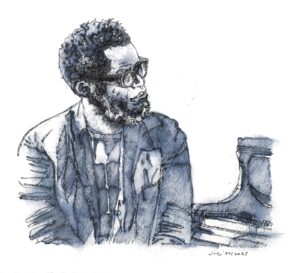
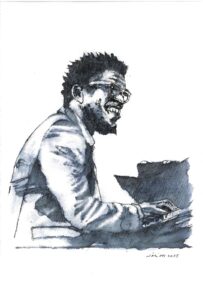
In his most recent album, Créole Renaissance, the Santiago-born Aruán Ortiz (1973) traces the world of the négritude movement of the Francophone Caribbean. In a series of explorations and meditations for solo piano, Ortiz invites us to share a vision of highly original poets and essayists. Founded in the 1930s in Paris, négritude was led by Aimé Césaire (1913-2008) from Martinique, Leopold Sedar Senghor (1906-2001) from Senegal, and Léon Damas (1912-1978) from French Guiana. All three were excellent poets and all three were politicians: Senghor would become the first president of independent Senegal (1960-1980), Césaire the mayor of Fort-de-France for more than fifty years and also a deputy in the National Assembly (of France) for several decades, and Damas was a deputy in the National Assembly for three years. The three, however, are remembered for their literary and cultural contributions more than their political achievements, although the latter are not insignificant.
Négritude was a revaluation of Africa and its cultural, spiritual, and political significance in the Afro-diasporic world, which included the USA (Harlem Renaissance), afrocubanismo (Cuba), and similar movements in Puerto Rico and the Dominican Republic. Haiti had its own movement, indigénisme, which arose as a response to the American military occupation of the island (1915-1934), contributed to interwar anti-colonial sentiments, and had an impact beyond the Second World War. Négritude also influenced Africa, especially in Senegal (and also Cameroon and Congo). The UNIA (Universal Negro Improvement Association and African Communities League), founded and led by Marcus Garvey, did not share all ideas of négritude but was a significant force in this era, especially for its focus on Pan-Africanism and the goal to build Black institutions for social and economic progress. In Europe, from the 1920s onward, there was a renewed interest in African art, along with major studies in anthropology driven by figures such as Franz Boas, Leo Frobenius, Melville Herskovits, Harold Courlander, W. E. B. Du Bois, and Zora Neale Hurston. In Cuba, scholars like Fernando Ortiz, Lydia Cabrera, and Rómulo Lachatañeré conducted valuable research on Afro-Cuban culture, including oral literature, dance, religion, and music.
This history helps us contextualize this album-project by Aruán Ortiz, since nine of the ten compositions directly reference négritude, be it through names like Césaire, René Ménil, or Senghor, magazines or publications (L’Etudiant Noir, Légitime Défense, and Tropiques), or specific texts (such as “The Great Camouflage,” an essay by Suzanne Césaire, Aimé’s wife). One of the most significant aspects of Ortiz’s album is the prominence given to Suzanne Césaire (1915-1966), who was a key figure in négritude as a thinker, editor, poet, and essayist, and who inspired the créolité movement of the eighties in Martinique and influenced Édouard Glissant.
The first track of Créole Renaissance is titled “L’Etudiant Noir” (“The Black Student”), in reference to the magazine of the black students from Martinique, founded by Aimé Césaire, and in which he first published his ideas on négritude, and which also featured poems by Damas and essays by Senghor. The magazine had only two issues in 1935 (in March and May-June), but it was preceded by two literary and journalistic efforts: Revue de Monde Noir, edited by the Martinican sisters Paulette (1896-1985) and Jeanne Nardal (1902-1993), and Légitime Défense (1932), established by the Martinicans René Ménil, Etienne Léro, and Jules Monnerot, who later collaborated with Georges Bataille.
The fervor for founding magazines was part of négritude and, finally, in 1947, Présence Africaine was created, which is still published today, although the movement that launched it has long ceased to exist. I believe what is attractive about this era for Aruán Ortiz is how rich and complex it was in terms of its sources (a substantial ajiaco): the Harlem Renaissance, Surrealism, anthropology, Marxism, psychoanalysis, and Existentialism, all influenced the creation of this artistic, cultural, and political movement. Authors like Claude McKay, W. E. B. Du Bois, Alain Locke, and Langston Hughes, all towering figures of the Harlem Renaissance, had deeply moved Césaire, Senghor, and Damas.
Surrealism rejected the hegemony of Western reason and sought other streams of consciousness (mystical states, non-European religions, alchemy, shamanism, etc.) in which African or Afro-Caribbean religions became preferred paths of exploration. The Surrealists were great believers in freedom, especially when allied with imagination and the poetic word. Psychoanalysis recognized the value of the unconscious and the role of dreams in human development (Freud), and also the magnitude of the collective unconscious and archetypes (Jung) in shaping cultures. Anthropology was highlighting the importance and dignity of African cultures (and those of the diaspora), while advocating for seeing all cultures as valuable without the racist and Eurocentric criteria of the past, with its schemes and hierarchies that implied notions of superiority and inferiority. Marxism, for its part, with its analyses of imperialism and colonialism, proposed useful ideas for these authors living under French colonialism. (Coinciding with this anti-colonialism occurred the famous reevaluation of Hegel by Kojève, very influential in its analysis of the Master-Slave relationship.) And Existentialism, with its emphasis on authenticity and alienation, had much to offer the négritude movement. All these philosophies, ideas, and practices nourished négritude and imbued it with an undeniable intellectual richness.
Aruán Ortiz, an avid reader and curious Cuban, is aware that these currents also had their Cuban variants: we cannot overlook that it was Langston Hughes who translated Guillén into English, that there was a close friendship between Wifredo Lam and Césaire (the Cuban illustrated poems by the Martinican and Césaire dedicated poems to the painter). Carpentier not only helped disseminate Afro-Cuban music in France but also coined the idea of “lo real maravilloso” (distinct from magical realism), based on Haitian history and Vodou, a religion that fascinated the French Surrealists. And although he did not share many of their ideas, Carpentier knew many of the Surrealist authors (Breton, Desnos, Char), as well as the painters (Miró, Dalí, Matta, Masson). Lydia Cabrera’s Cuentos negros was published in France (in French, 1936) before the book was released in Cuba, and let us not forget that it was she who translated Césaire’s Cahier d’un retour au pays natal into Spanish in 1943 (with drawings by Lam). That same year, Virgilio Piñera published “La isla en peso,” a poem that some critics claim is too influenced by Césaire’s masterpiece, a theory I do not share: what Piñera’s poem lacks is the Negrist component of the Martinican, since he was a white Cuban and did not live in a French colony like the Martinique of the thirties (although he did live on an island with limited sovereignty). And, of course, on a musical level, the work of Amadeo Roldán and García Caturla was part of these artistic movements (and of great interest to Ortiz).
This long but necessary digression is to understand the cultural baggage that accompanies Créole Renaissance and to be able to listen to it with head and heart. Not as a suite à clef, identifying a bit of Césaire here or Senghor there, or musically of Ellington or Monk or Boulez, but as a point of departure or, to take from the title, a renaissance. For Ortiz, returning to this historical and cultural moment is not an act of nostalgia but one of inspiration and an example of creativity for our times.
In the introductory text of the first issue of Tropiques, one reads the following: “[N]ow is the time to no longer be parasites of the world, now it is a matter of saving it. It is time to brace for the struggle like valiant men. Wherever we look, we see the shadow advancing. One by one, the hearth fires are extinguished. The circle of darkness closes, amid the shouts of men and the clamor of beasts. Nevertheless, we are among those who say no to the darkness. We know that the salvation of the world also depends on each one of us. That the earth needs every one of its children. Even the humblest.” (emphasis mine.) It is 1941, in the middle of the war, and the darkness is an obvious metaphor for Nazism. Martinique is under the Vichy (pro-fascist) regime, governed by Admiral Robert, which meant economic hardship, an absence of civil rights, and open racism against non-white inhabitants, who were the vast majority of the population. Pressure from the USA forced Robert to abandon the island in 1943, and Martinique returned to the hands of the Free French forces. Tropiques published fourteen issues from 1941 to 1945.
The call to anti-fascist action is poetic, but no less effective for it. The use of the word parasite, with all its colonial and exploitative connotations, is contrasted with action, with the courage to fight against barbarism, which in turn contrasts with darkness as a symbol of terror, fascism, and genocide. At the same time, it is a call to form a community that includes all who say no to that darkness, a large, solidary, and inclusive group capable of stopping something as highly destructive as fascism. Today, we are in times that threaten to restore that barbarism, with right-wing populist movements that reject immigrants, promote the dismantling of civil rights, attack voting rights, and restrict access to reproductive rights. The warning from Tropiques has lost none of its relevance 84 years later.
It is thus that the eighth song on the album is titled “We Belong to Those Who Say No to Darkness” and evokes that phrase taken from Tropiques. It begins with low, almost somber notes, and in this, it is not difficult to hear the darkness. But it is a darkness with nuances: sometimes the piano emits muted sounds, other times it sounds like a clavichord, and at other times the pianist plays the strings inside the piano, producing strange effects. There are moments when the artist seems to strike (gently) the strings, creating a kind of buzz. Ortiz prepared the piano in the low and middle registers. With his right hand, the pianist elaborates small motifs of several notes, but nothing that resembles a melody. It is an austere piece—but with varied sonority—with notes floating slowly.
The second track is titled “Seven Aprils in Paris (and a Sophisticated Lady)”, with an obvious reference to an instrumental song composed by Duke Ellington in 1932 (later, Irving Mills and Mitchell Parish added lyrics to it). The “seven Aprils” refer to the fact that Aimé Césaire spent that amount of time in Paris (1932-1939), where he also met Suzanne Césaire, marrying her in 1937. Who is the sophisticated lady? For Ellington, it was about two of his high school teachers who taught during the school year but travelled around Europe in the summer. For Ortiz, as he confirmed to me, it refers to Suzanne Césaire, but it could also refer to the Nardal sisters or even Josephine Baker. But given the tenor of his project, it makes more sense to stick with Suzanne. Ellington’s piece became quite popular, and a year later, three recordings by other composers appeared, including the great Art Tatum. In Ortiz’s hands, Ellington’s piece is quite transformed: the tempo is slower, beginning with elongated low notes (using the pedal); the melody fragments while maintaining an irregular ostinato with the left hand. At the end, the piece becomes more animated with higher notes and then an abrupt ending. According to jazz scholar Ted Gioia, “Sophisticated Lady” does not lend itself well to improvisation, but Ortiz achieves brief and superb improvisations.
The fourth composition, titled “From the Distance of My Freedom”, has a spoken part by Ortiz that touches on themes belonging to négritude: alienation, colonialism, racism, surrealism, and the Black Renaissance. With the piano in the background, the text begins with the phrase: “The silence of exclusion is black realism.” The interplay between voice and silence predominates in the first part; in the second, the visual aspect (visibility and invisibility) predominates. The text employs words like primitivism, modernism, surrealism, universalism, Black interculturalism, elitism, and indigenism. Then it reads: “The silence of exclusion is Black Renaissance,” followed by the mention of four magazines and the fact that they raised their voices to express the importance and dignity of Blackness: Légitime Défence (1932), Tropiques (1941-1945), La Gaceta del Caribe (1944), and Présence Africaine (1947 to the present). Here, for the first time, Ortiz makes a Cuban reference to La Gaceta del Caribe, whose editor was Nicolás Guillén, founded in the same year as Orígenes, and of which only six issues appeared.
The second part begins with “Renacimiento negro”, but the tone is more personal, autobiographical, and although not directly mentioned, somewhat more in the style of Franz Fanon. The pianist says: “I excavated my Afro-Caribbean experiences / My history speaks from my existentialism / from my ancestral mysticism / Black Renaissance / I excavated my Afro-Caribbean experiences / Through my black skin / Through my white teeth / No masks allowed / Black Renaissance / I am a Creole bathed in sun / I am watching you / with my consciousness / from the seeds of my empirical freedom / from the freedom of my humanism / I am watching you / I am watching you / I watch you, yes, you.”
Delving into his Afro-Caribbean experiences not only connects with the search for identity but also invokes history from his lived experience (existentialism) and spirituality (“ancestral mysticism”). Here, Ortiz sounds more like Césaire, but when he speaks of excavating through his black skin and the prohibition of masks, the Fanon of Black Skin, White Masks comes into view. Similarly, the ending, with its emphasis on the gaze, is a kind of challenge: the repetition of “I am watching you” contains an unspoken question: “Do you see me?” or “Do you dare to look at me, to acknowledge me?” Ortiz has managed to establish a very fruitful dialogue with the voices of négritude. Although he was a student of Césaire and frequently quoted him in Black Skin…, Fanon adopted a rather strong critique of négritude. Césaire made revolution through poetry, Fanon made poetry with revolutionary discourse, which means that for the psychiatrist-activist, poetry lies in militant action. With this, I do not mean to say that Ortiz is a Fanonian (or, on the other hand, a follower of Césaire), but rather that he is confronting these discourses with a critical eye; as an artist, he values imagination as a central aspect of social change.
During the enunciation of the text, Ortiz plays somewhat mysterious chords and low notes. After the text—which takes about five minutes—there are another almost three minutes of composition. Ortiz improvises with his right hand, quickly evoking the tensions arising from the text, and ends with a dissonant passage followed by a low note sustained by the pedal. An introspective composition, philosophical perhaps, but also one of affirmation, and not only of roots, but of life, creativity, and the human capacity to undertake new beginnings.
Another composition that references a text is the sixth, “The Great Camouflage,” titled after the essay by Suzanne Césaire published in the last issue of Tropiques in 1945. The song is instrumental, but it captures the spirit of the essay, which offers great contrasts between the physical beauty of the island and the social situation of its inhabitants, a reality that her husband described as “the harlequinades of poverty.” According to her translator (Keith Walker), Suzanne Césaire used the metaphor of camouflage to describe Martinican society: deception and self-deception, inauthenticity, a culture without a life of its own, bad faith, the sequels of slavery that produce a social environment that plays hide-and-seek with itself.
How does Ortiz portray this “camouflage” on a musical level? Well, the pianist does not try to imitate the effusive character of the text, nor its exuberant language. On the contrary, the piece is introspective and slow, like the gradual movement of shadows. It begins with low notes and chords, and the pianist uses the pedal to let the notes extend. There is space between the notes. The beginning has somber chords, and the entire piece is sparse; there is no ornamentation. Ortiz alternates between low and high notes, and it is more a succession of sonic clouds hanging in the atmosphere than a melodic development. This is consistent with other compositions on the album that do not try to “imitate” the text. Ortiz is not interested in this being programmatic music; quite the opposite.
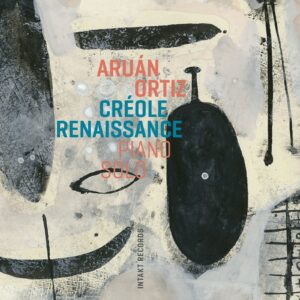
The album cover serves to confirm Ortiz’s non-programmatic approach: it is a painting from the forties by the painter Julio Girona (1914-2002). Girona began as a draftsman and creator of political cartoons, but later moved on to painting. It is an abstract work with figures (one resembles a fish, another a fruit), and there are crossed lines containing circles and small crosses that might evoke some Palero ritual drawings. There is also what looks like a Taíno petroglyph. Girona creates a universe with an ancient atmosphere, but with the tools of modern painting (abstraction, surrealism à la Miró, the muted colors of a certain phase of Cubism). Ortiz does the same: he captures that tension between the ancestral and the high modernity of négritude, but with entirely contemporary musical means. Girona was also very active in the anti-fascist struggle of the forties, so using his work on the cover links it with track eight (and the quote from Tropiques).
The ninth song, “The Haberdasher,” is based on an interesting story. It has to do with André Breton and how he discovered the magazine Tropiques when he traveled by ship to Martinique in 1941 on his way to the USA. Also on that ship were Victor Serge, Anna Seghers, Claude Lévi-Strauss, and the painters Wifredo Lam and André Masson. Breton was traveling with his wife and his daughter, Aube. It was while looking for an item of clothing for Aube that he entered a haberdasher’s shop, where among its fabrics a copy of the magazine Tropiques was displayed. It turned out that the haberdasher was the sister of René Ménil (1907-2004), and immediately Breton wanted to meet Ménil and the poet Aimé Césaire, which he managed to do; a fortuitous encounter or, as Lezama would say, a good example of concurring chance.
The album concludes with a track titled “Lo que yo quiero es Chan Chan”, alluding to the hit by Francisco Repilado, better known as Compay Segundo. More than a deconstruction of Compay’s song, Ortiz revels in the melody, playing certain recognizable notes, but never the complete melody all at once. The piece is a kind of melodic striptease; and it is possible that the camouflage of the sixth song is highlighted here at the end with greater resolution.
We generally appreciate musicians and composers for their musical talents, which Aruán Ortiz has in abundance, but we rarely see composers as intellectuals, as people who articulate coherent and thoughtful ideas. Aruán Ortiz is a composer of high intellectual caliber, something that has been constant in his work and has been evidenced in projects like Santiarican Blues, Cub(an)ism, Random Dances and (A)tonalities, Pastor’s Paradox. We could even suggest that Ortiz’s thinking owes something to Glissant and his Poetics of Relation, which is rhizomatic, like his music. Glissant also distinguishes between savoir (objective reason) and connaissance (subjective knowledge), that is, intuitive, poetic, a discernment that is thinking with things, not about them. This is what Ortiz’s music does in this extraordinary album. To say that a composer is an intellectual attracts certain associations: abstraction, coldness, and a lack of emotion. But this is not the case with Aruán Ortiz: his abstraction invites us to explore new sonorities, his dissonances are like questions, and what might be incorrectly seen as a lack of emotion is rather a challenge for the listener to seek another way of feeling, a way that has the force and rigor of thought. With this profound philosophical and musical inquiry into one of the most vital themes of the 20th century, Aruán Ortiz has given us a work of intelligence, mystery, and poetic wonder.