
Introduction
The work of Goga Trascierra[1] can be divided into two main groups. The first tends towards the sculptural; the second, towards the pictorial. And I say “tends” because there are no monolithic truths here, and if something characterizes these pieces, it is their amphibious essence. They are works that blur the boundaries between manifestations, formats, and categories. They inhabit the interstice: between function and contemplation, between the useful and the symbolic, the masculine and the feminine, weight and light, the everyday and the extraordinary, raw matter and creative sensibility.
I detect three fundamental themes that transversally run through Goga Trascierra’s work: duality, construction, and intimate life. The first and the third will be discussed independently in this text; the second will be touched upon throughout the different sections presented, each of which corresponds to some constitutive element of Goga’s work.
Duality
As above, so below. Form and content. The Apollonian and the Dionysian. Eros and Thanatos. Construction and destruction. Change, a material that transmutes into something else. The creative act also implies a death (or several). Inseparable opposites, the existence of one is a sine qua non condition for the existence of the other; if one is missing, the other is annihilated. The perfect balance so that the tension is just right, so that the pendulum maintains its rhythm and peace. Such is each of Goga’s works.
Function and Contemplation
In the aforementioned first group of works, the most outstanding pieces are the lamp-sculptures made (like all her work) with construction materials.
In the act of dignifying (resemanticizing) the everyday and the manual, by endowing with artistic value what is traditionally perceived as utilitarian or rough, Goga transforms materials associated with masonry (cement, brick, rebar, mesh) into pieces that oscillate between the functional and the aesthetic, between the useful and the symbolic, without fully surrendering to either extreme. They are art, yes. They are design, too. But not one thing more than the other; they live in an intermediate territory. And their strength lies in the contradiction between hard materials and warm light, between what we associate with the instrumental and what, suddenly, becomes profoundly close.
Painting, Chaos and Order
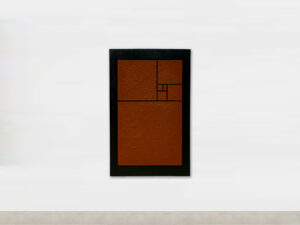
In the second group of works mentioned at the beginning, the pictorial one, something is very striking: there is one group, let’s say, rational, and another chaotic. Apollo and Dionysus.
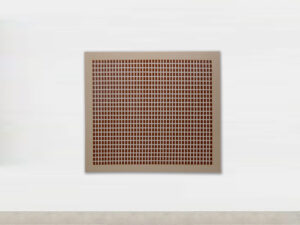
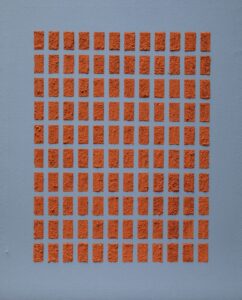
In the former, there is no room for curves; there is calculation, millimeter precision, and always a motif that repeats, like bricks in a wall. This idea of repetition has innumerable interpretations, but I will focus on two: on the one hand, the allusion to the algorithmic, to Ortega y Gasset’s mass-man, to Marcuse’s one-dimensional man, both very symptomatic of contemporaneity; and on the other (I believe in Goga’s case it leans more this way), the mere formal exercise, the pure experimental game of seeing how such and such a thing looks arranged in such and such a way, the manual labor without the need for an accompanying pseudo conceptual discourse.
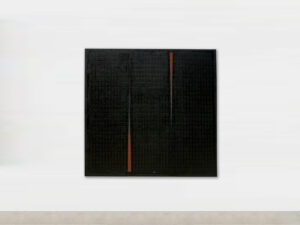
Then, there is the other group, ultra-gestural, completely given over to accident, error, improvisation.
A reminiscence of Rothko, Kandinsky, Reinhardt, Judd, Anni Albers, and even Damien Hirst, if you will? Yes. Is it relevant? Truthfully, no.
In any case, something I greatly enjoy about these paintings is that Goga Trascierra develops them in parallel, moving from one extreme to the other with great ease, as if inside her a maniac of order and a reckless hothead coexisted peacefully. Both use the same tools and materials, both have the same cultural background and life experience; however, one obeys one impulse and the other its opposite. I will not say that each group of paintings seems made by different artists because, ultimately, one is oneself and many at the same time. And, above all, because within each of us, both wolves coexist; no one escapes. The challenge is to feed them separately in just measure, to maintain balance or, in other words, sanity.
Matter and Light
In all these works, the materials that compose them are as much protagonists as the piece itself; they act as symbols all the time. Here, form directly constitutes an essential part of the content.
Light is also a material. In the luminous sculptures, light occupies a central place, not as an ornament or a technical resource, but as an active matter. They pierce it, contain it, filter it, frame it. Each structure seems designed not so much to emit light, but to reveal it. Each focal point, each angle, each projected shadow participates in the sculptural gesture. The result is not only visual but spatial: it modifies the atmosphere, alters perception, and tenses the relationship between object and environment. Here, light does not oppose matter; they need each other.
Intimate Life
A theme as present as it is subtle in Goga Trascierra’s work is the domestic, intimate life, the interior landscape. Construction materials. What is built inside a home? The walls listen, certainly, so do the furnishings. Heaviness implies firmness, but not always rootedness.
To what extent do you stop inhabiting a house, and it begins to inhabit you? And the shared space, the intimacy built with another, the individual ways of living in the same site, the same objects?
The artist is an architect and bricklayer: not only does she design, but she builds with her hands. And the construction is not only physical; relationships, careers, identities are also built.
Intimacy is also slow time, contemplation, domestic rituals: turning on a lamp, turning it off, a minimal, routine gesture.
Beyond their function, objects generate attachment, memory, desire, and affective relationships of various kinds. And here is where art comes in as a facilitator of a certain connection and vulnerability: the intimate is not only a refuge, it can also be exposure.
Memory
Cement, rebar, wire rod, brick: remnants of construction that, far from being recycled, are resignified. In them lies a concrete memory: that of manual labor, the rough construction, the construction in progress (the house in process?). Nothing is concealed; on the contrary, the wire remains exposed, the welding is noticeable, the dust is not always cleaned. As if the object carried with it the mark of its own gestation.
There is also in the materials (perhaps it would be more appropriate to say: in the pieces) another memory: the one the artist imposes on things. Borges said that one does not miss places but eras. On this wall I painted my first mural, in this room I had sex for the first time, in that patio my sister and I fought once, in that garden there was a gigantic palm tree that is no longer there. The family home has been abandoned; no one lives there, just a pile of distorted memories.
And then, there is that other memory, the worst, the most fictitious, that of what could have been… the brick that did not become a wall, the wall that did not become a house, the house that did not become a home.
Every piece by Goga Trascierra seems to respond to a story, a pulse, a material memory that is activated by touch and gaze. It is up to each viewer to assemble it for themselves.
Regarding memory, note this other presence of time: here, the process matters as much as the result. Each work is a testament to the making: to the cut, the joinery, the time spent turning one object into another. There is no simulation, nor excessive polishing: accident and the (seemingly) unfinished define each piece.
Relationship with Space
We are talking here, in all cases, about pieces that condition the space, that activate it. They function equally in a gallery, a studio, an apartment, or a garden. They retain their presence without imposing themselves. They adapt; they can inhabit several worlds at once, without betraying themselves. They are not neutral. They are not discreet. They do not decorate: they declare.
And this probably has nothing to do with it, but note how curious: Goga was born and lives in one of the most intense cities in the West, Mexico City, a city where construction (physical and symbolic) never stops. Perhaps there is another influence there? I like to think so.


Brutalism and Sensibility
There is in each piece a profound attention to rhythm, to silence, and to emptiness. Nothing is superfluous, nothing is missing, nothing shouts. In all of them, a kind of softened brutalism manifests itself: hard forms and bare materials arranged with a very lightened subtlety and formal sensibility, where the rough coexists with the delicate—a corollary of that aforementioned universal duality that permeates everything: the feminine alongside the masculine, which are not opposites, but complementary. And precisely, here the imaginary of “heavy work” associated with brute force, with the masculine, is subverted through the artistic practice of a woman who manipulates these materials with freedom and mastery (even though male labor may indeed participate in the execution process of some pieces). The artist is welding, assembling, mixing sand, getting her hands dirty.
And note, this should not be understood as a militant statement or a vindication of anything. On the contrary, her work is not a political gesture in the slightest, but an aesthetic exercise, an investigation defined more by the pleasure of creative and manual play, by the exploration of the human, by the constant search for beauty, than by anything else.
Outro
In a time that privileges the immediate, the ephemeral, and the prefabricated, the work of Goga Trascierra bets on the antipode: slow mystery, meticulousness, the transmutation of the ordinary into an experience of light and matter. For those who understand art as something not only to be contemplated but to be lived, finding a piece by Goga can be like coming across something that was missing, even if one didn’t know it.
Notes:
[1] This text only comments on Goga’s most recent work, that of the last 5 years. Her previous work differs considerably, both in terms of concept and form.