I. ritual vomiting
At our last meeting, we talked about littleness. I said that’s the way we should be, and I resolved to rehearse it. But the result was still too big.
I couldn’t harmonize my microlithic eagerness with the small tools on the Magician’s table. He knows that I have seen him hide pebbles and ossicles under his tongue, and that I know of his false purge when he spits them out in front of me. He knows I let him be. And it’s a sight to behold: his fullness, the chant, the dance of his hands… He lies, as all shamans do (this is as universal as December being black and January being white), but I won’t tell. I let him be, for I want to be him. For even if my illness cannot be extirpated, he always comes to remove my harm through himself and bleeds for me.
II. geophagia
My first time chewing mud was in kindergarten. We were playing. There was a plastic coffee cup full of dirt from the playground. A boy offered it to me and I “drank” from it without noticing its content. I remember a sensation that only now I can name: beyond the laughter of the other children and my endless clayey saliva, I suffered the rough rupture of the implicit alliance that is the game. Why disturb the codes of its simulated beauty? Milestone one: Someone small created deception.
III. agraphic
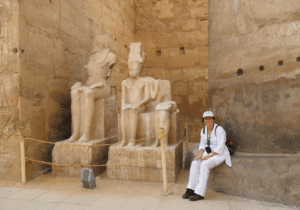
I decided to study Art History since there is no Egyptology here in Cuba. But looking at my newspaper clippings with pictures of the pyramids and temples, every time I opened the locker, was the only thing that saved me in that countryside boarding school. There, I learned different forms of escapism that I still use to this day.
When I finally entered university, I discovered other remote things that began to interest me as much as Egypt, although I still believe that the canopic jars are the most beautiful objects ever created. I did well during those years, despite my scattered mind. I still don’t know if Chartrand’s mist is Cuban or not, but I do know that the major theme of Cuban art is sorrow. If I had realized it sooner, I would have written my thesis on that topic rather than on “Indigenous Arawak sculpture in Cuba”. What does it matter if later, when I finished my master’s degree, I could not answer the question that my daddy, an expert technician in lathes and milling machines, asked me: “What use is that to you now?”
IV. bruxism
If I had been Jung’s patient, I would have told him only one memorable dream. It was short, early in the morning in late November. Broad daylight in an open field, a savannah that faded on the horizon. A few steps away from me, strangers were gathering around the only tree there was, watching for movement in the crown. As soon as I tried to get closer, a white bat emerged from the green dome. Immaculate and luminous, with translucent wings. It circled briefly over my head and flew away, soaring higher and higher, towards the sun. I immediately began to cry, desperate and inconsolable. The crying woke me up and didn’t stop. At intervals, I would giggle nervously. Naturally, to make up for it, the end of the dream was that mommy came out of nowhere and hugged me.
V. split lips
When I started to tear the skin off my lips, I found my twin. We were born while the scorpion died inside a curujey (on leap day, we bade it farewell and buried it together). Now I love her out of contrast, and unless some death crosses our path, I don’t feel her presence. My twin is the pole star: everything revolves around her. With a sword, I point in her direction. Now I know how to look at the sky, one step away from the abyss.
VI. cavities
Faced with the scenery of the Constantino cavern, my primal fears revived. I had never climbed subterranean mountains, nor had I ever known such a raw and cold wind. “Avernus” means “without birds.” Unlike Dante, I made it through everything but the last descent: seven kilometers through the forest and then, inside, the little terrors; all the way to the pearly pearls, which I never saw; I stayed up (down), waiting. A year earlier, in Perdida, I had done the same thing having overcome the lapiés, I reached the destination and stayed at the cave mouth. I didn’t see the crystals or the volcanoes. “Why did you come all this way?” I asked myself on both occasions, motionless, while I waited for the others.
VII. jaw rigor
I thought that this is what death must be like: wet as a gecko, wet as the blood of the magician; smoky and irremediably black; a gloomy womb fertile in clairvoyance, thanks to fear; a minimal and rigid will. But all this is life.
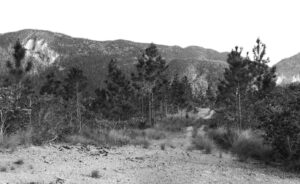
Death might be like the thorny midday sun (fatal to those who look for flint chips on the surface) or even better, like the shadowless path of Alturas de Pizarras, white chalk hills. Something soft rolled round with quartzite, sandstone, and shale, draining down to diluvium, dry as a cotton ball. To yield. And stay still there, under the dominion of Pinus caribaea and tropicalis, perennials.
Winter solstice, 2024
* These words by emerging Cuban artist Sabrina Fanego accompanied her very first solo exhibition ‘stones that fit in the mouth’, that took place at ONA Galería, Havana, between December 2024 and January 2025.