
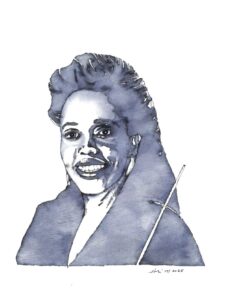
Tania León, winner of the Pulitzer Prize in 2021, just released a new album, the fruit of her two years as Composer in Residence (2023-2025) with the London Philharmonic Orchestra. The album contains four compositions, one from 1999, “Horizons,” and the other three world premieres: “Stride” (2020), “Pasajes” (2022), and “Raíces” (“Origins”) from 2024. Since her Pulitzer recognition, awards and honors for León have followed in rapid succession. In 2022, she received the Kennedy Center Honors, and the following year, the Nemmers Prize in Music Composition, awarded by Northwestern University every two years. In 2023, she also won the Tomás Luis de Victoria Ibero-American Music Prize, being the third Cuban to receive it (after Harold Gramatges in 1996 and Leo Brouwer in 2010). Furthermore, this year she received a Grammy Trustees Award for her musical contributions and, in April, she was awarded the William Schuman Prize, established in 1981 by Columbia University’s School of the Arts, for the life and work of a composer.
Let’s start with “Horizons,” which was commissioned by the Hammoniale-Festival der Frauen (a festival for women composers) in Hamburg, where it premiered in 1999. The first recording was released on her CD Singing Sepia (2008) with the NDR Sinfonieorchester under the baton of Peter Ruzicka. The most recent version features violinist Karina Canellakis conducting the London Philharmonic Orchestra (LPO), and the British premiere was in October 2023 at the London Royal Festival Hall. León describes the piece as follows: “Instead of having a fixed form, ‘Horizons’ is more like a stream that unpredictably grows and shrinks, following a winding course. It begins with bright ripples in the flute and throughout its trajectory, events in the foreground intermittently interrupt the textures in the background, the currents flowing beneath the surface.”
Alejandro Madrid points out, for his part, that in the piece there is a great contrast “between the declamatory character of the winds and the static quality of the strings.” The composition is also built on other contrasts: rhythmic, textural, volume, and motivic. It also contains excellent passages for trumpet and percussion. The note D predominates, a note the composer claims is the strongest vibration at the center of the earth, as if it were the matrix of the world. The piece is programmatic, based on a brief story: a tropical forest, a flock of birds, a bird that flies alone, followed by a storm and a hurricane. It continues with an aerial view of the forest, an indigenous population (the Maya), a transformation, a seagull that becomes a condor that lands in Yucatán, and ends with the bird’s song. León states that the composition is autobiographical: “The strings are the forest and what I do with the flute represents the birds […] There is one that takes off and flies upward; that is me […] It has to do with the journeys I have taken around the world, where I am a bird flying through storms and typhoons.” But the end of the piece is a return home with long, slow notes in the flute.
“Stride” was part of the New York Philharmonic’s project in 2020, celebrating the centennial of the nineteenth amendment to the U.S. Constitution, which codified women’s right to vote. The Philharmonic commissioned nineteen women composers to create a piece honoring that historic event. León became interested in the life of Susan B. Anthony (1820-1906) and researched the great abolitionist and suffragist, reading her biography and her writings. Her activism was an inspiration, and León adds, “For me, it was tremendous to see the enormous inner strength she had. So I started looking for a title for the piece, which is not the way I usually proceed. The title reflected how I imagined her as a person who would not take no for an answer. She kept pushing and pushing, always forward, walking with firm steps until she could achieve everything. And that is precisely what Stride means. Something that is always moving forward.” The work premiered at the David Geffen Hall (formerly Avery Fisher Hall) at Lincoln Center on February 13, 2020, and won the Pulitzer Prize in 2021.
“Stride” lasts a little over 14 minutes: it begins with the strings, with a somber and slow sonority, but soon the brass enters as if announcing Anthony’s presence. Some critics point out that the piece does not fully represent the title, that Anthony’s firm and bold stride is not reflected in the music. But I believe they expected a piece with a defined and ascending arc, a kind of prolonged crescendo like Ravel’s Bolero: León’s approach is less obsessive than Ravel’s and with more varied rhythms. Two moments evoke the firm step: at five and a half minutes, there is an ostinato in the strings that lasts for over a minute, and at the end (the last minute), another ostinato in percussion that evokes an African (or Caribbean) rhythm. In other moments, the trumpets, while not quite fanfares, do suggest something triumphant, small victories within a long trajectory that contains obstacles or setbacks. And as always, León masterfully handles textures—woodwinds, strings, and brass.
“Pasajes,” from 2022, was commissioned by New Music USA, an organization that provides grants to composers of new or contemporary music. It premiered with the Arkansas Symphony Orchestra in April 2022. The London Philharmonic Orchestra performed it on February 21, 2025 (the European premiere) under the baton of Edward Gardner, who has been its principal conductor since 2021. The work has four parts, all alluding to nature or the environment: the first with peaceful colors and melodies, and the second evokes an imaginary bird surrounded by creatures in the field. Gradually, we enter the third segment, which incorporates Caribbean percussive elements and ends with a revelry similar to a comparsa carnival group. Compared to the first two pieces discussed, “Pasajes” is more melodic, lyrical, and traditional, although León always employs a contemporary musical language. She rarely quotes popular music directly; she always works it so that those references are heavily disguised. Again, the use of the flute stands out, especially in the second part, as does the use of textures (at around four and a half minutes, there is a passage where the piano, xylophone, strings, woodwinds, and brass are combined exquisitely). The finale captures the bustle and joy of those parading through the streets during carnival.
The longest piece on the album, “Raíces” (“Origins”), is from 2024, and its world premiere was on March 6 of that year at the London Royal Festival Hall, under the direction of Edward Gardner. It was later performed at the Concertgebouw in Amsterdam and several venues in the U.S. in the fall of 2024. León, in a conversation with writer and scholar of contemporary music Paul Griffiths, notes that “Raíces” has four parts: an introduction (“Calma”), followed by a first part inspired by dance with Cuban syncopations, a second part where woodwinds predominate, recreating an enchanted forest, and a very lively third part where Latin American music and jazz converse.
It begins with the strings sounding like a whistle, but, as the composer says, a highly meditative calm. Soon arrives the part that evokes dance, with tremendous vitality sustained by percussion. About the second part (the forest), León describes how, as a child, she heard that Beethoven walked in the forest seeking inspiration; she does the same. Walks in the forest bring back memories of Hans Werner Henze (1926-2012), the German composer who wrote two chamber operas based on books by Miguel Barnet (El cimarrón, 1970-71) and La cubana (1973; based on Canción de Rachel). Henze was an important mentor for León. The forest section is powerful with a skillful handling of the woodwinds (especially the flute). In the finale, the woodwinds (flute, oboe, clarinet) also stand out, with the xylophone creating crystalline textures. Among the percussion, León uses chajchas (or chapchas), an Andean instrument made from goat or sheep hooves (alpaca or llama hooves are also used) as a rattle. The piece ends with maracas and the chajchas.
The four compositions on this album showcase León’s skill and versatility, especially in her handling of woodwinds, which reminds us of Stravinsky’s Symphonies of Wind Instruments (1920/1947), dedicated to Claude Debussy, or The Firebird. The first (especially the 1947 version) is an enigmatic, somewhat austere piece, but of great originality. León continues in that vein, but with her own distinctive mark. On composing, Roscoe Mitchell, saxophonist and composer (and member of the Art Ensemble of Chicago), says: “If you listen to nature, all sounds are made with enormous confidence. I seek to do the same.” León would subscribe to Mitchell’s words, but it must be clarified that it is not about “imitating” nature but thinking with it.
It is encouraging to see that Tania León, in her eighties, not only continues to compose but is also showing a creativity that has not diminished in the least. Although the accolades have arrived late in her life, they indicate that Tania León’s career is one of continuous excellence and quality. To date, only five albums entirely dedicated to her work have been recorded, this latest one being the fifth. A bigger effort is needed to document and record the work of one of the most brilliant, powerful, and imaginative figures of our time.